L-Citrulline vs L-Arginine: The Real Difference for Pumps, Performance, and Blood Flow
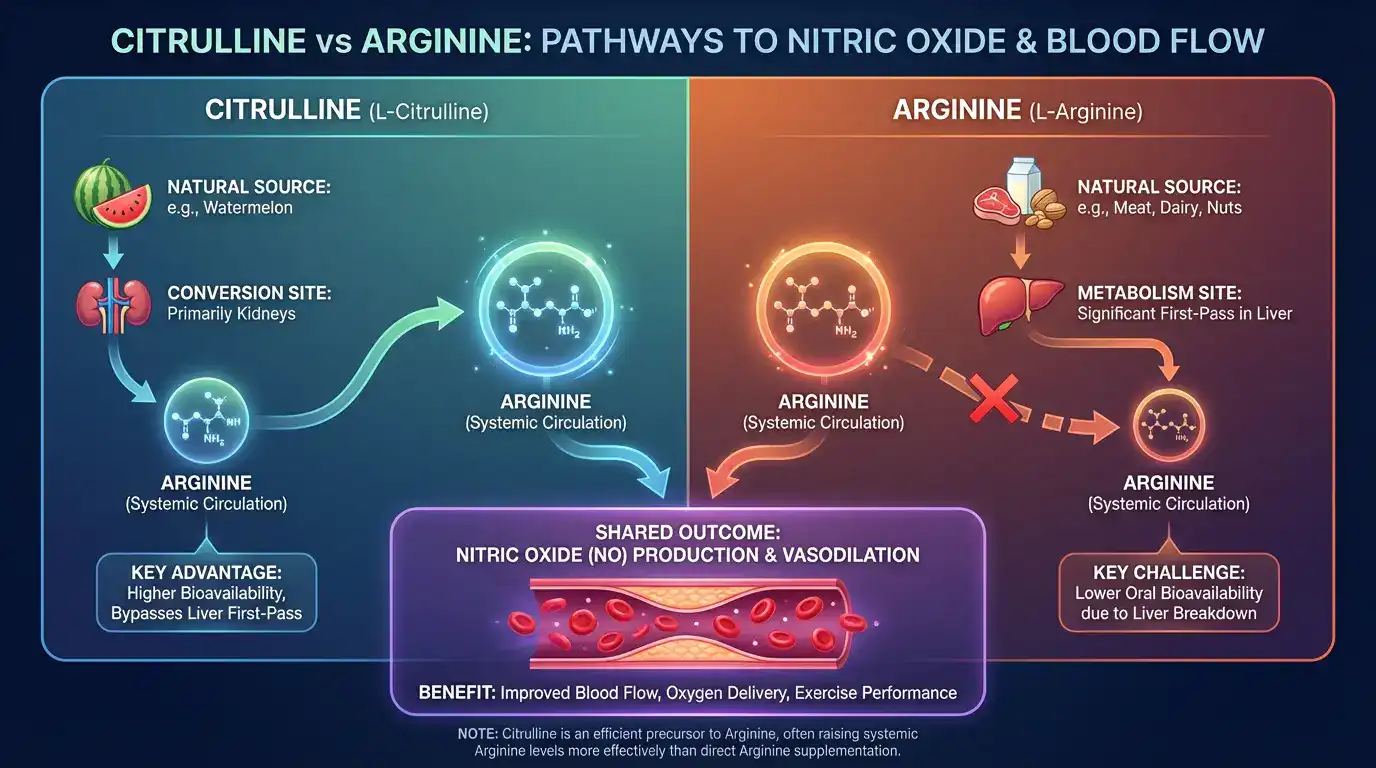
If your goal is pumps and performance, L-citrulline usually beats L-arginine. The reason is simple: oral arginine gets broken down heavily before it reaches circulation, while citrulline is absorbed more reliably and then converts into arginine inside the body, raising blood arginine and nitric oxide more effectively.
This guide keeps it decision-first: which one to take, what dose actually works, what to do if you feel nothing, and when arginine still makes sense.
- Winner for pumps: L-citrulline.
- Most common effective dose: 6–8 g L-citrulline, 30–60 minutes pre-workout.
- Why arginine disappoints: heavy breakdown before circulation.
- When arginine still matters: some clinical or niche contexts, not most pre-workout goals.
Decision table: citrulline vs arginine for pumps
If you want a fast choice, this table is the whole story in one view.
| Category | L-citrulline | L-arginine | What this means |
|---|---|---|---|
| Raises blood arginine | Typically stronger | Often weaker orally | More arginine in blood usually equals better NO support |
| Pump + work capacity | More consistent | More variable | Citrulline is the more reliable “feel” ingredient |
| Typical effective dose | 6–8 g pre-workout | Higher doses needed | Arginine often needs more to “show up” |
| Most common issue | GI fullness at high dose | Breakdown before circulation | Arginine can fail even when dose looks “big” on the label |
Which is better for pumps: L-citrulline or L-arginine?
For most people, L-citrulline is better for pumps. It tends to raise blood arginine more effectively than taking arginine directly, which supports nitric-oxide signaling and blood flow during training.
Why does arginine not work well as a supplement?
Oral arginine often performs poorly because a significant portion is broken down in the gut and liver before it reaches the bloodstream. That limits how much is available for nitric-oxide production during training.
How does L-citrulline increase nitric oxide?
L-citrulline increases nitric oxide indirectly by converting into arginine in the body, which is then used for nitric-oxide synthesis. The key advantage is that citrulline is absorbed more reliably than arginine for many people.
What is the best L-citrulline dosage for pumps?
A common effective range is 6–8 grams of L-citrulline, taken 30–60 minutes pre-workout. This is the dose range where many people actually notice the pump and endurance differences.
Is citrulline malate better than L-citrulline?
Neither is universally “better.” Pure L-citrulline is simpler for dosing and is very reliable for pumps. Citrulline malate can be useful for endurance feel, but label ratios can make true citrulline grams harder to interpret.
Is L-citrulline safe to take?
For many healthy adults, L-citrulline is well tolerated. The main caution is blood-pressure stacking with medications or vasodilators, and individual sensitivity at higher doses.
Why you’re not getting pumps even with citrulline
- Under-dosing: many pre-workouts use 1–3 g, which is often below the “noticeable” range.
- Hydration/electrolytes are the bottleneck: pumps depend on fluid and sodium status.
- Timing: taking it too close to training reduces peak effect for some people.
- Training style: pumps respond more to higher-rep, shorter-rest work than heavy singles.
Selected Professional References
External sources to verify mechanisms, dosing, and outcomes (no internal links here).
Final Takeaway
If your goal is pumps, work capacity, and blood flow, choose L-citrulline. Arginine is the “direct” precursor on paper, but citrulline is the form that typically gets into circulation and raises arginine where it counts.