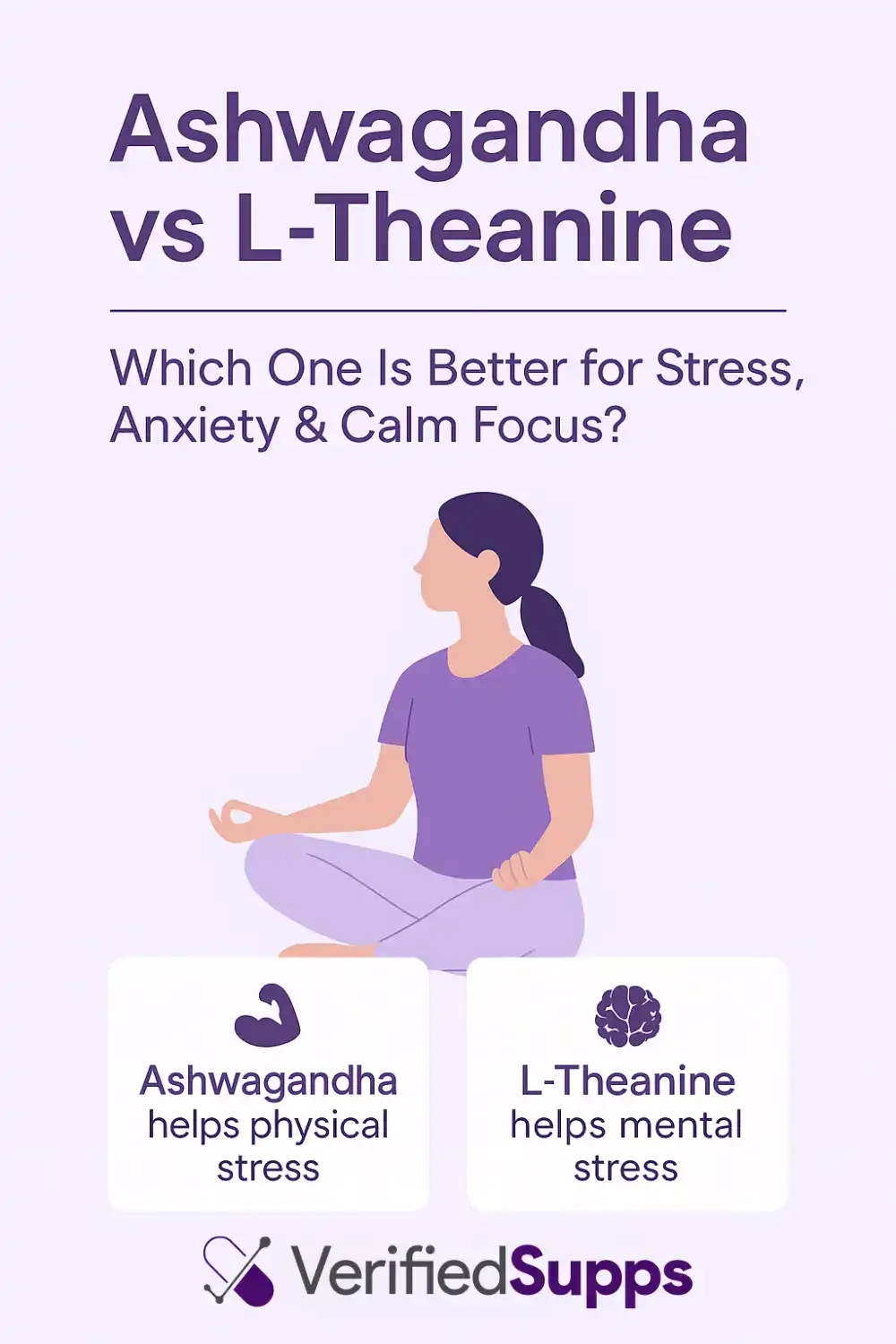
Ashwagandha vs L-Theanine: Which One Actually Fits Your Stress?
If your stress feels like a loud mind (racing thoughts, overthinking, jittery focus), L-theanine usually fits better. If your stress feels like a stuck body (tension, wired-but-tired, “stress hormone” baseline), ashwagandha often fits better. They can also be used together—because they target different parts of the stress system.
This is the decision-first version: pick the right tool, dose it sensibly, and avoid the common reasons it “doesn’t work.”
Quick Take
- Mental stress: L-theanine (often fast, “clean calm”).
- Physical stress baseline: ashwagandha (often slower build, “body-level” support).
- Best of both: use both (day + night system), but start one at a time.
- Caution: ashwagandha may be inappropriate in some thyroid/autoimmune contexts; confirm with a clinician if unsure.
Parent Hub: Want the complete calm-focus blueprint (supplements + routines) in one system?
Open: The Complete Calm Focus Stack (VerifiedSupps)
Pick the right one in 60 seconds
Match the supplement to the shape of your stress.
| If your stress feels like… | Best first pick | Typical “feel” | Works best when… |
|---|---|---|---|
| Racing thoughts, overthinking, jittery focus | L-theanine | Fast, clean mental quiet | Used situationally (work/coffee) or before bed for mind-racing |
| Wired-but-tired, tension, “stress stuck in the body” | Ashwagandha | Slow build, steadier baseline | Taken daily for weeks, not “one-off” |
| Mental + physical stress together | Both (sequence matters) | Mind quiet + body downshift | Start one first, add the other after 3–7 days |
If you can only pick one today: choose the one that matches your stress profile. That choice alone often determines whether you feel anything.
Ashwagandha vs L-theanine: which is better for stress?
Neither is “better” overall—each fits a different stress pattern. L-theanine tends to fit mental stress (fast calming without feeling sedated). Ashwagandha tends to fit body-level stress (tension, wired baseline), but usually takes longer to notice.
A simple lens: L-theanine helps you feel calm while staying sharp. Ashwagandha helps you feel less physiologically “revved up” over time.
How does L-theanine calm anxiety and racing thoughts?
L-theanine is often used for “noisy mind” stress because it can support a calmer, more stable attention state. Many people describe it as a gentle exhale—thoughts feel less sticky, and caffeine feels less sharp.
Best-fit use cases
- Overthinking or “tabs open” attention.
- Caffeine jitters or edge.
- Bedtime mind-racing (calm without heavy sedation).
Does ashwagandha help cortisol and physical stress symptoms?
Ashwagandha is most often used for stress resilience and “body stress” patterns—tension, wired-but-tired feelings, and a baseline that won’t downshift. If it helps, it’s usually experienced as a calmer physical baseline rather than an immediate mental quiet.
Who tends to notice it most
- People who feel stress in their body (tight chest, tight shoulders, restless baseline).
- People who want long-term resilience, not a quick “calm button.”
- People whose stress is tied to sleep quality and recovery.
Can you take ashwagandha and L-theanine together?
Yes—this is a common “day + night” system. Theanine is often used situationally (work stress, caffeine, bedtime mind-racing). Ashwagandha is often used daily as a baseline support tool.
A simple way to combine without confusion
- Start with one for 3–7 days (identify whether your stress is mental or physical).
- Add the second only if needed, at a conservative dose.
- Track: sleep quality, morning calm, caffeine response, and “body tension” baseline.
What dose of L-theanine is best for stress and focus?
Many people start around 100–200 mg depending on sensitivity and goal. Lower can work if you’re sensitive; higher is sometimes used situationally. The key is to use the smallest dose that reliably gives “clean calm.”
Practical timing
- With caffeine: helps smooth the edge.
- Acute stress: take when the mental noise starts.
- Sleep (mind racing): many take it 30–60 minutes before bed.
What dose of ashwagandha is best for stress and sleep support?
Ashwagandha dosing depends heavily on the extract and standardization. Many people start with a conservative daily dose and judge trends over 2–4 weeks, not overnight. If you feel “nothing” after a few days, that can be normal.
How to avoid common dosing mistakes
- Use a standardized extract and follow the label serving.
- Take it consistently (daily) if your goal is baseline stress support.
- If it makes you feel too flat or sleepy, reduce dose or move timing earlier.
Calm supplement picks (optional)
🔬 Premium L-Theanine · Nootropics Depot
Clean, well-dosed L-theanine that fits a calm-focus routine or alongside coffee.
View at Nootropics Depot☕ L-Theanine + Caffeine · Amazon
A convenient option if you want smoother caffeine and calmer focus.
View L-Theanine on Amazon🌙 Shoden® Ashwagandha · Amazon
A standardized extract option aimed at longer-term stress support and sleep depth.
View Shoden Ashwagandha on AmazonIf you choose to purchase through these links, it may support this site at no extra cost to you. Only add what feels right for you and your health.
Simple stack note: many people pair these with a magnesium foundation at night (muscle relaxation + nervous-system support). This tends to matter most when stress shows up as tension and poor sleep quality.
Tiny real-life example (to make this click)
Noisy mind during the day → theanine. Tense body and stress baseline that won’t downshift → ashwagandha.
Two tools. Two moments. One direction: calm.
Why it isn’t working (common mistakes and fixes)
The most common reason people “feel nothing” is a mismatch: mental-stress people take ashwagandha expecting instant quiet, or body-stress people take theanine expecting deep physical downshift. The next most common reason is inconsistent use and unrealistic timelines.
Fixes that usually work
- Pick the right lever: mental stress → theanine; physical baseline stress → ashwagandha.
- Use the right timeline: theanine is often “same day”; ashwagandha is often “weeks.”
- Don’t stack four new things at once: change one variable at a time.
- Watch for “too much calm”: if you feel flat or sleepy, reduce dose or adjust timing.
- Check the real drivers: sleep debt, caffeine overload, alcohol, and chronic overwork can overpower any supplement.
Go Deeper (VerifiedSupps Guides)
If you want the next step, these are the cleanest follow-ups.
Final Takeaway
If your stress is mostly mental, start with L-theanine. If your stress is mostly physical and baseline-driven, consider ashwagandha. If you want the most complete approach, combine them—but sequence it: one first, then the other, with conservative dosing and realistic timelines.
FAQ
Is ashwagandha better than L-theanine for anxiety?
If anxiety is mostly racing thoughts, theanine often fits better. If anxiety is mostly body tension and stress baseline, ashwagandha may fit better.
How long does ashwagandha take to work?
Many people judge it over weeks rather than days. If it helps, changes are often gradual and baseline-oriented.
Does L-theanine work immediately?
Often, yes—many people use it situationally for mental stress, caffeine edge, or bedtime mind-racing.
Can I take ashwagandha and L-theanine together?
Often yes, but it’s best to start one at a time, then combine if needed so you can tell what’s doing what.
Can ashwagandha make you feel emotionally flat?
Some people report feeling too “muted” or sleepy. If that happens, reduce dose, adjust timing, or discontinue.
Does L-theanine make you sleepy?
For many people it’s calm-but-alert. Some feel sleepy at higher doses or when taken at night.
Who should avoid ashwagandha?
People with thyroid issues, autoimmune concerns, pregnancy/breastfeeding, or those on certain medications should confirm safety with a clinician.
What’s the safest way to test these supplements?
Change one variable at a time, keep dosing consistent, and judge trends—especially for ashwagandha.