Supplements for Calm Mornings: A Clear, Science-Backed Guide
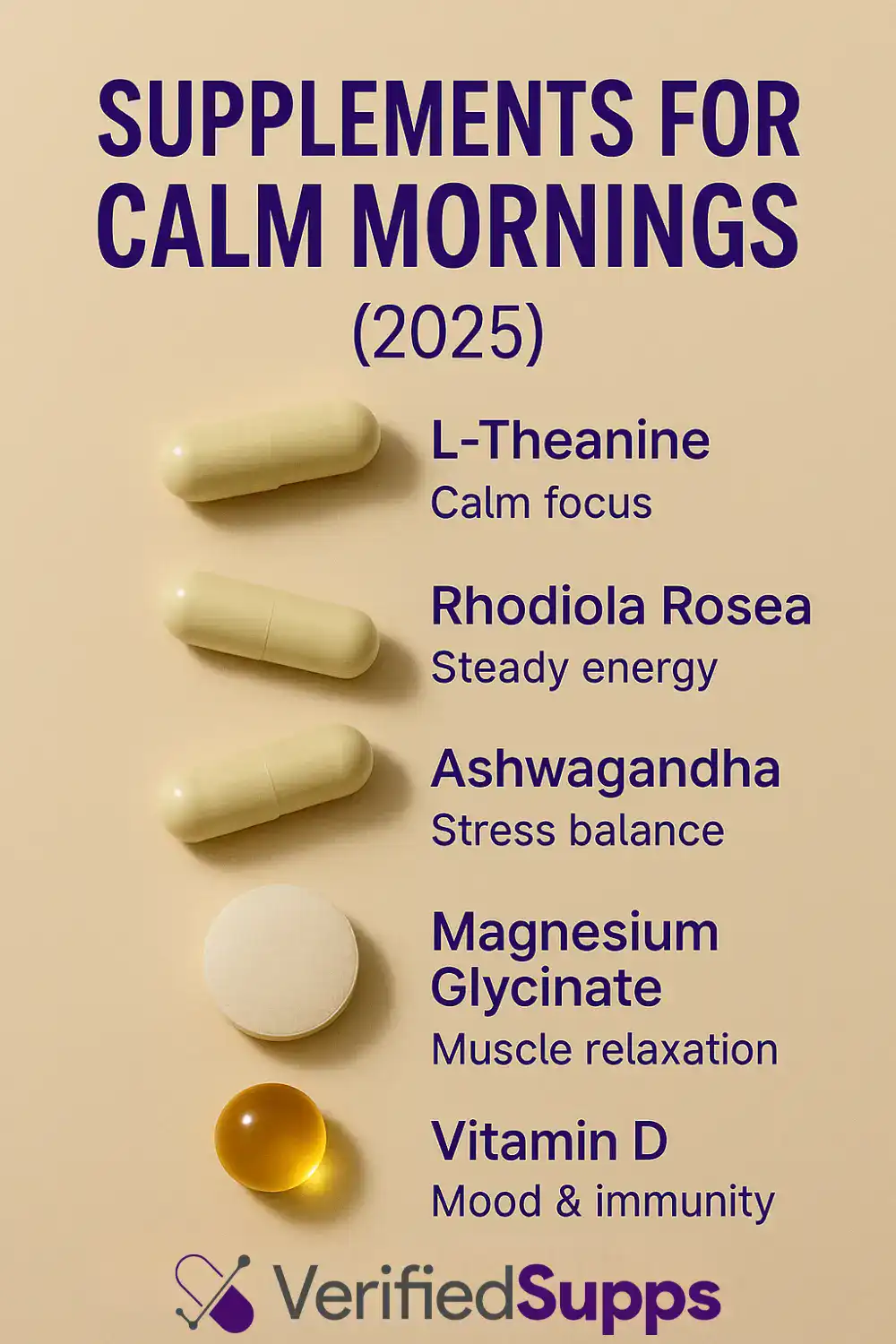
The best “calm morning” supplement depends on what your mornings feel like. If your mind wakes up loud and fast, L-theanine is usually the cleanest first move. If you wake up heavy and depleted, rhodiola may fit better. If your stress feels physical and baseline-driven, ashwagandha can make sense as a daily tool. Magnesium and vitamin D are often the foundational supports that make everything else feel steadier.
You don’t need five supplements. You need one good first pick, correct dosing, and a routine you can repeat.
Quick Take
- Fast mental quiet: L-theanine (often best first pick for “loud mind” mornings).
- Steady non-jitter energy: rhodiola (best fit for “heavy” mornings).
- Body-level stress baseline: ashwagandha (slower build, daily tool).
- Foundation supports: magnesium (nervous-system tone) and vitamin D (mood/energy baseline).
- Best rule: start with one tool that matches your pattern, then build.
If morning anxiety is severe, persistent, or paired with panic symptoms, chest pain, fainting, or major sleep disruption, treat that as a clinical conversation—not a supplement experiment.
Parent Hub: Want the complete calm-focus system (supplements + routines) in one place?
Open: The Complete Calm Focus Stack (VerifiedSupps)
What are the best supplements for calm mornings?
The best supplements for calm mornings are the ones that match your pattern: L-theanine for a loud mind, rhodiola for low, heavy energy, ashwagandha for body-level stress baseline, plus foundation supports like magnesium and vitamin D.
Early snippet magnet: Calm morning stack builder
| Morning pattern | Best first pick | Typical dose | When to take |
|---|---|---|---|
| Mind is loud, anxious, overthinking | L-theanine | Often 100–200 mg | On waking or with coffee |
| Energy feels heavy, motivation low | Rhodiola | Often 100–300 mg extract | Morning (earlier is better) |
| Body feels “on edge,” tension baseline | Ashwagandha | Often 300–600 mg extract | Daily consistency matters |
| Baseline nervous-system steadiness | Magnesium / Vitamin D | Magnesium often 200–400 mg elemental; D varies | Magnesium often later; D with food |
The fastest way to win this: pick one lane (mind vs energy vs body stress), run it for a week, then add one more only if needed.
Recommended Calm Morning Stack
If you want to turn this into a real routine, here are simple ways people buy the core tools — premium (ND) or convenient (Amazon).
🍵 L-Theanine · Calm Focus
Great for smoothing mental noise and pairing with morning coffee.
Premium (Nootropics Depot) Amazon Option🌿 Rhodiola · Steady Energy
Supports stress resilience and smoother morning energy without the spike.
Premium (Nootropics Depot) Amazon Option🧘 Ashwagandha · Stress Balance
Helps support a softer, less “on edge” start to the day.
Premium (Nootropics Depot) Amazon Option🧲 Magnesium Glycinate · Calm Body
Supports muscle relaxation and calmer nervous-system tone.
Premium (Nootropics Depot) Amazon Option☀️ Vitamin D · Mood & Daytime Energy
A foundational daily habit for mood, immunity, and energy stability.
Premium (Nootropics Depot) Amazon OptionIf you choose to purchase through these links, it may support this site at no extra cost to you. Only add what feels right for your body and your routine.
What should I take in the morning for anxiety and racing thoughts?
For morning anxiety that feels like mental noise, L-theanine is one of the simplest, cleanest options because it can calm without pushing you down. It’s often used with coffee to reduce edge and improve “calm focus.”
Best-fit signals
- You wake up thinking fast.
- Caffeine helps but makes you edgy.
- You want calm + function, not sedation.
Typical range: many start around 100–200 mg and adjust based on sensitivity.
What supplement helps morning energy without caffeine jitters?
Rhodiola is often used for smoother energy and stress resilience—especially when your mornings feel mentally heavy or motivation is low. It’s not a “kick.” It’s more of a steadier output tool.
Practical use notes
- Take it earlier in the day if it affects your sleep.
- Use a standardized extract and start conservative.
- If you feel overstimulated, reduce dose or discontinue.
Build your calm morning ritual (simple)
On waking: L-theanine (if mind-racing is the issue)
With coffee or breakfast: rhodiola (if energy is heavy)
With a meal: vitamin D (baseline support)
Later in the day: magnesium (if tension is the driver)
Tiny adjustments. Gentler mornings. A more grounded baseline.
Is ashwagandha good to take in the morning?
It can be—if your mornings feel like physical stress (tension, wired baseline, “on edge” body). Ashwagandha is usually a slow-build tool, meaning it’s better judged over weeks than hours.
When it tends to fit
- Stress feels physical, not just mental.
- You want a steadier baseline over time.
- You’re willing to take it consistently for a fair test.
Caution: if you have thyroid/autoimmune concerns, are pregnant/breastfeeding, or take prescription medications, confirm safety with a clinician before use.
Should you take magnesium in the morning or at night?
Many people prefer magnesium later in the day because it’s often used for tension relief and sleep quality. Morning use can still make sense if your stress is very physical or you’re prone to muscle tension early—but timing is less important than tolerance and consistency.
Two practical rules
- Track elemental magnesium (not just “glycinate mg”).
- If GI tolerance is an issue, lower dose or split it.
Should you take vitamin D in the morning?
Vitamin D is best taken with a meal (it’s fat-soluble), and morning or midday is often easiest for consistency. It’s a baseline support tool—mood and energy shifts, when they happen, are usually gradual.
Reality check
If you expect an immediate “lift,” you’ll be disappointed. Vitamin D is more like correcting a background deficit than adding a stimulant.
Why aren’t supplements helping my morning anxiety?
Most “no results” outcomes come from one of three things: wrong tool (mind vs body vs energy), inconsistent use, or a bigger driver overpowering everything (sleep debt, caffeine overload, alcohol, untreated anxiety, or medical factors).
Common mistakes (and fixes)
- Wrong match: taking ashwagandha for instant mental quiet, or taking theanine for deep body tension.
- Too many variables: starting three supplements and changing caffeine the same week.
- Sleep debt: poor sleep can dominate morning anxiety regardless of supplements.
- Caffeine timing: caffeine on an empty stomach can feel like anxiety for many people.
- Medical or medication factors: thyroid issues, stimulant meds, antidepressants, blood sugar swings—treat root causes directly.
A clean 7-day test
- Pick one supplement that matches your pattern and take it consistently.
- Keep caffeine and sleep schedule steady.
- If partial improvement shows up, add one complementary tool (not three).
Go Deeper (VerifiedSupps Guides)
These are the clean next steps if you want to go deeper without overwhelm.
L-theanine for anxiety
Best-fit profiles, dosing, and what “clean calm” really feels like.
Rhodiola rosea benefits
Steady energy, stress resilience, and best timing.
Magnesium complete guide
Forms, dosing, timing, and side effects—fully mapped.
Vitamin D benefits
Mood, immunity, energy—plus how to dose responsibly.
Final Takeaway
Calm mornings come from the right first lever: theanine for a loud mind, rhodiola for heavy energy, ashwagandha for body-level stress baseline—then magnesium and vitamin D as steady foundations. Start small, stay consistent, and judge trends instead of chasing a perfect morning.
FAQ
What is the best supplement for morning anxiety?
If anxiety is mostly racing thoughts, many people start with L-theanine. If anxiety is mostly body tension and baseline stress, daily tools like magnesium and sometimes ashwagandha may fit better.
Can I take L-theanine every morning?
Many people do. If you’re unsure due to medications or health conditions, confirm with a clinician.
Does rhodiola feel like caffeine?
Usually not. People often describe it as steadier energy and resilience rather than a spike. If it feels overstimulating, lower the dose or stop.
Should I take ashwagandha in the morning or at night?
Either can work. Many people choose the time that fits their routine and tolerance. Judge it over weeks, not hours.
Can magnesium make mornings calmer?
It can if your stress pattern includes tension and poor sleep quality. Many people prefer magnesium later in the day, but some do fine with morning dosing.
Is vitamin D a “feel it today” supplement?
Usually not. If it helps, it tends to show up as gradual baseline improvement, especially when levels were low.
Can I combine theanine and rhodiola?
Often yes. If you’re sensitive, change one variable at a time so you can tell what’s helping.
What matters more than supplements for calm mornings?
Sleep quality, caffeine timing, alcohol, hydration, and stress load usually have bigger effects than any single supplement.