By VerifiedSupps Editorial Team
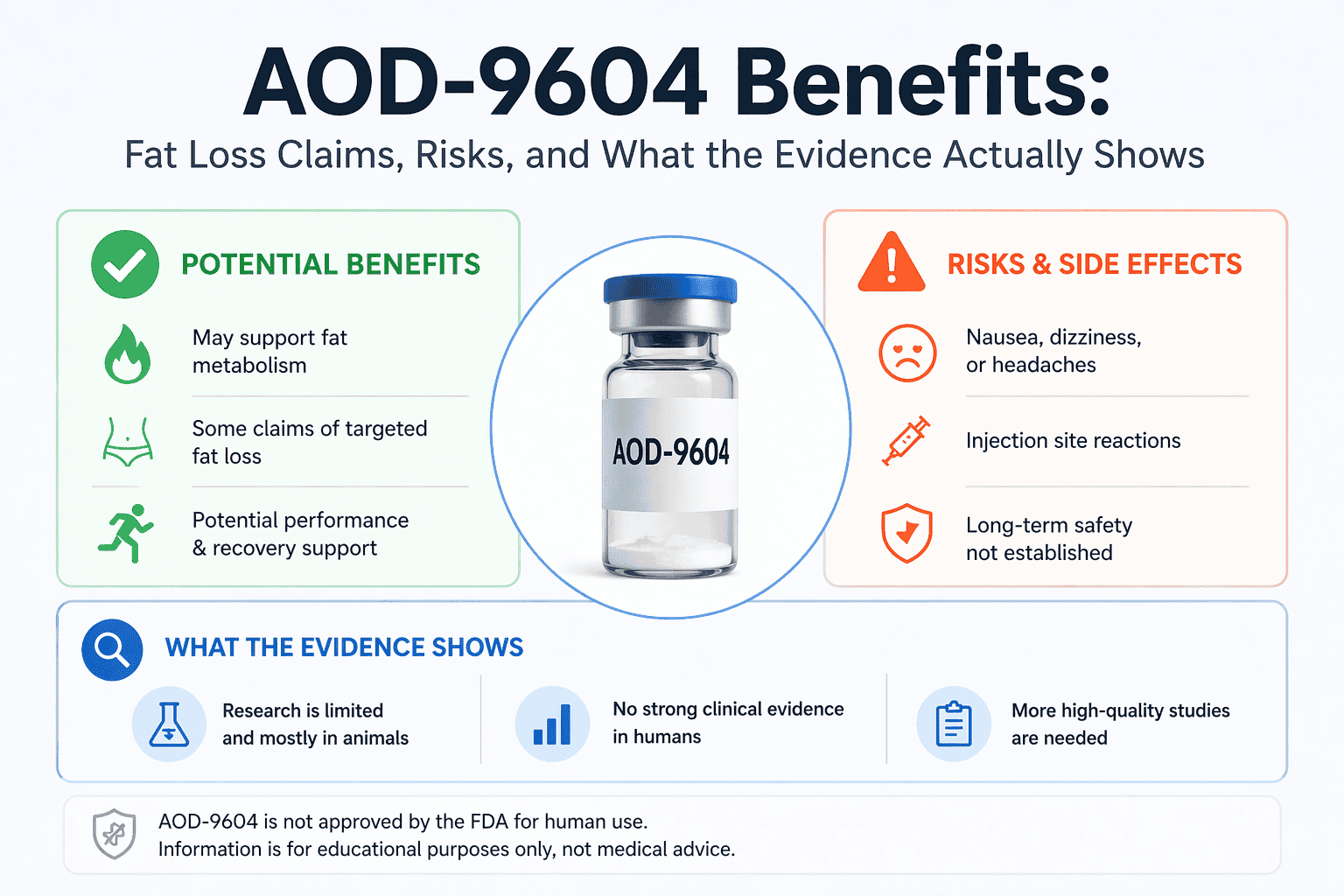
AOD-9604 Benefits: Fat Loss Claims, Risks, and What the Evidence Actually Shows
AOD-9604 is not an imaginary peptide with no history. It was developed as a modified human growth hormone fragment, specifically Tyr-hGH177–191, and it went through a real obesity-development program with six clinical trials involving 936 subjects. The problem is that the excitement around it lasted longer than the obesity efficacy story did.
The most honest current summary is this: AOD-9604 was designed to target the fat-metabolism side of growth hormone biology without looking like full hGH, and its human safety profile in the original obesity program looked reasonably clean. But the obesity program still failed where it mattered most. The later pivotal efficacy study did not meet its primary endpoint, and development for obesity was discontinued.
This page is for the real AOD-9604 question: what it is, whether it actually worked for fat loss, what happened to its development, and why its current safety and anti-doping story should make people slow down.
Key terms: AOD-9604, Tyr-hGH177-191, hGH fragment 176-191, lipolytic peptide, obesity drug candidate, LAT8881, compounding risk, WADA ban
Quick Take
AOD-9604 makes the most sense as a once-promising obesity fragment that never developed into a convincing modern weight-loss drug. The strongest honest case is “interesting lipolytic concept with decent historical tolerability,” not “proven fat-loss peptide.”
TL;DR decision
AOD-9604 is more legitimate than a random internet peptide, but much less impressive than current weight-loss drug marketing around it suggests. The cleanest current read is “historical obesity candidate with underwhelming efficacy and continuing regulatory caution.”
Evidence standard: human trials, dose ranges, guideline-level sources when available
Who this is for: people hearing about AOD-9604 for fat loss and trying to sort out whether it is a real metabolic peptide, a failed obesity drug, or just another online recovery claim
Who this is not for: anyone looking for underground sourcing, sports use, or reassurance that a peptide with a real development history must therefore be a good current weight-loss option
Reviewed by: VerifiedSupps Editorial Team
Last reviewed: April 20, 2026
Parent Hub
VerifiedSupps Articles
Use the broader article hub if you want a calmer framework before assuming every peptide with a real development history is still a good current option.
Quick decoder: what does AOD-9604 actually look like today?
This is the fastest way to separate “interesting fragment” from “successful obesity drug.”
| If your real goal is… | Best current answer | Why | Best honest framing |
|---|---|---|---|
| A strong modern obesity drug | No | The obesity program did not deliver enough efficacy in the later pivotal study | Historically interesting, not a current obesity leader |
| A lipolytic concept with real biology | Yes | It was designed from the C-terminal hGH fragment to target fat-metabolism effects without looking like full hGH | Mechanistically plausible |
| A peptide with a clean routine U.S. use story | No | FDA currently flags compounded AOD-9604 for potential safety risk and reviewed it negatively for bulks-list inclusion | Regulatory caution still matters |
| Something safe for athletes to use | No | WADA lists AOD-9604 under prohibited growth hormone fragments | Banned in sport |
Best next step (today): Think of AOD-9604 as a once-promising fat-metabolism fragment that disappointed as an obesity drug, not as a hidden modern weight-loss breakthrough.
Does AOD-9604 actually work for fat loss?
Not strongly, at least not by modern obesity-drug standards. The fairest answer is that AOD-9604 had enough early promise to justify a real obesity program, but not enough later efficacy to survive as a serious anti-obesity medicine.
Mechanism
- AOD-9604 is based on the C-terminal region of human growth hormone, a region thought to carry lipid-mobilizing effects.
- The goal was to preserve fat-metabolism activity while avoiding the classic growth-promoting and glucose-related downsides of full hGH.
- That concept looked good enough in early biology and animal work, but it did not turn into a convincingly effective obesity drug in humans.
What would change my recommendation: a strong modern randomized obesity trial showing clinically meaningful weight loss versus placebo. Right now, that is exactly the part of the story AOD-9604 does not have.
How much weight loss has AOD-9604 shown in human trials?
The honest headline is that the human obesity program was mixed early and disappointing later. Across the development program, there were six clinical trials involving roughly 900 to 936 participants, including two larger oral phase IIb obesity studies.
The 2014 safety-and-metabolism review says weight-loss effects were seen in initial trials, but not in the last study, where an intensive diet-and-exercise regime was also incorporated. The 2019 and 2023 LAT8881 protocols are even more direct: the most recent efficacy study did not meet the primary endpoint, and development for obesity was discontinued.
That is really the key takeaway. You do not need the perfect historical kilogram breakdown to know the obesity program did not succeed by modern standards.
What is AOD-9604 and how is it supposed to work?
AOD-9604 is a 16-amino-acid peptide fragment based on the C-terminus of human growth hormone, with an added N-terminal tyrosine for stabilization and a disulfide bridge between its cysteine residues. In development documents it is also described as Tyr-hGH177–191.
The whole design logic was to keep the fat-metabolism side of GH biology without behaving like full growth hormone. In both reviews and human safety work, AOD-9604 did not show meaningful IGF-1 stimulation or negative carbohydrate-metabolism effects, which is one reason it drew attention as a potentially “safer than hGH” fat-metabolism fragment.
That does not mean the concept failed scientifically. It means the concept did not translate into strong enough obesity efficacy to survive as a serious weight-loss drug.
What happened to AOD-9604 after obesity development failed?
It did not completely disappear. It was repurposed as LAT8881 and moved into neuropathic-pain research. That is useful context, because if you still hear AOD-9604 described as a major upcoming obesity medicine, that is outdated.
Both the 2019 and 2023 LAT8881 protocols say the compound was initially developed for obesity under the name AOD9604, that phase 2 studies did not show statistically significant weight loss or did not meet the primary endpoint, and that development for obesity was discontinued. The same protocols frame the newer pain work as a repurposing effort rather than a continuation of the obesity program.
That means the peptide’s “current life” is better understood as a repurposed research compound than as a stealth obesity winner waiting to reemerge.
Is AOD-9604 safe?
The historical trial answer and the current U.S. compounding answer are not the same thing. In the original obesity program, the human safety paper paints a fairly reassuring picture. In today’s FDA compounding-risk framework, the tone is much less comfortable.
Historical trial signal
The 2013 human safety summary said AOD-9604’s profile was indistinguishable from placebo, with no clinically relevant IGF-1 changes, no worsening of carbohydrate metabolism, no detected anti-AOD antibodies in tested patients, and no withdrawals or serious adverse events judged related to the drug.
Current FDA risk signal
FDA now says compounded AOD-9604 may pose significant immunogenicity risk for certain routes, may involve peptide-related impurities and API-characterization complexity, and that the agency has only no or limited safety information. FDA also notes serious adverse events may be associated with AOD-9604, although causality is not clear.
That is why the safest honest answer is not “AOD-9604 is dangerous” or “AOD-9604 is proven safe.” It is “historical clinical tolerability looked decent, but the current gray-market and compounding context is much less reassuring.”
Is AOD-9604 approved or banned?
For athletes, the answer is very clear: it is banned. The 2026 WADA Prohibited List includes growth hormone fragments, specifically naming AOD-9604 and hGH 176–191 as examples.
For routine U.S. use, the answer is also not encouraging. In the December 2024 Pharmacy Compounding Advisory Committee meeting, FDA discussed AOD-9604-related bulk drug substances for the use of obesity, and the committee voted 12-0 against placing AOD-9604 free base and acetate on the 503A bulks list. That does not look like a substance moving toward normal routine acceptance.
So the cleanest current status summary is: not a modern approved obesity medicine, not sport-safe, and still sitting inside a cautious regulatory frame rather than a settled one.
What should you do if you are thinking about AOD-9604?
The smartest move is to decide whether you care about history, mechanism, or actual current usefulness. AOD-9604 is still interesting historically and mechanistically. It is much less compelling as a current fat-loss solution.
Common mistakes
- Using the early “lipolytic GH fragment” story as if the later obesity failure never happened.
- Borrowing confidence from preclinical mouse fat-loss work and treating it like strong human obesity proof.
- Ignoring the difference between historical clinical tolerability and current compounding-product risk.
- For athletes, ignoring the fact that AOD-9604 is directly named on the prohibited list.
Clean test protocol
| Inputs | A clear goal, an honest understanding that the obesity program failed, and a clear distinction between historical trial safety and today’s unapproved-compounding context |
|---|---|
| Duration | Reassess only if new credible human efficacy data appear. Right now, the case is largely historical rather than evolving into a successful obesity-drug story. |
| 3 metrics | Whether the evidence is animal or human, whether the result was actually clinically meaningful, and whether the current product status is legitimate and regulated |
| Stop conditions | Any gray-market sourcing, any athletic use, or any pitch that treats AOD-9604 like a successful modern obesity medicine instead of a discontinued obesity candidate |
How to tell it’s working
Right now, the better test is whether your framework got cleaner. A good AOD-9604 review should leave you less impressed by the phrase “fat-loss peptide” and more aware that a real drug program still can fail on efficacy.
Red flags / seek care
Seek medical care for chest pain, fainting, severe swelling, trouble breathing, persistent vomiting, or strong injection-site reactions after any unverified peptide product. Treat uncertain source quality itself as a safety problem, not a technical detail.
Selected Professional References
These are the most useful sources for understanding AOD-9604’s identity, obesity-development failure, historical trial safety, and current safety and anti-doping status.
LAT8881 Neuropathic Pain Protocol
One of the clearest current primary sources showing AOD9604’s obesity program was discontinued and later repurposed.
Used for: Tyr-hGH177-191 identity, six trials, and discontinued obesity development
LAT8881 IV Pain Study Protocol
Useful because it repeats the obesity-development failure and repurposing story in a separate later protocol.
Used for: confirming the program pivot away from obesity
Safety and Tolerability of the Hexadecapeptide AOD9604 in Humans
The strongest direct source for the historical human safety and tolerability discussion.
Used for: placebo-like tolerability, no relevant IGF-1 rise, and no negative glucose signal
Safety and Metabolism of AOD9604
A useful bridge source for how the fragment was supposed to work and why the obesity-efficacy story ultimately disappointed.
Used for: mechanism logic, early signal, and later efficacy failure context
The Effects of hGH and AOD9604 on Lipid Metabolism
Helpful for understanding why the peptide originally looked worth pursuing at all.
Used for: the animal lipolysis / fat-loss rationale
FDA Risk Language for AOD-9604
The most important official source for the current U.S. compounding-risk picture.
Used for: immunogenicity, impurities, limited safety information, and possible serious adverse events
PCAC Minutes: AOD-9604-Related Bulk Drug Substances
The key current official source for how FDA’s advisory process treated AOD-9604 in compounding policy.
Used for: 12-0 vote against inclusion on the 503A bulks list
WADA Prohibited List
The clearest current source for the sports-ban status of AOD-9604.
Used for: current anti-doping status as a growth hormone fragment
Go Deeper (VerifiedSupps Guides)
These are the best next reads if you want the peptide-weight-loss and peptide-safety cluster to make more sense after the AOD-9604 story is clear.
Are Peptides Safe?
Best next read if your real question is whether the peptide category deserves more caution than the marketing suggests.
How to Choose Supplements Without Guesswork
Helpful if AOD-9604 mostly reminded you how often interesting biology gets overstretched into confident product claims.
Retatrutide for Weight Loss
Useful if you want a contrast with what a much stronger modern obesity-drug evidence stack looks like.
How Much Protein Do You Actually Need?
Helpful if your broader goal is body-composition strategy instead of chasing weak fat-loss peptides.
Final Takeaway
AOD-9604 is one of those compounds that can sound much stronger in conversation than it looks in the full evidence record. It had a real obesity-drug history, a real fat-metabolism rationale, and a historically decent tolerability profile. But it still failed where it mattered most: it did not turn into a convincingly effective obesity drug. The cleanest conclusion is “interesting historical peptide, weak modern fat-loss case, and current reasons for caution.”
FAQ
What is AOD-9604?
AOD-9604 is a modified human growth hormone fragment, also described as Tyr-hGH177-191, originally developed as an obesity treatment candidate.
Does AOD-9604 actually work for fat loss?
Not strongly by modern obesity-drug standards. It had enough early promise to justify real development, but the later obesity efficacy study did not meet the primary endpoint and development for obesity was discontinued.
How much human trial evidence exists for AOD-9604?
There were six clinical trials involving roughly 900 to 936 participants, including two larger oral phase IIb obesity studies.
Is AOD-9604 safer than full growth hormone?
Historically, it looked different from full hGH in that it did not show meaningful IGF-1 elevation or negative carbohydrate-metabolism effects in the human safety program. That does not make the current compounding story low risk.
What happened to AOD-9604 after obesity development failed?
It was repurposed as LAT8881 and moved into neuropathic-pain research.
Is AOD-9604 FDA-approved?
It is not part of the current approved obesity-drug lineup, and FDA currently treats compounded AOD-9604 as a substance with potential significant safety risk.
Is AOD-9604 banned in sport?
Yes. WADA’s 2026 Prohibited List includes growth hormone fragments such as AOD-9604 and hGH 176-191.
What are the biggest current risks with AOD-9604?
The biggest current risks are compounding-related: immunogenicity potential, peptide-related impurities, API-characterization complexity, and limited safety information.
Why does AOD-9604 still get hype online?
Because it had a real obesity-drug history and a plausible fat-metabolism mechanism, which makes it easy to market long after the efficacy story stopped being convincing.
What is the safest way to think about AOD-9604 right now?
Treat it as a historically interesting fat-metabolism fragment with underwhelming obesity efficacy and a current regulatory caution story, not as a hidden modern weight-loss breakthrough.
VerifiedSupps Medical Disclaimer
This content is for educational purposes only and is not medical advice. AOD-9604 is not a routine approved obesity medicine, and current FDA materials describe meaningful safety uncertainty around compounded versions. A historical clinical program and a plausible lipolytic mechanism do not make gray-market peptide use safe, effective, or appropriate. Do not use unverified peptide products as a substitute for evidence-based weight-management care. Seek urgent medical care for chest pain, fainting, severe swelling, trouble breathing, persistent vomiting, or strong reactions after using any unverified peptide product.