By VerifiedSupps Editorial Team
Taurine for Heart Health and Blood Pressure: Benefits, Dosage, and Safety
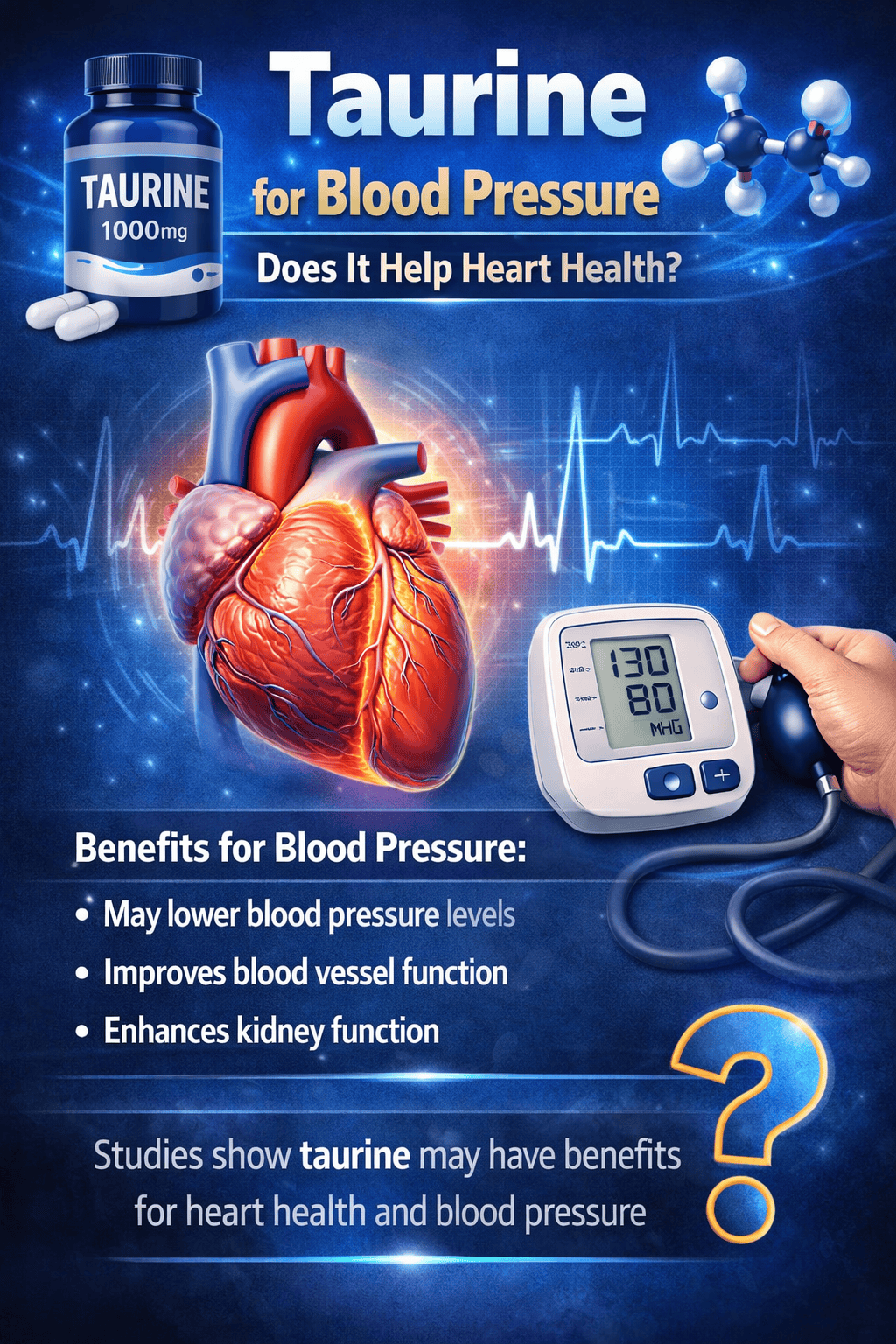
Taurine looks legitimately promising for blood pressure, vascular function, and broader cardiometabolic support. The strongest human data are not about dramatic “heart health” feelings. They are about measurable shifts in markers like systolic and diastolic blood pressure, endothelial function, triglycerides, glucose control, and insulin resistance.
That is why taurine makes the most sense as a supportive nutrition tool, not a replacement for hypertension treatment or heart-disease care. In practical terms, the most useful daily range is usually 1.5 to 3 g/day, and the strongest conservative long-term safety benchmark in healthy adults remains up to 3 g/day.
This page focuses on taurine’s cardiovascular and blood-pressure role specifically. It is not the broad taurine overview page, and it is not the dedicated taurine timing page.
Key terms: taurine, blood pressure, heart health, endothelial function, vascular function, cardiometabolic support, triglycerides, taurine dosage
Quick Take
Taurine is a better fit for high-normal blood pressure, vascular support, and cardiometabolic-risk support than for vague “heart health” marketing. The blood-pressure effect looks modest but real in human data, heart-failure signals exist but still lean on smaller and older studies, and the everyday range most people should think in is roughly 1.5 to 3 g/day.
TL;DR decision
If your goal is supportive blood-pressure or cardiometabolic improvement, taurine is reasonable to consider. If your goal is treating established cardiovascular disease on your own, it is not. Start lower, stay realistic, and treat taurine as a supportive layer around standard care, not a substitute for it.
Evidence standard: human trials, dose ranges, guideline-level sources when available
Who this is for: adults who want a realistic taurine strategy for blood pressure, vascular support, or broader cardiometabolic support
Who this is not for: anyone trying to replace BP medication, heart-failure care, or clinician-guided treatment with a supplement trial
Reviewed by: VerifiedSupps Editorial Team
Last reviewed: March 31, 2026
Parent Hub
Taurine Benefits: The Complete Science-Backed Guide
Use the main taurine guide if you want the full picture first, including exercise, metabolic, cognition, dosing, and safety context beyond the cardiovascular angle.
Taurine for heart health: quick decision table
Use this to decide whether taurine makes sense for your specific cardiovascular question.
| If your main goal is… | Does taurine make sense? | Practical dose range | Best next move |
|---|---|---|---|
| High-normal BP or mild BP support | Yes, reasonable | Usually 1.5–3 g/day | Track home BP trends, not sensations |
| Broader cardiometabolic support | Often yes | Usually 1.5–3 g/day | Think in weeks, not days |
| Established heart failure or structural heart disease | Possibly, but only as clinician-guided support | Individualized | Do not self-replace standard care |
| Energy drinks marketed as “heart support” | No, not a clean test | Avoid using mixed products to judge taurine | Use taurine alone if you want a real answer |
Best next step (today): Pick one cardiovascular target to judge—home BP trend, triglycerides, or clinician-tracked metabolic markers. Taurine works best when the question is specific.
Does taurine help heart health and blood pressure?
Yes, probably—modestly. Human trials and meta-analyses suggest taurine can reduce blood pressure by a few mmHg on average, improve vascular function, and support broader cardiometabolic health. That is not a dramatic effect, but it is meaningful enough to take seriously.
Mechanism
- Taurine appears to support vascular function, including endothelial function and arterial stiffness markers.
- It may influence calcium handling, membrane stability, and platelet signaling, which matter for vascular tone and cardiovascular function.
- It also improves several cardiometabolic risk markers, which may indirectly support cardiovascular health even when the direct “heart effect” feels subtle.
This is why taurine should be viewed more like a measured support tool than a miracle heart supplement. It can help, but the strongest human story is about modest improvements in real markers, not magical symptom changes.
What would change my recommendation
If you already have low blood pressure, take blood-pressure or glucose-lowering medication, or have symptomatic heart disease, taurine should feel more like a clinician-guided adjunct than a casual supplement trial. The evidence is promising enough to matter, but not strong enough to justify self-managing cardiovascular treatment around it.
How much taurine should you take for heart health and blood pressure?
The most practical cardiovascular range is usually 1.5–3 g/day. That range fits the current meta-analysis data well, lines up with the better blood-pressure and cardiometabolic trials, and stays inside the strongest conservative safety envelope for everyday use.
Specific studies help make that range feel real instead of abstract. The prehypertension trial used 1.6 g/day for 12 weeks. The newer type 2 diabetes trial used 2.4 g/day for 12 weeks. The broader cardiometabolic meta-analysis then suggested 1.5–3.0 g/day looked most effective overall.
Simple rule: if you are just testing taurine, start lower. If you are specifically testing blood pressure or cardiometabolic support, 2 g/day is a very reasonable middle ground. More is not automatically better.
When is the best time to take taurine for blood pressure support?
For blood pressure and vascular support, the best timing is usually the time you can keep consistent. The cardiovascular trials are much more about daily dose and total duration than about proving that morning beats night or night beats morning.
Pharmacokinetic data show that oral taurine can peak at roughly 1.5 hours after a fasting dose in healthy volunteers, but that matters much more for acute exercise timing than for chronic blood-pressure support. If your goal is a long-term cardiovascular trend, consistent daily use matters more than trying to game the clock.
Practical rule: morning, lunch, or evening can all work. Pick the slot that is easiest to repeat and easiest to separate from high-caffeine products, so you can tell what taurine itself is doing.
Is taurine safe if you have high blood pressure or heart disease?
For healthy adults, taurine appears generally well tolerated. The strongest conservative long-term benchmark remains an observed safe level of up to 3 g/day. Shorter cardiovascular studies have used higher amounts without major safety signals, but long-term confidence above 3 g/day is not as strong.
The more important safety issue is usually context. If taurine nudges blood pressure, glucose handling, or vascular function in a favorable direction, then people already using medication for those same systems should be more deliberate. That is especially true if you are older, have symptomatic heart disease, or notice dizziness, weakness, or unusually low readings after starting it.
Bottom line: taurine looks like a sensible supportive supplement in the right person, but not a casual self-treatment tool in someone with complex cardiovascular disease.
Why isn’t taurine helping my blood pressure?
Usually because the test was messy, too short, or aimed at the wrong outcome. Taurine tends to work more like a trend-support supplement than a “feel it today” supplement, so expecting an obvious sensation is one of the easiest ways to judge it badly.
Common mistakes
- Using taurine through an energy drink and assuming you learned something about taurine alone
- Stopping after a few days instead of giving the trend enough time
- Tracking “how do I feel?” instead of tracking actual home blood pressure
- Taking too little to matter or changing dose or timing every few days
Clean test protocol
| Inputs | Use taurine alone, not an energy drink. Pick one dose in the 1.5–3 g/day range. Keep your medication plan stable unless your clinician changes it. |
|---|---|
| Duration | Aim for about 6–8 weeks of consistent use for a fair home trial, unless side effects or clinician feedback stop the test earlier. |
| 3 metrics | Track average home BP, whether readings are more stable, and any dizziness, weakness, or unusual low-BP symptoms. |
| Stop conditions | Stop and reassess if you develop persistent GI symptoms, new dizziness, low BP readings that worry you, or anything that feels more like a medication interaction than a supplement issue. |
How to tell it’s working
The best sign is not a feeling. It is a trend: lower average home BP, slightly better vascular metrics if you are testing clinically, or better supporting labs over time. Taurine is usually better judged like magnesium or omega-3 than like caffeine.
Red flags / seek care
Seek prompt medical input for chest pain, fainting, severe dizziness, troubling palpitations, significant weakness, or blood pressure readings that look dangerously low or erratic. Taurine should not be used to self-manage worsening cardiovascular symptoms.
Can taurine improve cholesterol, triglycerides, and other cardiometabolic markers?
Yes, and this is one reason taurine deserves more respect than a narrow “blood pressure supplement” label. The better meta-analytic data suggest taurine can improve triglycerides, total cholesterol, LDL cholesterol, fasting glucose, HbA1c, fasting insulin, and insulin resistance, alongside the blood-pressure effects.
That matters because “heart health” is rarely just about one number. Cardiovascular risk usually travels with lipids, glucose control, inflammation, and vascular function, not blood pressure in isolation.
That broader pattern is one of taurine’s strongest arguments. It looks less like a single-target supplement and more like a cardiometabolic-support tool.
Can taurine help heart failure or is the evidence still too limited?
This is the part of the taurine story where optimism needs the most caution. Some cardiovascular meta-analysis work suggests improved LVEF and NYHA class, especially in heart-failure subgroups, which is encouraging. But those heart-failure signals still come largely from older and smaller studies, not from the kind of large modern trials that would make this feel settled.
There is also a dedicated systematic review focused on dilated cardiomyopathy and heart failure in humans, which tells you the question is real and clinically interesting. It also tells you the evidence base is still specialized rather than routine-care ready.
The practical read is simple: taurine is reasonable to discuss with a clinician in heart-failure or cardiomyopathy contexts, but it is not the part of the evidence I would present as strong enough for solo self-experimentation in place of standard treatment.
Selected Professional References
These are the main sources anchoring the blood-pressure, vascular, cardiometabolic, heart-failure, and safety claims in this guide.
Effects of Oral Taurine Supplementation on Cardiometabolic Risk Factors
The most important recent meta-analysis for taurine’s blood-pressure, lipid, glucose, insulin-resistance, and inflammation effects.
Used for: dose range, cardiometabolic outcomes, BP effect framing
Taurine Supplementation Lowers Blood Pressure and Improves Vascular Function in Prehypertension
One of the clearest human randomized trials showing taurine can improve clinic and ambulatory BP plus vascular function.
Used for: real-world BP dose example, vascular support, prehypertension context
Taurine Ameliorates Blood Pressure and Vascular Function in Patients with Type 2 Diabetes
Important newer trial showing taurine’s BP and vascular effects can extend into a higher-risk cardiometabolic population.
Used for: 2.4 g/day example, vascular function, diabetes-related cardiovascular context
Insights into the Cardiovascular Benefits of Taurine
Broad cardiovascular meta-analysis useful for BP, heart rate, LVEF, NYHA class, and the “promising but still uneven” heart-health picture.
Used for: heart-health overview, BP, heart-failure subgroup context, safety overview
The Effects of Oral Taurine on Resting Blood Pressure in Humans
A useful older BP meta-analysis that keeps expectations grounded: the effect size looks modest, not magical.
Used for: approximate BP effect size, realistic expectation setting
Effect of Taurine Administration on Symptoms, Severity, or Clinical Outcome of Dilated Cardiomyopathy and Heart Failure
Helpful for keeping the heart-failure story honest: interesting enough to study closely, but not settled enough to overstate.
Used for: heart-failure caution, evidence-base maturity, why stronger trials are still needed
Risk Assessment for Taurine
Still the key anchor for taurine’s conservative long-term daily safety range in healthy adults.
Used for: up to 3 g/day long-term safety framing
Go Deeper (VerifiedSupps Guides)
Once the taurine-and-heart question is clear, these are the next pages that help place it inside the bigger cardiovascular and mineral-support picture.
Taurine Dosage Guide
Use this if your next question is purely dose and timing rather than heart-health evidence.
Omega-3 Complete Guide
Good next read if you want another evidence-based cardiovascular support tool to compare with taurine.
Sodium vs Potassium
Open this if your blood-pressure question may be more about minerals and electrolyte balance than taurine alone.
Electrolytes Complete Guide
Use this if the real issue is blood pressure plus hydration, mineral intake, or broader cardiovascular rhythm support.
Final Takeaway
Taurine looks most convincing for modest blood-pressure improvement, vascular support, and broader cardiometabolic support. That is meaningful, but it is not the same thing as proving taurine prevents heart attacks, replaces medication, or settles advanced heart-disease care. Use it where the evidence is strongest, keep the dose grounded, and judge it by measured trends, not marketing language.
FAQ
Does taurine lower blood pressure?
Human trials and meta-analyses suggest taurine can modestly lower blood pressure, usually by a few mmHg rather than a dramatic amount.
How much taurine should I take for blood pressure support?
The most practical range is usually 1.5 to 3 grams per day. Trial examples include 1.6 grams per day and 2.4 grams per day.
What is the best time to take taurine for heart health?
For blood pressure and vascular support, consistency matters more than a perfect time of day. The trials are mainly about daily dose and duration.
How long does taurine take to affect blood pressure?
Think in weeks, not in a day or two. The clearer human cardiovascular trials ran for around 12 weeks, and broader cardiometabolic shifts usually need sustained use.
Can taurine help heart failure?
The signal is promising, especially for some functional and surrogate markers, but the evidence still leans on smaller and older studies rather than large modern definitive trials.
Can taurine improve cholesterol or triglycerides?
Yes, taurine has shown improvements in triglycerides and several other lipid and metabolic markers in meta-analyses of randomized trials.
Is taurine safe with high blood pressure medication?
It may be, but this is where clinician guidance matters more because taurine can affect blood pressure and other cardiometabolic markers that overlap with medication effects.
Should I take taurine in the morning or at night for blood pressure?
There is no strong human evidence that morning or night is universally superior. Pick a time you can keep consistent.
Is taurine in energy drinks the same as taking a taurine supplement?
Not really. Energy drinks add caffeine and other ingredients, so they are not a clean way to judge taurine’s cardiovascular effects on its own.
Is 3 grams of taurine too much?
For healthy adults, 3 grams per day sits inside the strongest conservative long-term safety range. That does not mean everyone needs that much.
VerifiedSupps Medical Disclaimer
This content is for educational purposes only and is not medical advice. Taurine is not a substitute for evaluation or treatment of high blood pressure, heart failure, coronary disease, arrhythmia, diabetes, or any other diagnosed condition. Use extra caution if you have low blood pressure, take blood-pressure or glucose-lowering medication, or have symptomatic cardiovascular disease. Seek urgent medical care for chest pain, fainting, severe dizziness, or other concerning cardiovascular symptoms.