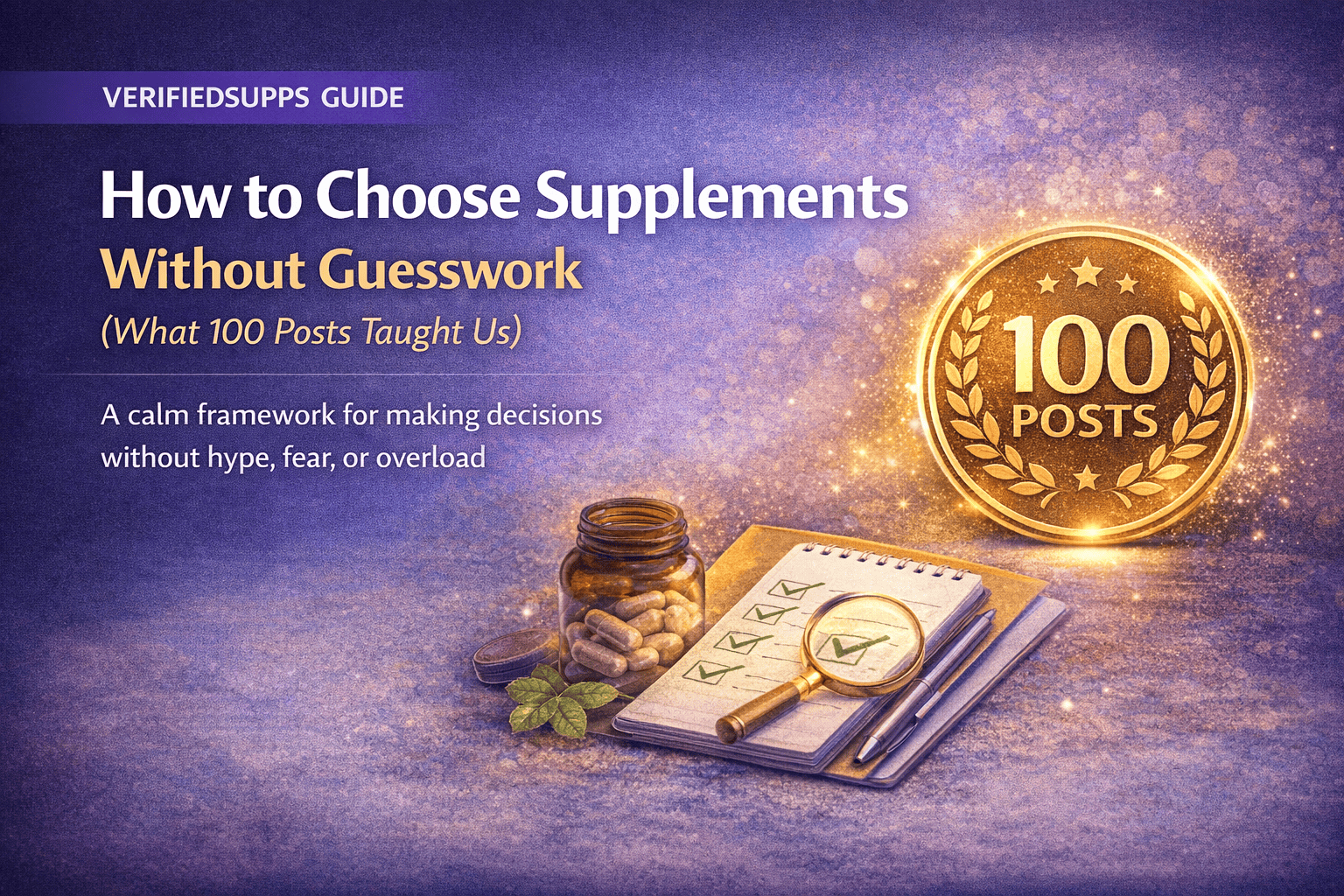
How to Choose Supplements Without Guesswork (What 100 Posts Taught Us)
Direct answer: the best supplement decision is rarely “what’s popular.” It’s: what is my bottleneck, what tool matches it, and how do I test it calmly without stacking noise on top of noise.
After building 100+ guides, one pattern repeats: people don’t need more supplements—they need a cleaner decision process that produces clear outcomes.
What’s the best way to choose supplements?
The best way is a simple sequence: identify one bottleneck → choose one tool → test it cleanly → keep what works. This page owns one intent: making your supplement choices measurable and repeatable—so you can stop chasing trends.
| Step | What to do | What to avoid | What success looks like |
|---|---|---|---|
| 1) Bottleneck | Choose one outcome: sleep, stress, cramps, focus, digestion, recovery | Trying to fix everything at once | One clear metric improves |
| 2) Tool | Pick one supplement that plausibly matches that system | Buying a “stack” because it sounds complete | You can explain why it should help |
| 3) Test | Keep timing stable; avoid adding variables for 7–14 days | Changing dose and adding new products mid-test | Trend improvement, not a single-day spike |
| 4) Decide | Keep, stop, or adjust one variable at a time | Emotional scoring daily | Clear “keep” or “stop” based on data |
- Prescription meds (blood pressure meds, anticoagulants, thyroid meds, stimulants): interactions and timing matter.
- Kidney or liver disease: higher caution with minerals and fat-soluble nutrients.
- Pregnancy/breastfeeding: different risk-benefit standards.
- High-stakes symptoms (palpitations, fainting, severe fatigue): evaluation first, supplements second.
- Labs show a clear deficiency: decision becomes targeted and less speculative.
Why do most supplements “not work”?
Most “failures” are not product quality problems—they’re decision problems: wrong bottleneck, wrong tool, inconsistent use, or the wrong metric. A subtle but real improvement will feel like “nothing” if you’re tracking the wrong outcome.
- You picked a tool that doesn’t match the bottleneck
- You changed multiple variables mid-test
- You didn’t run the test long enough
- Your metric didn’t match the goal
- A small but steady trend shift
- Fewer bad days in the trigger context
- Better recovery of baseline after stress
- Less need to think about it
How do I know what my supplement bottleneck is?
Your bottleneck is the one outcome that, if improved, would make everything else easier. Don’t start by listing symptoms. Start by choosing the system that’s limiting you most: sleep, stress, digestion, focus, cramps, or recovery.
- What outcome matters most right now? (sleep, calm, performance, digestion)
- What context triggers the problem? (heat, training, caffeine, evenings)
- What would count as a win in 14 days? (a measurable trend, not perfection)
Should I stack supplements or test one at a time?
Test one at a time unless you already know what the first tool is doing. Stacking before you understand the first lever is the fastest way to create confusion and spend more money without learning.
- Each supplement has a clear job
- You can name what each one should change
- You already validated the base lever
- You feel urgency and “need results now”
- You’re changing dose/timing daily
- You can’t tell what did what
How long should I test a supplement before deciding?
Long enough to produce a stable signal. For many goals, a clean window is 7–14 days of consistent use. If your goal is baseline mood/stress or deeper recovery signals, the window can be longer—but you still need stable inputs.
- Sleep/tension outcomes: 7–14 nights
- Workout performance/pumps: 2–4 consistent sessions
- Digestion changes: 7–14 days with stable diet
- Baseline mood/stress: longer window, but still clean inputs
Supplement troubleshooting: how to tell it’s working
Supplements “work” when your target metric improves in a repeatable way, without new problems. The biggest mistake is evaluating emotionally day-to-day instead of looking for trend changes.
- Adding a second supplement before you have a baseline
- Changing dose and timing repeatedly
- Tracking the wrong metric (sensation instead of outcome)
- Not testing in the same context that triggers the problem
- Pick one tool and keep everything else stable.
- Use a repeatable timing (same time daily; with food if it improves tolerance).
- Track 2–3 metrics tied to the bottleneck (not vague “overall feel”).
- Don’t add new supplements during the window.
- Adjust one variable only after the window (dose or timing, not both).
- Sleep: shorter sleep latency or fewer awakenings across 7–14 nights
- Stress: lower baseline tension score (0–10) over 1–2 weeks
- Performance: repeatable improvement across 2–4 similar sessions
- Failure signal: no measurable change after a clean window, or side effects that make it not worth continuing
- New severe symptoms or symptoms that escalate fast
- Concerning palpitations, fainting/near-fainting, chest pain
- Persistent diarrhea/vomiting or dehydration signs
- Known kidney/heart disease without clinician guidance
How do I evaluate supplement claims without getting fooled?
The cleanest approach is to separate label claims from evidence quality. Claims can sound scientific, but your decision should lean on human evidence, plausible mechanisms, and dose ranges that match how the supplement is actually used.
- What outcome is claimed? (sleep latency, cramps frequency, focus minutes)
- Is there human evidence? (not just cell/animal data)
- Does the dose match the evidence? (not “fairy dust”)
- Is it safe in your context? (meds/conditions change the answer)
Selected Professional References
Go Deeper (VerifiedSupps Guides)
Final Takeaway
Supplements work best when they fade into the background—quietly supporting the system they were chosen for. If you feel confused or disappointed, the fix is rarely “add more.” It’s almost always: choose better, test cleaner, and let trends decide.