By VerifiedSupps Editorial Team
L-Citrulline for ED: Erections, Blood Pressure, and What It Actually Does
L-citrulline can help some men with mild, blood-flow-linked erectile dysfunction, but it is a supportive circulation tool, not a Viagra replacement. The human evidence is limited but not empty: the best-known small trial found improved erection hardness in men with mild ED. Just as important for your other top query, available human data do not suggest that L-citrulline raises blood pressure. If anything, studies more often show neutral or modest blood-pressure lowering effects.
That makes the clean decision fairly simple. If you are asking whether L-citrulline for ED is worth trying, it can be a reasonable blood-flow experiment when the issue seems mild and circulation-related. If you are asking whether L-citrulline raises blood pressure, the better answer is usually no—but that same vascular effect is exactly why low blood pressure, nitrates, PDE-5 medications, and blood-pressure drugs deserve caution.
This page focuses on erection-related blood-flow support and the blood-pressure question that often comes with it. It is not a full blood-pressure treatment guide, and it is not a replacement for ED evaluation when symptoms are persistent, sudden, or worsening.
Key terms: erectile dysfunction, nitric oxide, vessel relaxation, blood flow, blood pressure, PDE-5 inhibitors, mild ED
Quick Take
Best fit: mild or inconsistent erections where the problem seems at least partly vascular. Less likely to help: libido problems, panic-driven shutdown, hormone-driven symptoms, or medication-related ED. Main safety issue: not “raising blood pressure,” but interacting with other blood-pressure-lowering or vasodilating factors.
TL;DR decision
If you want a clean L-citrulline for ED trial, start with 3 g/day, then move toward 6 g/day if tolerated, and judge it over 2–4 weeks rather than one night. Do not use it casually if you already run low blood pressure, use nitrates, or combine it with PDE-5 medication without clinician guidance.
Evidence standard: human trials, dose ranges, guideline-level sources when available
Who this is for: men comparing L-citrulline for ED, erections, and circulation support, especially when they also want to know what it does to blood pressure.
Who this is not for: anyone expecting a pharmaceutical-strength effect, or anyone with serious cardiovascular symptoms who needs supplements to answer a medical problem.
Reviewed by: VerifiedSupps Editorial Team
Last reviewed: March 10, 2026
Parent Hub
L-Citrulline Complete Guide
Use the full citrulline hub if you want the broader benefits, dosing, timing, safety, and comparison map. This page stays tightly focused on erections plus the blood-pressure question.
L-citrulline for ED quick decoder
This table is the fastest way to decide whether L-citrulline is even the right experiment.
| If your pattern is… | L-citrulline odds | Why | Best next step |
|---|---|---|---|
| Mild, inconsistent erections with a likely blood-flow component | Moderate | This is the pattern closest to the small human trial that improved erection hardness. | Run a clean 2–4 week daily trial |
| Reduced morning erections plus broader circulation or metabolic concerns | Possible, but incomplete | Citrulline may support blood flow, but ED can be a vascular or metabolic warning sign that deserves real evaluation. | Treat the supplement as secondary to the health workup |
| Strong desire but anxiety or panic blocks performance | Lower | The plumbing may be fine; the bottleneck may be nervous-system state, not nitric oxide support. | Address anxiety, sleep, and relationship strain first |
| Low blood pressure, nitrates, or PDE-5 medication already in the picture | Not a casual trial | The question becomes safety and vascular overlap, not “best supplement.” | Use clinician guidance before layering vasodilatory tools |
If you’re asking “l citrulline for erections — worth trying?” It is most reasonable when the issue looks mild and circulation-linked, not when bigger medical or anxiety drivers are obviously in charge.
Does l-citrulline help erectile dysfunction?
Sometimes, yes. The best direct human evidence is a small study in men with mild ED, where oral L-citrulline improved erection hardness more than placebo. That is enough to make it a reasonable supportive experiment for mild, blood-flow-linked ED, but not enough to treat it like a replacement for standard therapy or evaluation.
Mechanism
- Blood-flow support: erection depends on getting enough blood in while smooth muscle relaxes appropriately.
- NO pathway: citrulline supports arginine availability, and arginine feeds nitric oxide production.
- Best-fit use case: mild ED with a likely vascular component, not severe or sudden ED with major medical drivers.
What would change my recommendation?
- If the ED is sudden, painful, or rapidly worsening.
- If libido is low, energy is low, or hormone issues look more likely than circulation issues.
- If stress, panic, relationship strain, or sleep loss obviously dominate the pattern.
- If diabetes, vascular disease, smoking, obesity, or blood-pressure problems are already part of the picture.
- If prescription medication side effects are the more likely explanation.
How does l-citrulline help erections?
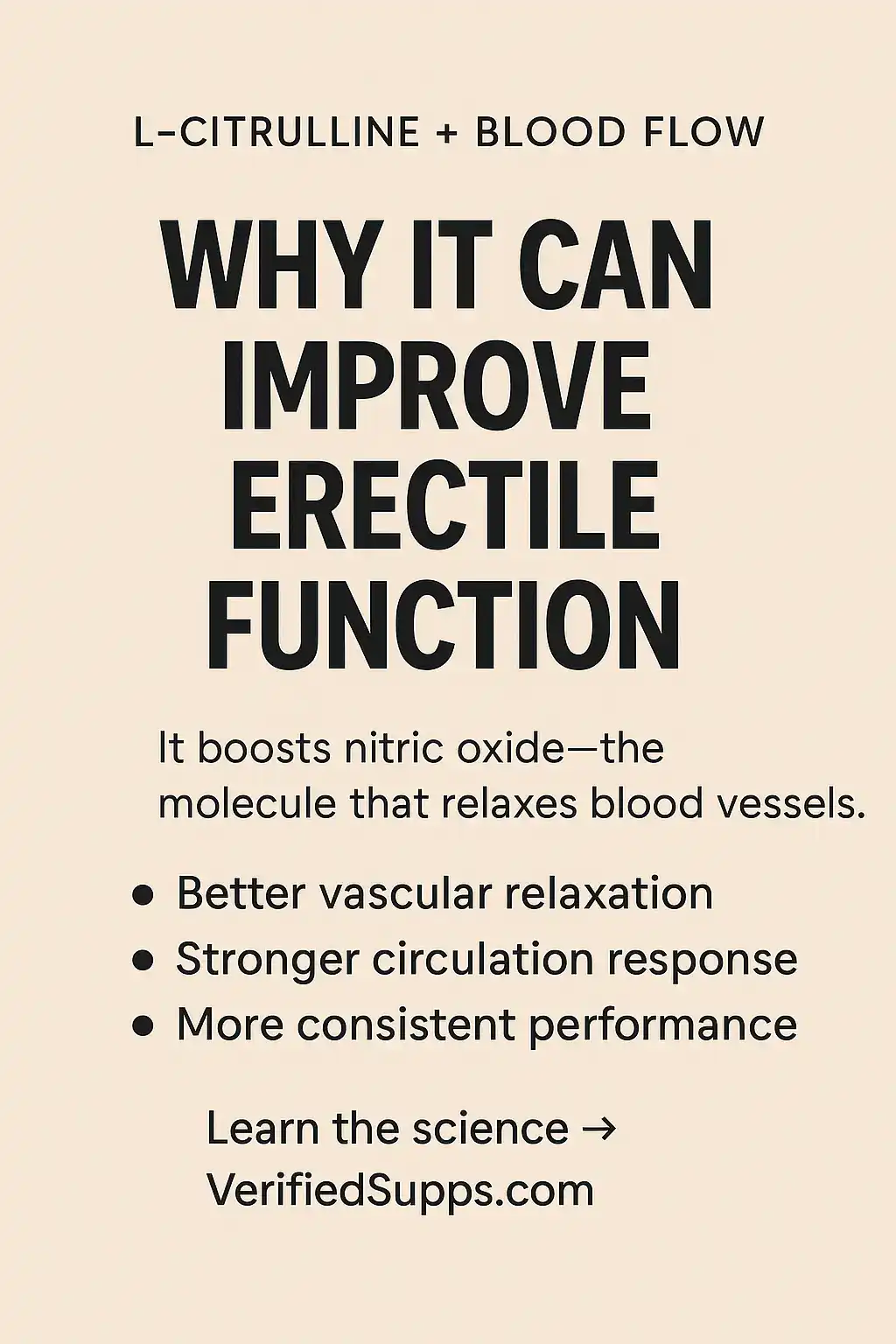
L-citrulline helps erections indirectly. It is converted into L-arginine, which supports nitric oxide production. Nitric oxide is one of the key signals that helps penile blood vessels and smooth muscle relax, making it easier for blood to enter erectile tissue when arousal is present.
- It is about plumbing, not desire: citrulline does not create libido.
- It supports the vascular side: better NO signaling can support vessel relaxation and blood entry.
- That is why it can help consistency more than “intensity.”
How much l-citrulline for ED?
A calm, realistic first trial is 3 g/day, then moving toward 6 g/day if tolerated. The mild-ED study used only 1.5 g/day, but blood-pressure and circulation studies often use 3–6 g/day or more, which is why that range is a practical real-world starting zone.
- Start low: 3 g/day is a clean comfort-first entry point.
- Usual practical ceiling for a self-test: 6 g/day before you decide it is “not working.”
- Use pure citrulline if possible: blends make the dose harder to interpret.
How long does l-citrulline take to work for erections?
A fair trial is usually 2–4 weeks of consistent use. That is a much better test than judging one single night, because ED outcomes swing with sleep, alcohol, stress, hydration, relationship dynamics, and general health.
- Fast conclusions are noisy: single-night testing tells you very little.
- Track trends: consistency, ease of response, and morning erection pattern matter more than “perfect” performance.
- Keep the setup stable: sleep, alcohol, and medication timing can easily overwhelm a small circulation effect.
Does l-citrulline raise blood pressure?
Usually no. Human data do not support the idea that L-citrulline raises blood pressure. The overall trend in supplementation studies is either neutral or modestly lower blood pressure, especially in longer or higher-dose protocols and in higher-risk groups.
- Meta-analysis signal: modest systolic blood pressure reduction overall, with diastolic reduction more visible in studies using 6 g/day or more.
- Important nuance: short-term studies in healthy older men have also shown no clear blood-pressure effect, so “neutral” is still common.
- Practical meaning: the real caution is not blood pressure going up. It is blood pressure going too low in the wrong medication or low-BP context.
Can you take l-citrulline with viagra or cialis?
This is a caution zone, not a casual stack. There is no blanket rule identical to the strict nitrate contraindication with PDE-5 drugs, but the blood-pressure and vasodilation overlap is real enough that combination questions deserve clinician guidance, especially if you already run low or get lightheaded.
- Hard stop: tadalafil and other PDE-5 drugs are contraindicated with organic nitrates because of the hypotension risk.
- Why the citrulline question still matters: L-citrulline can also influence vascular tone and blood pressure.
- Best practice: if you use prescription ED medication, ask your clinician before layering in higher-dose citrulline instead of assuming “natural” means interaction-free.
Why isn’t l-citrulline working for erections?
Most failed citrulline trials are not really citrulline failures. They are pattern failures, dosing failures, or “bigger problem” failures.
Common mistakes
- Expecting a Viagra-like effect from a circulation support supplement
- Taking it inconsistently and then judging it like a stable daily intervention
- Ignoring alcohol, sleep debt, or performance anxiety
- Assuming the problem is vascular when hormones, medications, or metabolic issues are more likely
- Using one good or bad night as the only “measurement”
Clean test protocol
| Inputs | Pure L-citrulline, same daily dose, lower alcohol, steadier sleep, and no other major supplement changes |
|---|---|
| Duration | 2–4 weeks |
| 3 metrics | Consistency of response, morning erection trend, and whether sleep or anxiety still dominates the outcome |
| Stop conditions | Lightheadedness, repeatable side effects, or no signal at all after a fair trial plus obvious evidence that a bigger driver is present |
How to tell it’s working
Working usually looks like slightly easier, more consistent response over time, not a dramatic “boost.” If you do not see a quiet improvement after a clean trial, that is useful information too—it suggests nitric-oxide support is not the main lever.
Red flags / seek care
Sudden or painful ED, penile deformity, neurologic symptoms, chest symptoms, fainting, or persistent ED that keeps recurring deserves medical evaluation, not supplement escalation.
Selected Professional References
External links only. These are rendered as premium clickable tabs so you can audit the claims quickly.
Oral L-Citrulline Supplementation Improves Erection Hardness in Men With Mild ED
Most important direct source for the ED question because it is the human trial people are usually referring to when they say citrulline may help mild ED.
Used for: “does l-citrulline help erectile dysfunction?”
The Role of Nitric Oxide in Erectile Dysfunction
Best source here for the basic erection physiology: erections depend on neurovascular signaling and nitric-oxide-mediated smooth-muscle relaxation.
Used for: “how does l-citrulline help erections?”
Effects of L-Citrulline Supplementation on Blood Pressure
Best blood-pressure source here because it directly addresses the “does l-citrulline raise blood pressure?” concern and finds the overall trend goes the other direction.
Used for: BP query and medication caution context
Tadalafil Label
Useful because it makes the nitrate contraindication explicit and explains the nitric oxide/cGMP hypotension overlap.
Used for: “can you take l-citrulline with Viagra or Cialis?” caution framing
Diagnosis of Erectile Dysfunction
Best official source here for the broader point that persistent ED deserves evaluation for vascular, hormonal, neurologic, medication, or psychological contributors.
Used for: why supplements are secondary when bigger drivers are present
Go Deeper (VerifiedSupps Guides)
These are the cleanest next reads if you want to zoom in on the specific part of the citrulline question that matters most.
L-Citrulline for Blood Pressure and Circulation
Best next read if the blood-pressure query is the real reason you landed here.
Citrulline Dosage Guide
Best next read if you want cleaner dose logic for circulation support versus performance use.
Citrulline vs Arginine
Best next read if you want the broader nitric-oxide supplement decision beyond the ED angle.
Is L-Citrulline Safe to Take Daily?
Best next read if your main question is long-term use, interactions, and who should be cautious.
Final Takeaway
L-citrulline is best understood as a blood-flow support tool, not a libido supplement and not a prescription-strength ED treatment. It may help some men with mild, circulation-linked ED. It does not appear to raise blood pressure in the way many people fear, but that same vascular effect is the reason low blood pressure, nitrates, PDE-5 drugs, and broader cardiovascular context should be taken seriously.
FAQ
Does l-citrulline work like Viagra?
No. L-citrulline is a circulation-support supplement, while PDE-5 medications are prescription therapies with a more direct acute effect.
What dose of l-citrulline is best for erections?
A practical first trial is often 3–6 g/day, judged over weeks rather than one-off tests.
How long does citrulline take to work for ED?
A fair trial is usually about 2–4 weeks of consistent use.
Does l-citrulline raise blood pressure?
No, the human evidence more often shows neutral or modestly lower blood pressure rather than raising it.
Can l-citrulline lower blood pressure too much?
It can matter if you already run low or use blood-pressure-lowering or vasodilating medications, which is why medication overlap deserves caution.
Is it safe to take citrulline with Cialis or Viagra?
This is a caution zone. If you use prescription ED medication, ask your clinician before layering in higher-dose citrulline.
Is l-citrulline better than l-arginine for erections?
For most oral supplement use, citrulline is usually the better bet because it supports usable arginine availability more reliably.
Can l-citrulline increase libido?
Not directly. L-citrulline mainly supports circulation, while libido is more strongly influenced by hormones, stress, sleep, and relationship factors.
When should you see a doctor for ED?
If ED is persistent, worsening, sudden, painful, or paired with broader health changes, it deserves medical evaluation.
VerifiedSupps Medical Disclaimer
This content is for informational and educational purposes only and does not constitute medical advice. Erectile difficulties can have vascular, hormonal, neurologic, psychological, medication-related, or metabolic causes. Always consult a qualified healthcare professional before starting supplements, especially if you have a cardiovascular condition or take prescription medications including blood pressure medicines, nitrates, or PDE-5 inhibitors. If symptoms are sudden, worsening, painful, or persistent, seek medical evaluation.