By VerifiedSupps Editorial Team
L-Citrulline Benefits: The Calm, No-Fluff Explanation That Actually Makes Sense
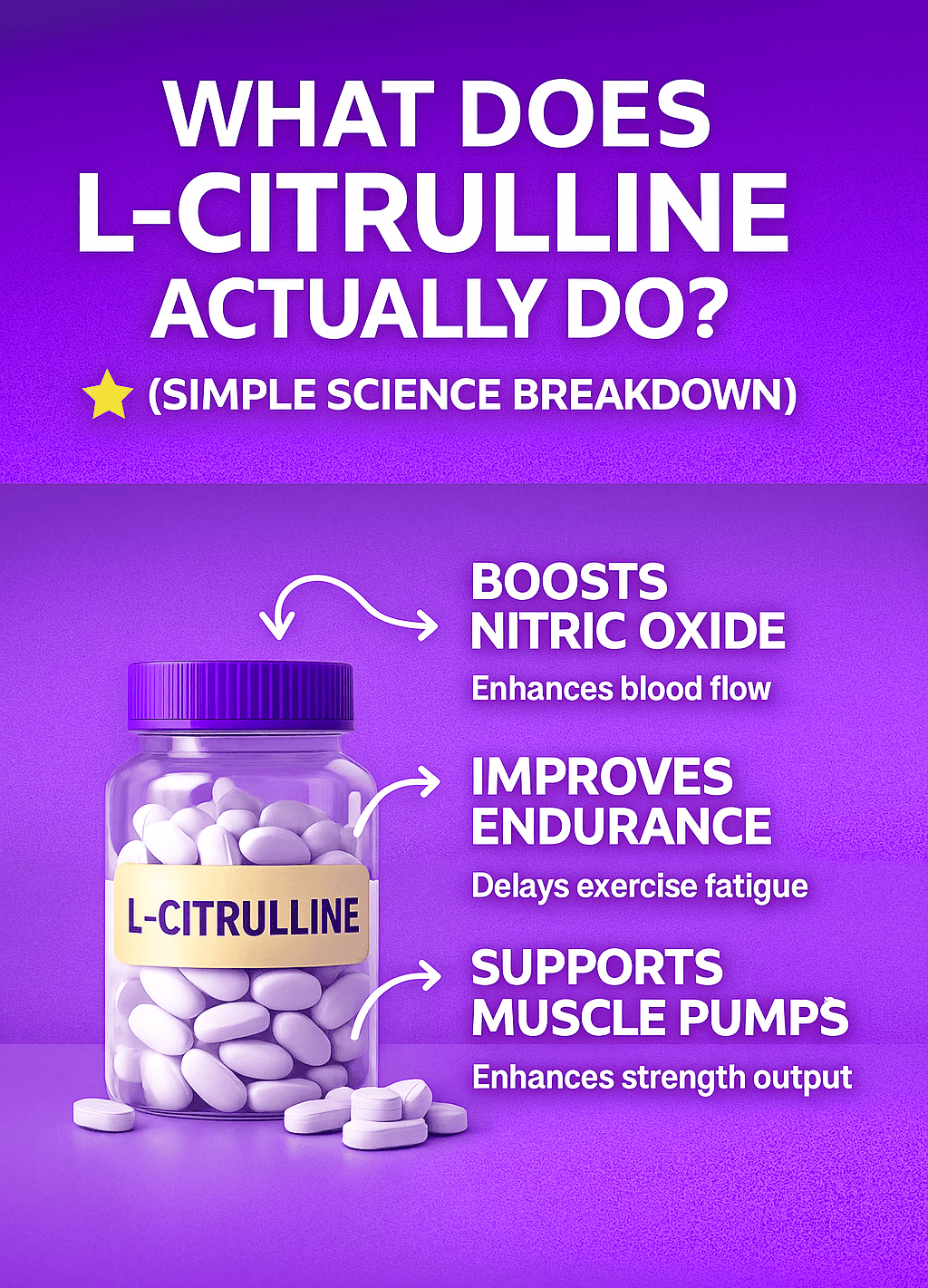
L-citrulline helps performance mainly by increasing arginine availability, which supports nitric oxide production and better blood flow. In real life, that usually shows up as fuller pumps, smoother endurance, and less early burn during hard sets when the dose is high enough to matter.
This is not a stimulant effect and it is not magic. Citrulline works best when the basics are already in place: enough dose, enough hydration, enough sodium, and a training style that actually creates a pump signal.
This page is focused on L-citrulline benefits for pumps, blood flow, endurance, dosage, and troubleshooting, not the broader full citrulline cluster.
Key terms: L-citrulline, nitric oxide, arginine, pumps, endurance, citrulline malate, pre-workout dose, blood flow
Quick Take
The core benefit is better blood-flow support through the nitric oxide pathway. The most common reason people think citrulline does not work is simple underdosing. For performance, pure L-citrulline at 6 to 8 grams pre-workout is the most practical baseline.
TL;DR decision
If you want better pumps, smoother high-rep output, and less early fatigue, L-citrulline is worth using — but only if the dose is real and the session setup is not working against it.
Evidence standard: human trials, dose ranges, guideline-level sources when available
Who this is for: people training for pumps, better session quality, smoother endurance, or blood-flow support
Who this is not for: anyone expecting a stimulant hit, or anyone using nitrates, PDE5 inhibitors, or blood pressure medication without checking compatibility first
Author: VerifiedSupps Editorial Team
Reviewed by: VerifiedSupps Editorial Team
Published: 2026-03-12
Updated: 2026-03-12
Last reviewed: 2026-03-12
Parent Hub
L-Citrulline
Use the main hub if you want the full citrulline cluster in one place: benefits, dosing, timing, comparisons, and safety. This page stays focused on benefits and real-world performance use.
L-citrulline dose + goal decoder
This is the fastest way to avoid the most common citrulline mistake: taking too little and assuming the ingredient is weak.
| Goal | Best practical form | Typical range | Timing |
|---|---|---|---|
| Pumps + workout performance | Pure L-citrulline | 6–8 g | 30–60 min pre-workout |
| Pre-workout label convenience | Citrulline malate | Usually around 8 g total, but check actual ratio | 30–60 min pre-workout |
| Daily circulation support | Pure L-citrulline | Around 3 g daily | Any consistent time |
Best next step (today): If your goal is pumps and session performance, stop judging citrulline off 1 to 2 grams or underdosed blends.
What does L-citrulline actually do?
L-citrulline mainly increases arginine availability in the body, which supports nitric oxide production. That matters because nitric oxide helps blood vessels relax, which can improve circulation and the delivery side of performance.
Mechanism
- It works upstream by helping raise arginine levels more reliably than arginine supplements do for many people.
- That supports nitric oxide, which influences vessel relaxation and blood flow.
- In training, the visible sign is often better pumps, but the deeper point is improved delivery under effort.
How does L-citrulline increase nitric oxide?
Citrulline is converted into arginine, and arginine is the direct input used to produce nitric oxide. That is why citrulline is often treated as the cleaner way to support the nitric oxide pathway.
Plain-English version
Instead of forcing more arginine straight into a system that breaks a lot of it down, citrulline often works better as the upstream input.
Does L-citrulline really help with pumps?
For many people, yes — when the dose is real and the workout setup gives the ingredient a chance to show itself. Pumps are basically a blood-flow-plus-demand signal, so citrulline tends to shine most in higher-volume training rather than low-volume singles.
What it can look like
Pumps show up earlier, feel fuller, and hang around longer during a hard session.
What it does not replace
Hydration, sodium, carbs, and enough training volume still matter a lot.
Does L-citrulline improve endurance and reduce fatigue?
It can, especially in the kind of training limited by repeated effort, local fatigue, and circulation rather than by one max-strength attempt. The real-world effect is often less early burn and better session smoothness.
What that usually feels like
Your later sets feel less like a cliff, and your workout feels more stable rather than more “amped.”
What is the best L-citrulline dose for pumps and performance?
The most practical performance range is 6 to 8 grams of pure L-citrulline taken 30 to 60 minutes before training. That is the range where most people stop guessing and start getting a fair test.
Best form
Pure L-citrulline if you want the cleanest dose math
Timing
30–60 minutes before training
Daily support
Around 3 g can make sense for non-performance circulation use
Biggest dosing mistake
Trusting a pre-workout label without checking actual grams
L-citrulline vs citrulline malate: which is better?
If your goal is simple nitric oxide and pump support, pure L-citrulline is usually the cleaner choice because dose math is easier. Citrulline malate can still work well, but only if you know the ratio and the actual amount of citrulline you are getting.
Why is L-citrulline not working? Common mistakes
When citrulline feels useless, it is usually a problem of dose, context, or expectations. Most failed citrulline tests are not true ingredient failures. They are setup failures.
Common mistakes
- Using 1 to 2 grams and expecting a strong pre-workout effect.
- Going into the session flat on water, sodium, or carbs.
- Using a training style that does not really create a pump signal.
- Taking an unclear blend and never knowing how much citrulline you actually used.
Clean test protocol
| Inputs | Use a clear measured dose, hydrate normally, include sodium, and do not test it on a flat low-carb low-hydration day. |
|---|---|
| Duration | Two to three pump-friendly workouts is enough for a fair first read. |
| 3 metrics | 1) pump fullness, 2) how early fatigue shows up, 3) how later sets feel compared with baseline. |
| Stop conditions | Stop or get guidance if you feel dizziness, blood-pressure-related symptoms, or you realize medication compatibility is not clear. |
How to tell it’s working
The cleanest signs are fuller pumps, less early burnout, and smoother later sets. You are looking for better session quality, not a dramatic stimulant feeling.
Red flags / seek care
Use clinician guidance before supplementing if you take nitrates, PDE5 inhibitors, or blood pressure medication, or if blood pressure symptoms are already part of your picture.
Selected Professional References
External links only. These are useful starting points for citrulline bioavailability, performance research, blood-pressure context, and mechanism background.
L-citrulline and arginine bioavailability
Useful for understanding why citrulline is often preferred over arginine for nitric oxide support.
Used for: mechanism + arginine logic
Citrulline malate and exercise performance
Helpful for the performance and endurance side of the discussion.
Used for: pumps + endurance context
L-citrulline and blood pressure reviews
Helpful for medication-compatibility and blood-pressure caution framing.
Used for: safety context
Mechanism and clinical-summary background
Useful for mechanism review and broader clinical framing around nitric oxide support.
Used for: mechanism background
Go Deeper (VerifiedSupps Guides)
If you want the next step after benefits, these are the four most useful follow-up guides.
Citrulline dosage guide
Use this if you want exact ranges by goal instead of broad dosing rules.
Citrulline vs arginine
Use this if you want the cleaner explanation for why citrulline often wins upstream.
Malate vs pure citrulline
Use this if you want label-math clarity and a cleaner product-choice decision.
The best pump stack
Use this if you want to build a full pump-focused setup around citrulline.
Final Takeaway
L-citrulline is a fundamentals supplement, not a flashy one. When you dose it correctly, session quality often improves in a calm, obvious way: better pumps, smoother endurance, and less early burn. When it feels like it failed, the usual problem is not the ingredient. It is the setup.
FAQ
How long does L-citrulline take to work?
For workout use, many people take it 30 to 60 minutes before training. Some notice it the first properly dosed session.
Is 3 grams of L-citrulline enough?
Often not for maximal workout pumps. Around 3 g is more common for daily support than for strong pre-workout performance use.
Can L-citrulline lower blood pressure?
It may support blood pressure in some contexts because it influences nitric oxide and vascular tone, which is why medication compatibility matters.
Is citrulline malate better than pure citrulline?
Not automatically. Pure citrulline is simpler to dose, while malate can work well if the ratio and actual citrulline amount are clear.
Can I take L-citrulline every day?
Many people do, but daily use still needs to fit your medication and medical context.
Does L-citrulline cause stomach issues?
Usually it is tolerated well, but some people get mild stomach discomfort at higher doses, especially without enough water.
Why do I get no pump even with citrulline?
Dose, hydration, sodium, carbs, timing, and training style all influence pumps. Citrulline helps the pathway, but it does not replace the basics.
Can I combine citrulline with creatine or caffeine?
Often yes. Citrulline supports blood flow, creatine supports repeatability, and caffeine supports alertness. If you are sensitive, change one variable at a time.
VerifiedSupps Medical Disclaimer
This content is for educational purposes only and is not medical advice. L-citrulline may be useful for blood-flow and performance support, but it is not a substitute for diagnosis, treatment, or medication management. Talk with a qualified clinician before using supplements if you have significant medical conditions, are pregnant or nursing, or take prescription medications, especially nitrates, PDE5 inhibitors, or blood pressure drugs.