Best Creatine for Beginners: What to Buy (and What to Ignore)
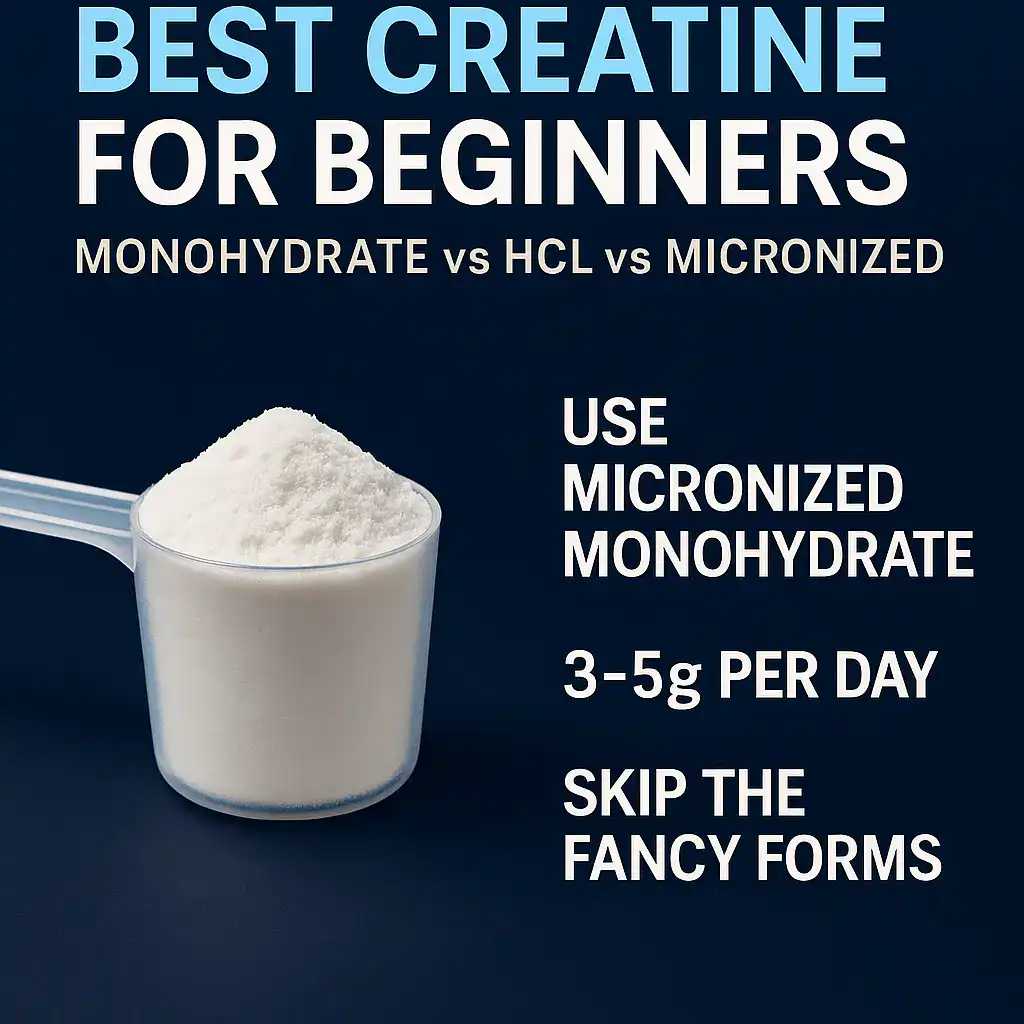
If you’re a beginner, the best choice is almost always micronized creatine monohydrate, taken daily at 3–5 g. It’s the form with the deepest research base, the best cost-to-results ratio, and the simplest “set it and forget it” routine.
Evidence standard: we prioritize major position stands, systematic reviews/meta-analyses, and high-quality human research when available.
Quick Take: Beginners usually win by keeping it boring.
- Buy: micronized creatine monohydrate
- Dose: 3–5 g daily (no loading required)
- Timing: whenever you’ll be consistent
- Expect: subtle improvements first, then clearer performance benefits as muscles saturate
Parent Hub: Creatine Monohydrate
The full guide: what creatine does, how to dose it, how to time it, and what outcomes are realistic.
Open the creatine hub →
What is the best creatine for beginners?
For most beginners, the best creatine is micronized creatine monohydrate. It’s the form used in the bulk of the research showing improved strength and high-intensity performance, and it’s typically the easiest to tolerate when you start with a conservative dose.
Constraint: other forms can work, but the question for beginners is “what’s most reliable, affordable, and simplest?” Monohydrate usually wins that tradeoff.
Beginner Creatine Buyer Checklist (copy/paste simple)
If you want “no surprises” creatine, use this checklist and ignore the rest of the marketing.
- Form: creatine monohydrate (micronized if you want smoother mixing).
- Label clarity: single-ingredient product (no proprietary blend hiding the dose).
- Quality signal: third-party testing claims (e.g., NSF/Informed Sport) or a clear purity standard.
- Dose convenience: easy to measure 3–5 g daily (scoop or scale).
| Form | Best for | Pros | Cons |
|---|---|---|---|
| Monohydrate | Nearly everyone | Most researched, cheapest, reliably effective | Can feel gritty unless micronized |
| Micronized monohydrate | Beginners, sensitive stomachs | Mixes easier, often “smoother” to take | Slightly higher cost (still usually inexpensive) |
| HCL | People prioritizing dissolvability | Dissolves very easily; smaller scoops | Often pricier; not clearly superior for outcomes |
| Buffered / ester / “liquid” / blends | Rarely necessary | Marketing variety | More confusion, less transparency, no consistent advantage |
A simple rule: if the label makes it hard to know what you’re taking and how much, it’s not beginner-friendly.
Is creatine monohydrate better than creatine HCL?
For performance outcomes, creatine monohydrate is the safer default because it has the strongest body of evidence and long-term safety data. Creatine HCL may dissolve more easily, but it’s not consistently shown to outperform monohydrate for strength or muscle-building outcomes.
Constraint: if you genuinely cannot tolerate monohydrate (even when micronized, split, and taken with food), HCL can be a practical fallback—just don’t expect “magic” results from the form alone.
- Most beginners: start with micronized monohydrate.
- If GI issues persist: reduce dose, split doses, and change timing before changing form.
- If you still can’t tolerate it: consider HCL for dissolvability and smaller dosing volumes.
What does micronized creatine mean and does it matter?
“Micronized” usually means the creatine particles are smaller, which often helps it mix better and feel less gritty. The core science is the same because it’s still monohydrate, but the user experience can be smoother—especially for beginners.
Constraint: micronized doesn’t automatically mean higher quality, but it can reduce the “I hate drinking this” barrier that makes beginners quit.
- If you’re sensitive: micronized monohydrate + split dosing is the simplest tolerance upgrade.
- If you don’t care: standard monohydrate is fine if you mix and drink it consistently.
How much creatine should beginners take per day?
A simple beginner dose is 3–5 grams per day. You don’t need a loading phase to get results—you just need consistency long enough to saturate muscle creatine stores.
Constraint: loading can saturate faster, but it increases the chance of stomach upset and rapid water-weight changes. If your goal is “easy and predictable,” skip loading.
Beginner routine (lowest side-effect approach):
- Start at 3 g/day for 7–10 days.
- If tolerated, move to 5 g/day (or stay at 3 g if that’s easiest).
- If GI upset happens, split the dose (morning + evening) or take with food.
How long does creatine take to work for beginners?
Most beginners notice clearer performance benefits after 2–4 weeks of daily use, because creatine works through saturation rather than an immediate stimulant effect.
Constraint: your training style changes what you “feel.” Creatine tends to show up most in repeated high-intensity efforts (sets, sprints, short bursts), not in low-effort workouts.
- Early signs: one or two extra reps, slightly better sprint repeatability, less performance drop-off across sets.
- Later signs: steady strength increases (assuming training and calories support progress).
- If nothing changes: check consistency, dose, and training intensity (see troubleshooting section below).
What side effects should beginners expect from creatine?
The most common real effects are mild water-weight changes and occasional stomach upset—usually from large single doses or poor mixing. Many feared side effects (like dehydration or kidney damage in healthy users) are often overstated or misunderstood.
Constraint: individual response varies. The “best” side-effect strategy is reducing the causes you control: dose, mixing, and timing.
Side-effect minimizers that actually work:
- Skip loading and use 3–5 g/day.
- Take with food if your stomach is sensitive.
- Split doses if 5 g at once bothers you.
- Hydrate normally and match fluids/sodium to sweat rate.
Why isn’t creatine working for me?
When creatine “does nothing,” the cause is usually inconsistent dosing, under-dosing, or training that doesn’t demand repeated high-intensity effort. Creatine isn’t a feeling—it’s a capacity increase.
Run this checklist in order (it catches most issues fast):
- Consistency: did you actually take it daily for at least 2–4 weeks?
- Dose: are you in the 3–5 g/day range (not 1–2 g “sometimes”)?
- Training signal: are you pushing sets close enough to fatigue that extra reps matter?
- Expectation mismatch: creatine won’t feel like caffeine; look for performance changes, not a buzz.
- Diet context: if calories/protein are too low, progress can stall even with creatine.
- GI issues causing missed doses: switch to micronized monohydrate, split dosing, or take with food.
Most beginner fix: take 5 g/day consistently and track performance on the same lifts for 4 weeks. Creatine shows up in trends, not in a single workout.
What creatine forms should beginners avoid?
Beginners are usually best served by avoiding forms that add cost or confusion without clear performance benefits. If you can’t easily verify the dose and purity, it’s not beginner-friendly.
Constraint: not every alternative form is “bad,” but many are unnecessary for first-time users.
- “Liquid creatine” and vague liquid blends
- Proprietary blends that don’t show the creatine dose clearly
- Forms marketed primarily as “advanced” without transparent evidence and dosing
If your goal is reliable results, “simple and measurable” beats “futuristic and expensive.”
Selected Professional References
External links only. These sources cover safety, common misconceptions, and practical dosing.
- International Society of Sports Nutrition position stand: safety and efficacy of creatine supplementation (PMC) — comprehensive overview of benefits, dosing, and safety.
- Common questions and misconceptions about creatine supplementation (PMC) — kidneys, dehydration/cramps, hair-loss claim, and more.
- Effect of creatine supplementation on kidney function: systematic review and meta-analysis (PMC) — creatinine changes vs filtration outcomes.
- Three weeks of creatine monohydrate supplementation and androgen changes in male rugby players (PubMed) — the study often cited in hair-loss discussions (hair loss not measured).
- Creatine supplementation safety discussion and kidney-marker interpretation (PMC) — helpful context on creatinine vs kidney dysfunction.
Go Deeper (VerifiedSupps Guides)
If you want the cleanest next step, these cover the biggest beginner questions.
Creatine and Kidney Safety
What labs mean, what “creatinine” is, and who should be cautious.
Creatine Side Effects
What’s real, what’s myth, and how to prevent the common issues.
Creatine and Hair Loss
Where the rumor came from and what the evidence actually shows.
Creatine Timing
Before vs after workout, and what matters more than timing.
Final Takeaway
If you’re new to creatine, you don’t need exotic forms or complicated dosing. You need a form that’s proven, a dose you can repeat daily, and expectations that match how creatine actually works.
The simplest high-probability plan is micronized creatine monohydrate at 3–5 g/day, taken consistently for at least a few weeks.
Keep it boring, keep it consistent, and judge results by performance trends—not by a single day’s “feel.”
Frequently Asked Questions
Should beginners do a creatine loading phase?
Loading can saturate faster, but it also increases the chance of GI upset and rapid water-weight changes. If your goal is “easy and predictable,” skip loading and use 3–5 g/day consistently.
Is creatine HCL better for stomach issues?
Some people find HCL easier to dissolve and tolerate, but many can tolerate monohydrate by switching to micronized, splitting doses, taking it with food, and dissolving it fully. Try those steps before changing forms.
Is 3 grams of creatine enough?
For many beginners, 3 g/day works, especially if taken consistently. If you want a simpler “one number,” 5 g/day is a common maintenance dose used in research and practice.
What’s the best time of day to take creatine?
Timing matters far less than consistency. Take it at a time you’ll remember every day. If it upsets your stomach, take it with a meal or split the dose.
Will creatine make me gain fat?
Creatine doesn’t cause fat gain directly. Early scale changes are usually water shifts. Over time, some people gain lean mass more easily because they train better.
Does creatine cause hair loss?
There’s no direct evidence that creatine causes hair loss. The concern largely traces back to a small study showing androgen changes without measuring hair outcomes. If you’re concerned, skip loading and track changes objectively rather than guessing day to day.
Can creatine affect kidney blood test results?
Yes. Creatine can increase serum creatinine, which can confuse interpretation of kidney labs. That doesn’t automatically mean kidney damage, but you should tell your clinician you supplement so results are interpreted in context.
Is creatine safe for beginners who are teens or older adults?
Creatine is studied across many populations, including older adults and athletic youth contexts, but individual risk depends on health status and supervision. If you’re under 18, pregnant, breastfeeding, or have medical conditions, get clinician guidance before starting.