By VerifiedSupps Editorial Team
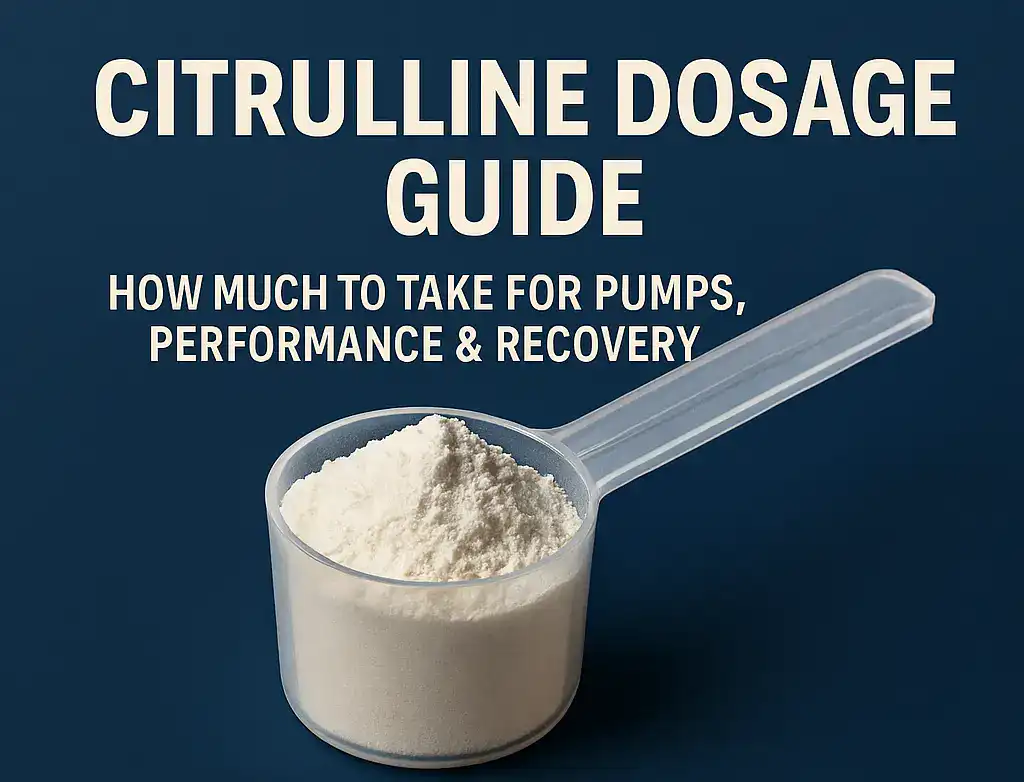
L-Citrulline Dosage: How Much to Take So It Works
For most people who want a real training effect, 6 to 8 grams of pure L-citrulline taken 30 to 60 minutes before training is the most reliable range. For daily circulation-style support, around 3 grams per day is the simpler baseline.
If you felt nothing from citrulline, the usual reason is not that the ingredient is weak. It is usually because the dose was too low, the label math was misleading, or hydration and sodium were the limiting factors.
This page is focused on dose decisions you can actually use: pump dosing, daily dosing, citrulline malate math, timing, and the fastest way to troubleshoot a flat result.
Key terms: L-citrulline dosage, citrulline malate dose, pre-workout pumps, nitric oxide, endurance, timing, daily support
Quick Take
For pumps and performance, most people should think in terms of 6 to 8 grams of pure L-citrulline pre-workout. For daily use, 3 grams is a clean baseline. The biggest mistake is confusing “grams of citrulline malate” with “grams of actual citrulline.”
TL;DR decision
If your goal is pumps and session performance, stop hoping a tiny dose will somehow work. Use a real pre-workout amount, get the timing right, and judge it in a workout that can actually show the effect.
Evidence standard: human trials, dose ranges, guideline-level sources when available
Who this is for: people training for pumps, higher-rep endurance, better session quality, or simple daily blood-flow support
Who this is not for: anyone expecting a stimulant hit, or anyone using nitrates, PDE5 inhibitors, or blood pressure medication without checking compatibility first
Author: VerifiedSupps Editorial Team
Reviewed by: VerifiedSupps Editorial Team
Published: 2026-03-12
Updated: 2026-03-12
Last reviewed: 2026-03-12
Parent Hub
L-Citrulline core guide
Use the hub for benefits, timing, safety, comparisons, and the broader nitric-oxide picture. This page stays tightly focused on the dose decision itself.
Citrulline dose calculator: the part most people get wrong
The number that matters most is how many grams of actual citrulline you are really getting.
| Goal | Pure L-citrulline | Citrulline malate (2:1) | What you usually notice |
|---|---|---|---|
| Pumps / blood flow | 6–8 g pre-workout | Around 8 g total gives about 5.3 g citrulline | Earlier pumps, fuller working sets, better vascular feel |
| Endurance / long sessions | 6–8 g pre-workout | Usually around 8 g total | Less fade, smoother late-session output |
| Daily circulation support | 3 g daily | Usually not necessary | Subtle baseline support, not a dramatic gym effect |
Best next step (today): If your product says “citrulline malate,” do the ratio math before deciding whether the dose is strong or weak.
How much L-citrulline should I take for a pump?
For most people, the real pump range is 6 to 8 grams of pure L-citrulline taken 30 to 60 minutes before training. Lower doses can still do something, but that range is where a lot of people stop guessing and start getting a reliable signal.
Mechanism
- More arginine availability supports nitric oxide production.
- That can improve vessel relaxation and blood-flow support during training.
- The visible result is often earlier, fuller pumps when the rest of the setup is solid.
How much citrulline malate should I take?
A common pre-workout amount is around 8 grams of citrulline malate when the ratio is 2:1. The catch is that 8 grams of malate is not 8 grams of actual citrulline, which is exactly why people get misled by labels.
Practical rule
If you want the least confusion, use pure L-citrulline. If you use malate, make sure the total grams still give you enough actual citrulline to matter.
When should I take L-citrulline?
Most people do best with citrulline 30 to 60 minutes before training. Fasted training often feels better closer to 30 to 45 minutes, while fed training often feels cleaner closer to 45 to 60 minutes.
Fasted training
Usually around 30–45 minutes before the session
Fed training
Usually around 45–60 minutes before the session
Can you take L-citrulline every day?
Yes, many healthy adults do. For daily support rather than obvious gym effects, around 3 grams per day is a clean baseline. Daily use is more of a “background support” move than a “feel it instantly” move.
Daily vs pre-workout
Daily use is the lower-friction baseline. Pre-workout dosing is the version people usually notice more clearly during training.
Why does citrulline feel like it doesn’t work?
The supplement is usually not the real problem. The setup is. The fastest way to ruin a citrulline test is to underdose it, use unclear label math, or take it into a low-hydration, low-sodium, low-volume session and expect a huge pump.
Common mistakes
- Using underdosed blends that only contain 1 to 3 grams total.
- Assuming grams of malate equal grams of actual citrulline.
- Going into training low on fluids or sodium.
- Testing it in low-volume strength work where pump effects are harder to notice.
Clean test protocol
| Inputs | Use pure L-citrulline or a clearly labeled 2:1 malate product, hydrate normally, include sodium, and do not test it on a flat depleted day. |
|---|---|
| Duration | One to three higher-volume workouts is usually enough for a fair first read. |
| 3 metrics | 1) pump fullness, 2) early-set fatigue, 3) how late-session sets feel compared with baseline. |
| Stop conditions | Stop or get guidance if you feel dizziness, low-blood-pressure symptoms, or realize your medication situation makes nitric-oxide support something you should review first. |
How to tell it’s working
The cleanest signal is not “I feel hyped.” It is better pumps, steadier working sets, and less fade later in the session.
Red flags / seek care
Use clinician guidance before supplementing if you take blood pressure medications, nitrates, PDE5 inhibitors, or have blood-pressure-related symptoms already in play.
Selected Professional References
External sources to verify dosing, arginine changes, malate performance research, and nitric-oxide pathway reviews.
L-citrulline dosing in exercise trials
Useful for checking where the common 6 to 8 gram performance range comes from.
Used for: dose realism
Plasma arginine changes with citrulline
Useful for understanding why citrulline is treated as the upstream nitric-oxide support input.
Used for: mechanism + arginine logic
Citrulline malate and performance
Useful for comparing malate use with pure citrulline in real workout contexts.
Used for: malate performance context
Reviews on citrulline and nitric-oxide pathways
Useful for the broader nitric-oxide mechanism and circulation-support background.
Used for: pathway background
Go Deeper (VerifiedSupps Guides)
If you want the clean next step after dose, these are the four most useful follow-ups.
Best time to take L-citrulline
Use this if timing is your real question and you want the cleanest pre-workout window.
Citrulline malate vs pure citrulline
Use this if product choice and ratio math are the confusing part.
Citrulline vs arginine
Use this if you want the clearer nitric-oxide comparison and why citrulline often wins.
The best pump stack
Use this if you want to build a real pump-focused setup around citrulline without underdosing anything.
Final Takeaway
If you want citrulline to actually work, dosing is the whole story. For pumps and performance, 6 to 8 grams of pure L-citrulline pre-workout is the range most people finally notice. For daily support, 3 grams is the simpler baseline. Everything else is just label math and setup quality.
FAQ
How much L-citrulline should I take pre-workout?
A common effective range is 6 to 8 grams taken 30 to 60 minutes before training.
Is 3 grams of citrulline enough?
Often yes for daily support, but many people will not notice a strong pump effect until they use more for pre-workout dosing.
How much citrulline malate equals 6 grams of citrulline?
If the malate is 2:1, you need more than 6 grams total because not all of that weight is actual citrulline.
Can I take citrulline every day?
Many healthy adults do, especially at around 3 grams daily for a background-support approach.
What is the max dose of citrulline?
Some people tolerate higher amounts, but more is not automatically better. Good setup usually matters more than mega-dosing.
Why did citrulline upset my stomach?
It is often dose-related. Splitting the dose, using enough water, and avoiding sloppy mixing usually helps.
Should I take citrulline on rest days?
Optional. It makes more sense if you are using it for daily circulation-style support rather than just gym performance.
Why did 1 scoop of my pre-workout feel weak?
Because many formulas simply do not contain enough actual citrulline to reach the range where pumps become obvious.
VerifiedSupps Medical Disclaimer
This content is for educational purposes only and does not constitute medical advice. L-citrulline can interact with medication and may not be appropriate for certain health conditions. Talk with a qualified healthcare professional before using supplements if you have cardiovascular disease, low blood pressure, take blood pressure medications, nitrates, PDE5 inhibitors, or other prescription medications, or if you are pregnant or breastfeeding.