By VerifiedSupps Editorial Team
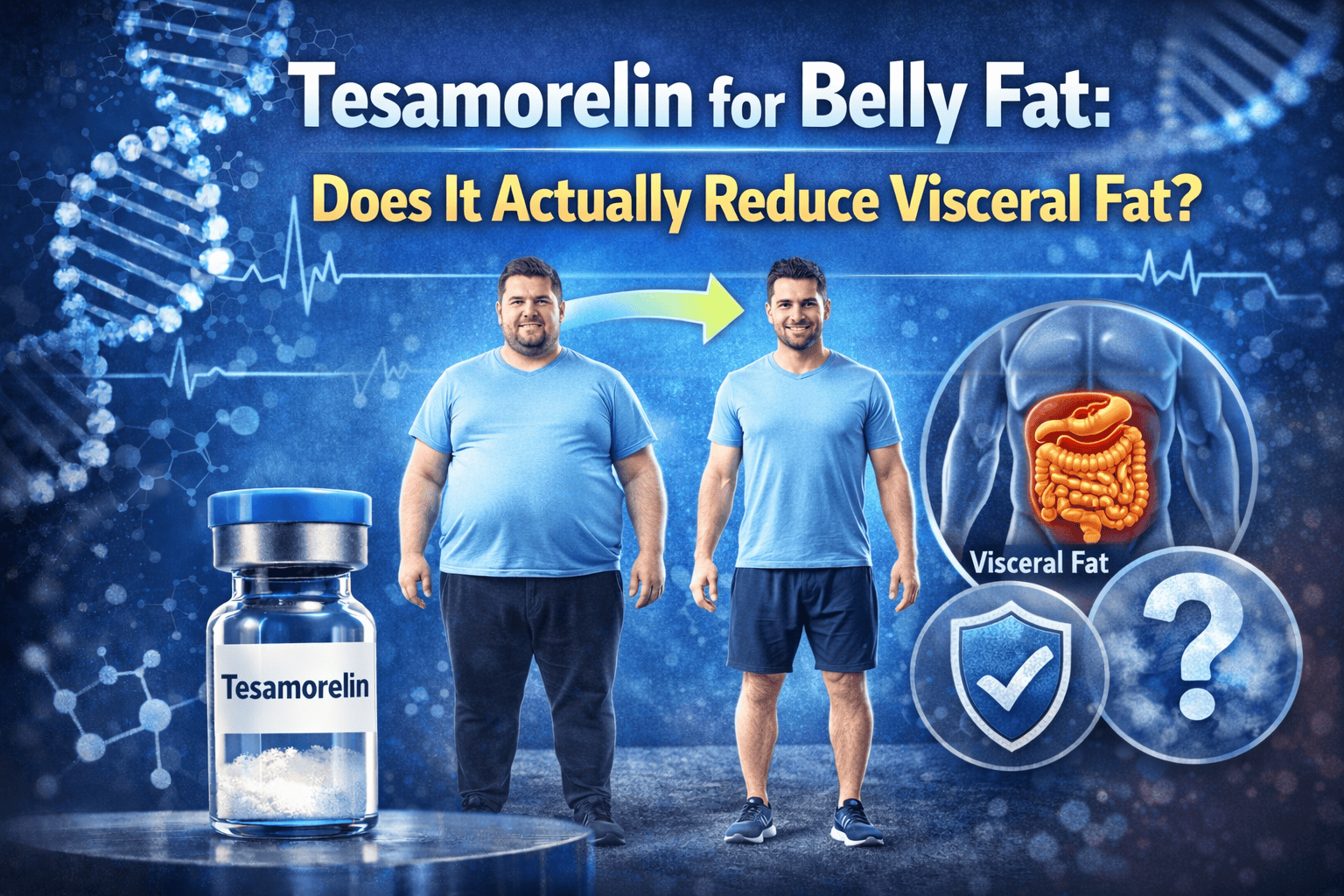
Tesamorelin for Belly Fat: Does It Actually Reduce Visceral Fat?
Yes, tesamorelin can reduce visceral abdominal fat in the right patients. But that answer is narrower than most people expect. The best-established use is not general obesity or cosmetic lower-belly fat. It is excess abdominal fat in adults with HIV-associated lipodystrophy.
That distinction changes almost everything. Tesamorelin does appear to selectively reduce visceral fat, but it is not a general weight-loss drug, it is not meant for ordinary pinchable subcutaneous belly fat, and the official label still says long-term cardiovascular safety has not been established.
This page is for the real tesamorelin question: whether it actually reduces visceral fat, how much it can reduce, what that means for “belly fat,” and where the evidence stops being strong.
Key terms: tesamorelin, EGRIFTA WR, visceral adipose tissue, visceral abdominal fat, HIV lipodystrophy, belly fat, subcutaneous fat, IGF-1
Quick Take
Tesamorelin is one of the better-supported peptides for reducing visceral belly fat, but only in a very specific lane. If your problem is HIV-associated visceral abdominal fat, the evidence is real. If your problem is general weight loss or ordinary subcutaneous belly fat, the fit gets much weaker.
TL;DR decision
Tesamorelin does appear to reduce visceral fat. But the clean, evidence-based answer is: it is a selective visceral-fat treatment for adults with HIV and lipodystrophy, not a broad belly-fat or scale-weight solution for everyone.
Evidence standard: human trials, dose ranges, guideline-level sources when available
Who this is for: people asking whether tesamorelin really helps with deep abdominal fat, especially visceral fat related to HIV-associated lipodystrophy
Who this is not for: anyone looking for a casual cosmetic fat-loss shortcut, a general obesity drug recommendation, or gray-market peptide advice
Reviewed by: VerifiedSupps Editorial Team
Last reviewed: April 16, 2026
Parent Hub
VerifiedSupps Articles
Use the broader article hub if you want a calmer, more grounded view of body-composition tools before assuming every peptide is a general fat-loss solution.
Quick decision table: is tesamorelin actually the right kind of “belly fat” tool?
This is the fastest way to avoid the wrong expectation before you even get into dose or side effects.
| If your real problem is… | Tesamorelin fit | Why | Best framing |
|---|---|---|---|
| Deep visceral abdominal fat in an adult with HIV and lipodystrophy | Strongest fit | This is the official indication and the best-supported clinical lane | Think targeted visceral-fat treatment, not generic fat loss |
| General obesity and scale-weight loss | Weak fit | The label explicitly says it is not indicated for weight-loss management and has a weight-neutral effect | Wrong main expectation |
| Pinchable lower-abdomen subcutaneous fat | Poor fit | Tesamorelin seems much more selective for visceral fat than for ordinary subcutaneous fat | Likely the wrong tool |
| A permanent fix after a short course | Unrealistic | Extension data show visceral fat tends to come back after stopping | Maintenance question, not one-and-done fix |
Best next step (today): First decide whether you mean true visceral fat or just “belly fat” in general. That single distinction answers most of the tesamorelin question.
Does tesamorelin actually reduce visceral fat?
Yes. In the right population, that part is real. Tesamorelin is not just hype when the target is visceral abdominal fat in adults with HIV-associated lipodystrophy.
Across the best-established clinical data, tesamorelin reduces visceral adipose tissue while doing much less to regular subcutaneous abdominal fat. That is why it deserves a more specific reputation than the internet usually gives it. It is not a generic “burn belly fat” peptide. It is a more targeted visceral-fat drug with a narrower and more medically defined use case.
Mechanism
- Tesamorelin is a growth hormone–releasing factor analog that stimulates the pituitary to release more endogenous growth hormone.
- That raises IGF-1 downstream, which is one reason the drug requires monitoring and is not a casual self-experiment.
- In studied populations, the resulting body-composition effect appears more selective for visceral fat than for ordinary subcutaneous belly fat.
What would change my recommendation: if the goal is general obesity or cosmetic belly fat rather than visceral adiposity in the right medical context, tesamorelin drops much lower on the list.
How much visceral fat can tesamorelin reduce?
A fair summary is that tesamorelin produces a meaningful visceral-fat reduction, but not a dramatic scale-weight transformation. In the pivotal HIV lipodystrophy trials, the usual headline is roughly 14% to 18% visceral fat reduction over 26 weeks, with longer-term data suggesting around 18% at 52 weeks if treatment continues.
At 26 weeks
The phase 3 HIV lipodystrophy trials showed clear visceral-fat reductions, with little actual scale-weight change and only modest waist-circumference improvement.
At 52 weeks if continued
Visceral-fat reduction was largely maintained when treatment continued into the extension phase, which suggests the effect does not disappear immediately during ongoing use.
If you stop
Patients switched from tesamorelin to placebo after 26 weeks saw visceral fat rise by about 24% to 25% from week 26 to 52, which is the opposite of a permanent one-time fix.
That last point is one of the most important. Tesamorelin can work, but it is not a “do one cycle and keep the result forever” drug. The visceral-fat effect looks more like a maintained treatment effect than a permanent reset.
Is tesamorelin for belly fat or weight loss?
It is much more accurate to call tesamorelin a visceral-fat drug than a weight-loss drug. That sounds like semantics, but it is not. Visceral fat and scale weight are not the same outcome, and tesamorelin’s label is very explicit that it is not indicated for weight-loss management.
This is why people get confused. If your expectation is “my body weight should fall a lot,” tesamorelin can feel underwhelming. If your expectation is “deep abdominal visceral fat may come down even if the scale does not move much,” the drug makes more sense. The official studies back that second frame, not the first.
There is also some non-HIV research suggesting tesamorelin may reduce visceral fat in obese people with relatively reduced growth hormone secretion without clearly worsening glucose. But that does not change the current real-world situation: the approved, strongest, most established use is still HIV-associated lipodystrophy, not general obesity or cosmetic belly-fat reduction.
Can tesamorelin reduce liver fat too?
Possibly, yes. This is one of the more interesting secondary reasons tesamorelin gets attention beyond simple abdominal appearance. In HIV-positive adults with abdominal fat accumulation, a randomized clinical trial found that tesamorelin reduced visceral fat and also modestly reduced liver fat over 6 months.
That does not mean tesamorelin should be casually treated like a general fatty-liver solution. The clinical importance of that liver-fat effect still needs to be kept in proportion. But it does support the idea that tesamorelin’s effects can extend beyond the mirror and into metabolically relevant fat depots.
A related analysis also found that clinically meaningful visceral-fat reduction with tesamorelin was associated with improved liver enzymes in HIV-infected patients with abdominal obesity. So the broader metabolic signal is real enough to matter, just not broad enough to oversell.
How do you take tesamorelin and how long does it take to work?
The current U.S. formulation is EGRIFTA WR, and the recommended dose is 1.28 mg injected subcutaneously once daily into the abdomen. One reconstituted vial provides 7 daily doses, which means it is mixed weekly but still injected every day.
That daily schedule matters because people often assume peptides like this are once-weekly fat-loss drugs. Tesamorelin is not built that way. The label also says to rotate abdominal injection sites and avoid injecting into the navel, bruises, scars, or irritated tissue.
As for timing, think in months, not days. The strongest efficacy readouts are built around 26 weeks, with longer 52-week continuation data for maintenance. This is not a “take it for two weeks and judge by the mirror” treatment.
Is tesamorelin safe?
It can be used safely in the right patients with real medical supervision, but it is not a casual peptide. The label has meaningful contraindications, real monitoring needs, and some clear reasons not to treat it like an ordinary fat-loss add-on.
Who should not take it
Active malignancy, pregnancy, known hypersensitivity, or disruption of the hypothalamic-pituitary axis are current contraindications.
What needs monitoring
IGF-1 can rise substantially, and glucose intolerance or diabetes can develop. That is why periodic IGF-1 and glucose monitoring are built into the prescribing information.
Common practical issues
Fluid retention, arthralgia, extremity pain, edema, injection-site reactions, hypersensitivity reactions, and glucose-related problems are the big practical watch-outs.
One other limitation is easy to ignore because it sounds abstract: long-term cardiovascular safety has not been established. That does not prove harm, but it does mean the evidence is still incomplete in a way that matters for chronic use.
What should you do if tesamorelin is not working or the fat comes back?
First, make sure you are judging the right outcome. Tesamorelin can reduce visceral fat without giving you a dramatic scale-weight change. So “my weight did not crash” is not the same as “the drug failed.”
Common mistakes
- Using scale weight as the main success metric instead of visceral-fat change.
- Expecting tesamorelin to fix ordinary subcutaneous belly fat.
- Stopping treatment and being surprised that the visceral fat starts to return.
- Ignoring glucose and IGF-1 monitoring because the drug “just” looks like a belly-fat treatment.
Clean test protocol
| Inputs | Confirmed indication, baseline abdominal assessment, glucose status, IGF-1 monitoring plan, and a clear understanding of whether the problem is visceral or subcutaneous fat |
|---|---|
| Duration | Give it a real 26-week window before making a strong judgment, then reassess whether the response is meaningful enough to justify ongoing treatment |
| 3 metrics | Visceral-fat change or waist trend, glucose or HbA1c stability, and whether the expected deep-abdominal prominence or firmness is actually improving |
| Stop conditions | No meaningful efficacy, worsening glucose control, persistent high IGF-1 without strong benefit, hypersensitivity, pregnancy, or any sign of malignancy concern |
How to tell it’s working
The best sign is not a huge drop on the scale. It is a meaningful reduction in visceral abdominal fat by imaging, clinical assessment, or consistent waist/abdominal change that fits the way visceral fat behaves, plus stable tolerability and lab monitoring.
Red flags / seek care
Get medical help quickly for severe allergic symptoms, chest pain, fainting, severe swelling, severe injection-site reactions, worsening hyperglycemia symptoms, or visual changes in a patient with diabetes.
Selected Professional References
These are the key sources behind the visceral-fat effect, the limited scale-weight effect, the rebound-after-stopping issue, and the current safety language.
EGRIFTA WR Prescribing Information
The single most important source for indication, limitations of use, current dosing, contraindications, and warnings.
Used for: who tesamorelin is actually for, current dose, and safety monitoring
EGRIFTA WR Patient Information
Useful for the clearest plain-language explanation that excess visceral abdominal fat is not the same thing as regular fat.
Used for: visceral-versus-regular-fat framing
Clinical Review Report: Tesamorelin Results
A very useful evidence summary of the main randomized trials and their visceral-fat outcomes.
Used for: pivotal phase 3 VAT results and weight/waist context
Extension Phases of LIPO-010 and CTR-1011
Essential for understanding what happens to visceral fat when tesamorelin is continued versus stopped.
Used for: maintenance of effect and rebound after discontinuation
Tesamorelin in Obese Subjects with Reduced GH Secretion
Helpful because it shows why tesamorelin gets discussed beyond HIV, while also highlighting how far that is from a broad official indication.
Used for: selective VAT effect outside HIV and off-label nuance
Effect of Tesamorelin on Visceral Fat and Liver Fat in HIV
Useful for the modest liver-fat signal and the reminder that visceral-fat reduction may have metabolic relevance beyond appearance.
Used for: liver-fat and VAT effects in HIV
Efficacy and Safety of Tesamorelin in People with HIV
A newer review-level summary that is especially useful for the “selective VAT reduction, not general fat loss” framing.
Used for: high-level efficacy and safety synthesis
EGRIFTA WR Clinical Profile
Useful as a quick official summary of the major safety themes clinicians need to watch.
Used for: glucose intolerance, injection-site reactions, and monitoring emphasis
Go Deeper (VerifiedSupps Guides)
These are better next reads if your real goal is cleaner metabolic decision-making, lean-mass support, or fat-loss thinking without relying on the wrong tool for the wrong kind of fat.
How to Choose Supplements Without Guesswork
Best next read if you want a calmer framework before assuming a peptide is the answer to every body-composition problem.
Berberine Benefits
Useful if your real focus is metabolic health and glucose support rather than a very specific visceral-fat treatment.
How Much Protein Do You Actually Need?
Helpful if your bigger concern is protecting lean mass while improving body composition, not just shrinking waist size.
Omega-3 Complete Guide
A better next step if your goal is broader cardiometabolic support while keeping your approach lower-risk and more conventional.
Final Takeaway
Tesamorelin does appear to reduce visceral belly fat. That part is not the problem. The problem is that people often turn that true statement into a much broader one than the evidence supports. The cleanest summary is this: tesamorelin is a targeted visceral-fat treatment with real evidence in HIV-associated lipodystrophy, minimal appeal as a scale-weight drug, and limited value as a casual cosmetic belly-fat hack. If your goal is ordinary weight loss or pinchable abdominal fat, you are probably asking the drug to do something it was not designed to do.
FAQ
Does tesamorelin actually reduce visceral fat?
Yes. In the right patients, tesamorelin reduces visceral abdominal fat. The strongest evidence and official use are in adults with HIV-associated lipodystrophy.
How much visceral fat can tesamorelin reduce?
A fair summary is roughly 14% to 18% visceral-fat reduction over about 26 weeks in the pivotal HIV lipodystrophy trials, with maintenance of effect if treatment continues.
Is tesamorelin approved for general belly fat?
No. Tesamorelin is approved for reduction of excess abdominal fat in HIV-infected adults with lipodystrophy, not for general cosmetic belly fat or routine obesity treatment.
Is tesamorelin a weight-loss drug?
Not in the usual sense. The label says tesamorelin is not indicated for weight-loss management and has a weight-neutral effect.
Does tesamorelin reduce subcutaneous belly fat too?
Not nearly as clearly. Tesamorelin appears to have a more selective effect on visceral fat than on ordinary subcutaneous abdominal fat.
How long does tesamorelin take to work?
Think in months, not days. The strongest efficacy data are built around 26 weeks, not a quick mirror check.
What happens when you stop tesamorelin?
Visceral fat tends to come back. Extension data showed substantial VAT regain in patients who were switched off tesamorelin after the initial treatment phase.
Can tesamorelin raise blood sugar?
Yes, it can worsen glucose tolerance or contribute to diabetes in some patients, which is why glucose monitoring is part of the prescribing information.
Can tesamorelin reduce liver fat too?
Possibly. Human HIV studies suggest tesamorelin can modestly reduce liver fat in addition to reducing visceral fat, but that should not be overread as a general fatty-liver treatment.
Who should not take tesamorelin?
People with active malignancy, pregnancy, hypersensitivity to the product, or disruption of the hypothalamic-pituitary axis should not take tesamorelin, and all patients need appropriate medical monitoring.
VerifiedSupps Medical Disclaimer
This content is for educational purposes only and is not medical advice. Tesamorelin is a prescription drug with a specific approved use in adults with HIV and lipodystrophy. It is not a general weight-loss medication, and it is not a substitute for diagnosis, metabolic evaluation, HIV care, or evidence-based obesity treatment. Because tesamorelin can raise IGF-1, affect glucose control, and requires medical monitoring, it should not be used casually or treated like a normal supplement. Seek urgent care for severe allergic symptoms, chest pain, fainting, severe swelling, major injection-site reactions, or significant hyperglycemia symptoms.