By VerifiedSupps Editorial Team
Taurine vs L-Citrulline for Pumps and Circulation: Which One Is Better?
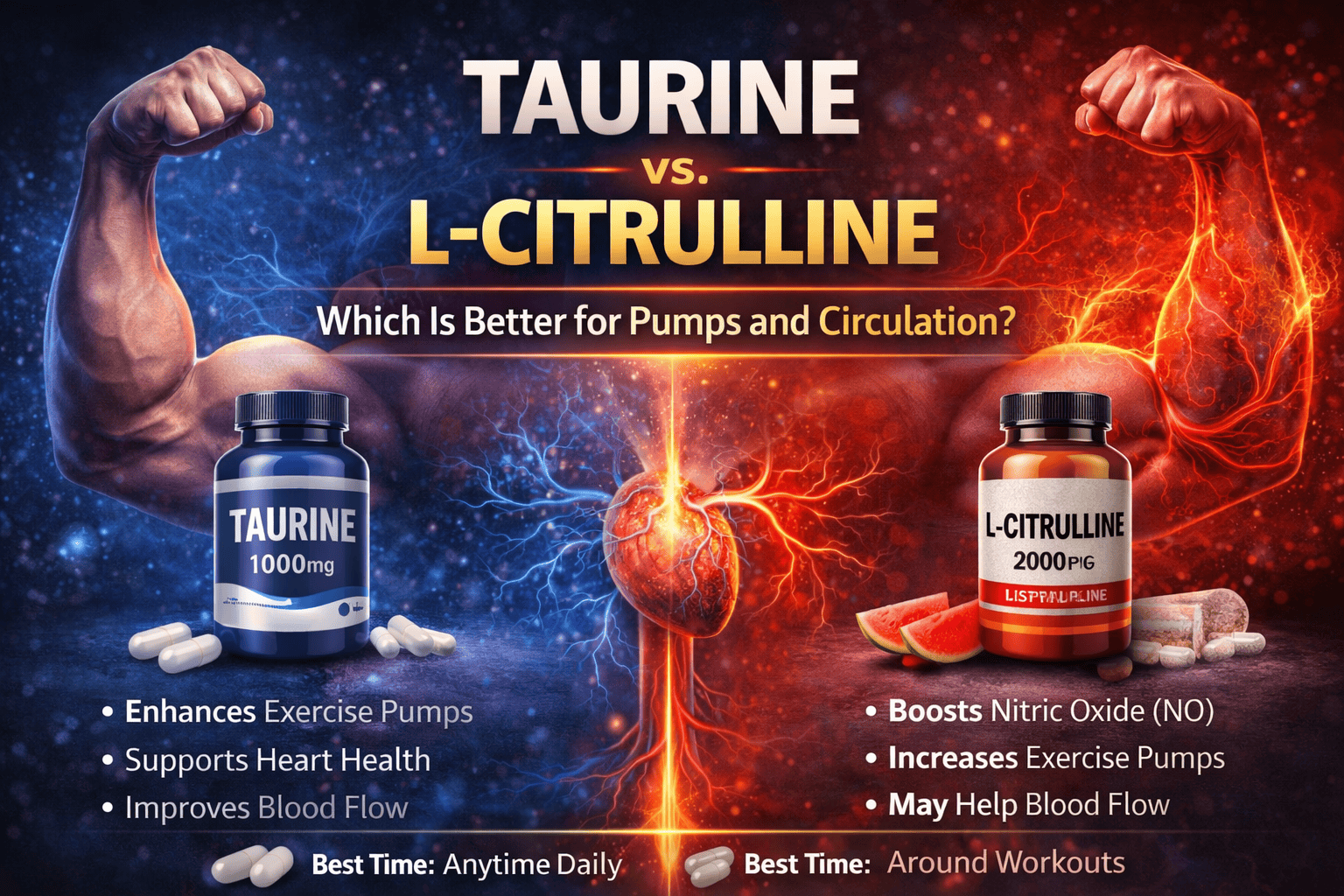
If your main goal is a more noticeable gym pump or a more direct blood-flow ingredient before training, L-citrulline is usually the better first pick. It has the more direct nitric-oxide and vasodilation logic, and the human evidence for circulation-related effects is more specifically aligned with that job.
If your main goal is broader day-to-day vascular or cardiometabolic support, taurine becomes much more competitive. Taurine is weaker as a classic “pump” ingredient, but stronger than most people realize for blood pressure, endothelial function, and broader cardiometabolic markers. The clean answer is not “one wins everything.” It is “pick the one that matches the job.”
This page compares taurine and L-citrulline specifically for pump-and-circulation intent. It is not the full taurine overview and not the full citrulline guide.
Key terms: taurine, L-citrulline, citrulline malate, nitric oxide, blood flow, pumps, vascular function, circulation, pre-workout
Quick Take
Choose L-citrulline first if the question is “Which ingredient is more likely to help my pump or blood-flow feel around training?” Choose taurine first if the question is “Which ingredient looks more interesting for longer-term vascular, blood-pressure, or cardiometabolic support?” If you are still unsure, citrulline is the better pump bet and taurine is the better steady circulation-support bet.
TL;DR decision
For visible pumps and acute workout circulation, start with L-citrulline. For a quieter daily support role around blood pressure and cardiometabolic health, taurine is often the better fit. They are not interchangeable, and the smarter choice depends on whether your target is “today’s workout” or “longer-term vascular support.”
Evidence standard: human trials, dose ranges, guideline-level sources when available
Who this is for: adults choosing between taurine and L-citrulline for pumps, blood flow, pre-workout support, or broader circulation support
Who this is not for: anyone treating supplements like a replacement for blood-pressure care, peripheral vascular workup, or cardiovascular treatment
Reviewed by: VerifiedSupps Editorial Team
Last reviewed: April 6, 2026
Parent Hub
Best Pre-Workout Ingredients Explained
Use the parent hub if you want the broader ingredient map first and then come back to this taurine-versus-citrulline decision with better context.
Taurine vs L-citrulline: quick decision table
This is the fastest way to stop guessing and choose based on the actual job you want the ingredient to do.
| If your main goal is… | Better first pick | Practical starting dose | Why |
|---|---|---|---|
| A more noticeable pre-workout pump | L-citrulline | 3–6 g L-citrulline or 6–8 g citrulline malate | More direct NO and blood-flow logic, though the gym-pump evidence is still mixed |
| Broader day-to-day circulation and BP support | Taurine | 1.5–3 g/day | Better cardiometabolic and BP-support signal in human meta-analysis data |
| A cleaner pre-workout non-stimulant add-on | L-citrulline first | About 60–90 min pre-workout | It matches the acute workout goal better than taurine does |
| You want one ingredient that may help circulation without caring about the pump feel | Taurine | 1.5–3 g/day | Taurine’s best human story is quieter, longer-game vascular support |
Best next step (today): If your actual question is “Which one should I buy first for the gym?” buy L-citrulline first. If your actual question is “Which one fits a longer-term vascular-support strategy better?” start with taurine.
Is taurine or L-citrulline better for pumps?
L-citrulline is usually the better pump pick. That does not mean the evidence is perfect. It means the pump-specific mechanism and the more direct blood-flow logic point toward citrulline more than taurine.
Mechanism
- L-citrulline raises arginine availability, which can support nitric-oxide production and vasodilation more directly than taurine.
- Citrulline has actual human data on endothelial function, aortic blood pressure, exercise blood flow, and some resistance-exercise outcomes.
- Taurine’s better-supported human roles are endurance, vascular/cardiometabolic support, and general exercise support rather than obvious NO-style “pump” effects.
The important nuance is that citrulline is not a guaranteed Hollywood pump supplement. A critical review of citrulline malate concluded that the performance evidence remains ambiguous overall, and at least one 2023 study found that a single 8 g dose of L-citrulline did not improve isometric force, muscle endurance, or muscle oxygenation in the protocol tested. On the other hand, the classic 8 g citrulline malate bench-press study did find more repetitions and less soreness after exercise.
So the practical answer is this: L-citrulline wins the pump comparison by inference, not because the literature is perfectly consistent. Taurine simply does not have equally direct human pump evidence.
Is L-citrulline or taurine better for circulation and blood flow?
This one depends on whether you mean acute workout blood flow or longer-term vascular support. For acute circulation around training, L-citrulline is still the cleaner choice. For longer-term vascular and blood-pressure support, taurine becomes much more interesting.
L-citrulline has human data showing improved endothelial function and lower aortic blood pressure, and it has also shown a modest improvement in muscle blood flow during submaximal exercise in older men. A 2024 trial in hypertensive postmenopausal women also reported improved exercise artery vasodilation and muscle oxygenation with citrulline. That is a pretty direct circulation story.
Taurine’s circulation story is different. It is less “pump now” and more “vascular support over time.” The 2025 taurine meta-analysis showed significant reductions in systolic and diastolic blood pressure, glucose, triglycerides, cholesterol, insulin, and inflammation-related markers, and the dose-response analysis pointed to 1.5–3.0 g/day as the most effective range overall.
So if you say “circulation” and mean vascular health trend, taurine deserves real respect. If you say “circulation” and mean I want a better pump during training, citrulline is still the better match.
Should you take taurine or L-citrulline before a workout?
If you are choosing one pre-workout for pump-and-circulation intent, L-citrulline is usually the smarter first choice. Taurine can still make sense pre-workout, but more as an exercise-support or endurance ingredient than as a classic pump ingredient.
For citrulline, a practical workout range is often 3–6 g of L-citrulline or 6–8 g of citrulline malate, taken about 60 minutes before training. Human data show that a single 6 g dose taken 1 hour before exercise is sufficient to increase nitric-oxide bioavailability, and review-level sports guidance often points to about 8 g citrulline malate 60 minutes pre-workout as the best-supported acute strategy.
For taurine, a practical pre-workout range is usually 1–3 g, often taken about 60–90 minutes before exercise. That said, the reason to do this is not “best pump.” It is more “possible performance, fatigue, or exercise-support benefit.” Even the newer one-shot taurine meta-analysis suggests the acute benefit pattern is not linear and that more is not automatically better.
Practical rule: if you only want one ingredient before a session for pump and circulation, choose citrulline first. If you already use taurine, think of it as complementary workout support, not as your main pump driver.
How much taurine vs L-citrulline should you take?
The right dose depends on the job. L-citrulline usually lives in a more acute pre-workout range, while taurine often makes more sense as a steady daily ingredient.
L-citrulline: for pump-and-circulation workouts, start around 3–6 g L-citrulline or 6–8 g citrulline malate before training. More is not automatically better, and the performance literature is mixed enough that a solid standard dose usually makes more sense than heroic dosing.
Taurine: for longer-game circulation or cardiometabolic support, the strongest practical range is 1.5–3 g/day. If you are only testing taurine around exercise, 1–3 g is usually enough to learn something without turning the trial into a dose contest.
Simple rule: use citrulline like a targeted pre-workout tool and taurine more like a repeatable daily support ingredient—unless you have a specific reason to do otherwise.
Can you stack taurine and L-citrulline together?
Probably yes, and the idea is reasonable. This is an inference from their different mechanisms, not a claim that the combined human evidence is already excellent.
Citrulline is more directly about arginine availability, nitric-oxide production, and the acute blood-flow story. Taurine is more about vascular support, cell regulation, endurance-style exercise support, and broader cardiometabolic health. On paper, those are complementary jobs, not duplicate jobs.
The smartest way to use that logic is not to throw both into your routine immediately. It is to test one first. If you want pumps, test citrulline first. If you want longer-term vascular support, test taurine first. Only after you know what each one seems to do for you does a stack become useful instead of confusing.
Practical stacking rule: start single-ingredient, learn the response, then combine only if the goals truly overlap.
Why didn’t taurine or L-citrulline help my pumps?
Usually because the goal and the ingredient did not actually match, the dose or timing was off, or the expectation was too dramatic. This comparison gets much easier once you stop asking “Which one is stronger?” and start asking “Which one was I actually using for the right reason?”
Common mistakes
- Using taurine for a visible pump goal and then deciding taurine “does nothing”
- Taking citrulline too close to training or at a token dose
- Judging either ingredient through a mixed energy drink or pre-workout instead of a clean single-ingredient test
- Expecting an absurdly obvious effect from an ingredient with mixed or modest human effect sizes
Clean test protocol
| Inputs | Choose one ingredient only. For pumps, use citrulline. For daily circulation support, use taurine. Keep the rest of your pre-workout or cardiovascular stack stable. |
|---|---|
| Duration | For citrulline, judge over several training sessions. For taurine circulation support, judge over at least 4–8 weeks, and longer if the goal is cardiometabolic. |
| 3 metrics | Track one workout marker, one circulation marker, and one tolerance marker. Example: pump/performance feel, home BP or warmth/perfusion trend, and GI tolerance or dizziness. |
| Stop conditions | Stop if you develop persistent GI symptoms, unusual dizziness, low-BP symptoms, or if the trial no longer matches the actual problem you are trying to solve. |
How to tell it’s working
With citrulline, the signal is usually more acute and workout-specific: better pump feel, sometimes better work capacity, maybe better recovery from hard sessions. With taurine, the signal is usually quieter: steadier vascular support, better BP trend, or better cardiometabolic follow-through over time. If you judged taurine by the same standard you would judge a NO-leaning pre-workout, you probably used the wrong scorecard.
Red flags / seek care
Seek clinician input if you are using either ingredient around blood-pressure medication, notice dizziness or unusually low readings, or have circulation symptoms that deserve evaluation on their own. A supplement comparison is never the right tool for chest pain, fainting, limb pain with exertion, or concerning cardiovascular symptoms.
Selected Professional References
These are the main sources used to compare the pump, blood-flow, vascular, dose, and safety logic behind taurine and L-citrulline.
Effects of Citrulline Supplementation on Exercise Performance and Recovery
One of the best overview sources for citrulline’s workout, recovery, nitrate/nitrite, and arginine-related effects.
Used for: exercise-performance framing, pre-workout pump logic, recovery context
Effects of L-Citrulline Supplementation on Endothelial Function and Blood Pressure Levels
Best direct source for citrulline’s endothelial and aortic blood-pressure effects.
Used for: circulation and endothelial-support comparison, BP framing
A Critical Review of Citrulline Malate Supplementation and Exercise Performance
Important because it keeps the citrulline story honest: strong mechanism, promising use, but still mixed and not perfectly settled.
Used for: anti-overclaim guardrail, why citrulline “wins” pumps with caveats
Does L-Citrulline Supplementation Improve Exercise Blood Flow in Older Adults?
Useful direct blood-flow paper for the circulation side of the citrulline comparison.
Used for: muscle blood flow, circulation-specific comparison
Effects of Oral Taurine Supplementation on Cardiometabolic Risk Factors
The most important recent taurine source for blood pressure, lipids, glucose, insulin resistance, and dose-response context.
Used for: why taurine looks stronger for steady vascular and cardiometabolic support
The Effects of an Oral Taurine Dose and Supplementation Period on Endurance Exercise Performance
Helpful for showing that taurine’s human exercise story is real—but it is more endurance/support oriented than classic pump oriented.
Used for: taurine pre-workout context, why taurine is not the first pump ingredient
Go Deeper (VerifiedSupps Guides)
If this comparison helped narrow the field, these are the best next reads to place each ingredient correctly inside your routine.
L-Citrulline: The Complete Science-Simple Guide
Go here if citrulline looks like the better fit and you want the full mechanism, performance, and dosing picture.
Taurine Benefits: The Complete Science-Backed Guide
Open this if taurine looks like the better long-game circulation or cardiometabolic support ingredient for you.
Taurine Dosage Guide
Use this if taurine won the comparison and now you want the simplest daily dose and timing strategy.
L-Citrulline for Blood Pressure & Circulation
Best next read if the circulation side of citrulline matters more to you than the pump side.
Final Takeaway
If your actual goal is visible pumps and a more direct pre-workout blood-flow ingredient, start with L-citrulline. If your actual goal is quieter, longer-term support for blood pressure, vascular function, and cardiometabolic health, taurine is often the more interesting ingredient. The best choice is not about which ingredient sounds more powerful. It is about which one fits the job you are actually trying to do.
FAQ
Is taurine or L-citrulline better for pumps?
L-citrulline is usually the better first choice for visible pumps because it has the more direct nitric-oxide and blood-flow logic.
Which one is better for circulation?
For acute workout circulation, L-citrulline is usually the cleaner choice. For longer-term vascular and cardiometabolic support, taurine becomes more interesting.
Can taurine increase blood flow?
Possibly, but taurine’s better-supported human story is broader vascular and cardiometabolic support rather than obvious pre-workout pump effects.
Does L-citrulline give a bigger pump than taurine?
Usually yes in practical use, but the citrulline gym-pump literature is still mixed enough that it should be framed as the better bet rather than a guaranteed outcome.
Can you stack taurine and L-citrulline together?
Probably yes, and the idea is reasonable because they appear to work through different pathways, but the direct combined human evidence is still limited.
How much L-citrulline should I take for pumps?
A practical range is 3 to 6 grams of L-citrulline or 6 to 8 grams of citrulline malate, usually taken about 60 minutes before training.
How much taurine should I take for circulation?
A practical range is usually 1.5 to 3 grams per day if the goal is broader vascular or cardiometabolic support.
Should I take taurine or citrulline before a workout?
If the goal is pump and acute circulation, citrulline usually makes more sense before a workout.
Which one is better for blood pressure?
Taurine currently has the cleaner broader human signal for blood pressure and cardiometabolic support, though citrulline also has promising endothelial and blood-pressure data.
Is taurine more of a daily support ingredient than a pump ingredient?
Yes. That is the cleaner way to think about it. Taurine fits better as a repeatable daily support ingredient than as a classic visible pump ingredient.
VerifiedSupps Medical Disclaimer
This content is for educational purposes only and is not medical advice. Neither taurine nor L-citrulline is a substitute for diagnosis or treatment of high blood pressure, vascular disease, chest pain, claudication, diabetes, or any other diagnosed condition. Use extra caution if you have low blood pressure, take blood-pressure or glucose-lowering medication, or use mixed stimulant products like energy drinks to judge circulation effects. Seek urgent medical care for chest pain, fainting, severe dizziness, limb pain with exertion, or any concerning cardiovascular symptom.