By VerifiedSupps Editorial Team
Taurine + Magnesium Stack for Calm and Recovery: Benefits, Dosage, and Best Use Cases
This is a sensible stack if what you want is a low-stimulant, nervous-system-downshift plus muscle-recovery support setup. But it is important to be honest about what is doing what. The “calm” side of the stack is carried more by magnesium, especially if your magnesium intake is low, stress is high, or sleep is shaky. The “recovery” side is where taurine becomes more interesting, because human data support at least a modest role in exercise support and some soreness or muscle-damage outcomes.
What this stack is not: a directly proven miracle combo with a huge body of two-ingredient human trials behind it. Most of the logic comes from the separate taurine and magnesium literatures, not from strong direct stack trials. That does not make it bad. It just means the best way to use it is as a complementary pairing, not as a magic formula.
This page focuses on taurine plus magnesium specifically for calm and recovery. It is not the broad taurine guide, and it is not the general magnesium forms page.
Key terms: taurine, magnesium, calm stack, recovery stack, sleep, stress, muscle soreness, magnesium dosage, taurine dosage
Quick Take
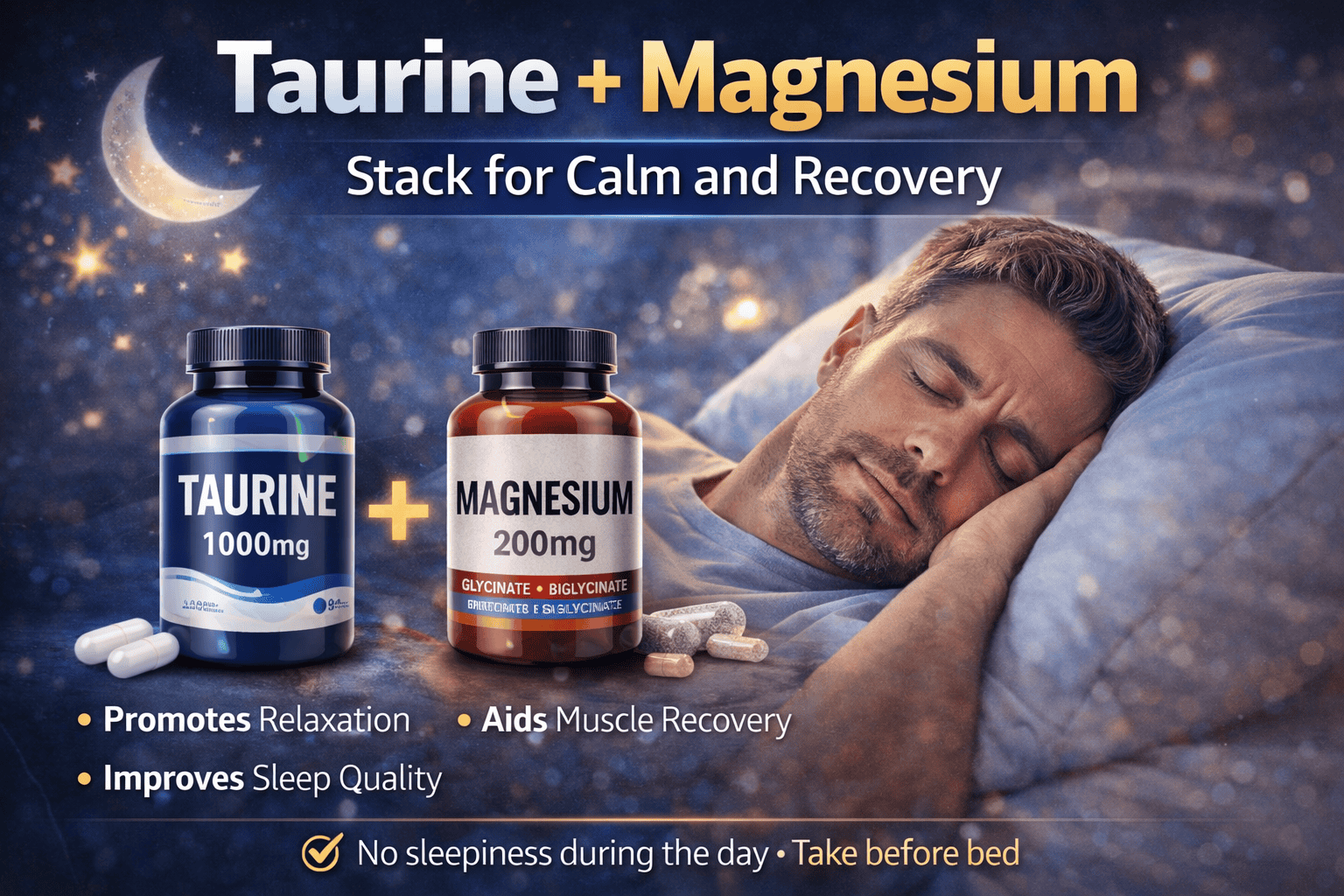
If you want the shortest useful answer: this stack makes the most sense when you want a calmer evening or a less edgy recovery routine after training. Magnesium usually does more of the heavy lifting for stress, sleep, and muscle relaxation. Taurine is the better bet for complementing recovery and exercise-related support. A clean starting setup is often 1 g taurine + 200 mg elemental magnesium, then adjust based on the actual goal and tolerance.
TL;DR decision
Use this stack when you want calm without a sedative feel and recovery without turning your evening into a stimulant cycle. It is a better fit for tension, wind-down, sleep-support experiments, and soreness support than it is for big acute performance changes or instant mood shifts.
Evidence standard: human trials, dose ranges, guideline-level sources when available
Who this is for: adults who want a non-stimulant stack for calmer evenings, better sleep support, less muscle tension, or a smoother recovery routine
Who this is not for: anyone using supplements to replace workup or treatment for significant anxiety, insomnia, chronic pain, kidney disease, blood-pressure issues, or serious overtraining symptoms
Reviewed by: VerifiedSupps Editorial Team
Last reviewed: April 6, 2026
Parent Hub
Best Supplements for Stress Relief
Use the broader stress-relief hub if you want to compare this stack against simpler first-line options before you commit to a two-ingredient routine.
Taurine + magnesium stack decoder
Use this before you buy anything. It makes the whole stack easier to match to the actual job you want it to do.
| If your main goal is… | Taurine | Magnesium | Best expectation |
|---|---|---|---|
| A calmer evening and less body tension | Helpful add-on, but not the star | Usually the main driver | Subtle downshift, not knockout sedation |
| Sleep-support experiment | Maybe useful, evidence limited | More reasonable first-line stack partner | Helps some people, but not a guaranteed sleep fix |
| Soreness and recovery support after training | More relevant here | Supportive if low intake or cramp/tension prone | Think smoother recovery, not dramatic performance change |
| A simple low-stimulant stack that does not feel edgy | Reasonable | Reasonable | Good fit if the goal is “steadier,” not “stronger” or “faster” feeling |
Best next step (today): Decide whether you care more about calm or recovery. That tells you which ingredient should do more of the work in the stack.
Is taurine plus magnesium a good stack for calm and recovery?
Yes, as a practical stack it makes sense—especially if you want a routine that feels calmer and less stimulant-driven. But the best way to think about it is not “synergy proved beyond doubt.” It is “two ingredients with different strengths that can make sense together.” Magnesium has the stronger direct human case for stress support and some sleep contexts. Taurine has the stronger direct human case for exercise support and some recovery markers.
Mechanism
- Magnesium supports muscle and nerve function, energy production, blood pressure regulation, and several pathways that matter for stress resilience and tension management.
- Taurine supports cell-volume regulation, membrane stability, and stress-response physiology, which helps explain why it keeps showing up in exercise, soreness, and recovery discussions.
- The combo makes most sense when you want both nervous-system downshifting and less ragged recovery, not when you want a dramatic stimulant effect or an instant mood lift.
What would change my recommendation
I would be more cautious if you have kidney disease, already run low blood pressure, take blood-pressure or glucose-lowering medication, get diarrhea easily from magnesium, or you are trying to use this stack as a stand-in for treating major anxiety, insomnia, or heavy overreaching from training.
How much taurine and magnesium should you take together?
A clean starting point is often 1 g taurine + 200 mg elemental magnesium. From there, the practical working range is usually 1–3 g/day taurine plus 200–350 mg/day supplemental elemental magnesium, depending on your total diet, tolerance, and why you are using the stack.
That does not mean you need the full magnesium RDA from capsules alone. The adult magnesium RDA is 310–420 mg/day depending on age and sex, and a lot of that can and should come from food. The formal U.S. upper limit for supplemental magnesium is 350 mg/day, mainly because GI side effects become more likely above that level.
For taurine, the strongest conservative long-term safety benchmark remains up to 3 g/day in healthy adults. That makes 1–3 g/day a useful real-world zone for stacking purposes. If you are taking taurine mainly for recovery, 1–2 g/day is often enough to learn something without turning the trial into a dose contest.
Simple rule: let magnesium stay conservative and GI-friendly, and let taurine carry a bit more of the adjustable range.
When should you take taurine and magnesium?
If the goal is calm, sleep support, or end-of-day decompression, evening use makes the most sense. If the goal is recovery after training, the stack still often works best later in the day, especially if your training is earlier and the main problem is carrying too much tension into the evening.
For most people, the simplest routine is with dinner or 60–120 minutes before bed. That gives you the best shot at seeing whether the stack helps sleep onset, tension, nighttime restlessness, or next-day soreness without confusing the experiment with daytime stimulants.
If your workouts are late at night, this gets even simpler: taurine plus magnesium fits better as a post-training evening support combo than as a classic pre-workout stack.
What type of magnesium works best with taurine?
For a calm-and-recovery stack, I would usually avoid magnesium oxide as the first choice. Official magnesium guidance notes that forms that dissolve well in liquid—like citrate, chloride, lactate, and aspartate—tend to have better absorption than oxide, and high-dose magnesium can cause diarrhea, nausea, and cramping.
In practical stack terms, that means your “best” magnesium is usually the one that does not turn the experiment into a gut problem. If you want a smoother evening stack, use a form you tolerate well and that does not feel laxative-leaning. This is one reason many people move away from oxide for daily calm-and-recovery use.
Practical rule: if the stack makes your stomach the loudest part of the experience, the form is wrong even if the label looks good.
Can taurine plus magnesium help sleep and stress?
Yes, it can be a reasonable stack for that goal—but with one important reality check: magnesium is doing more of the evidence-backed work here than taurine. In stressed adults with low magnesemia, oral magnesium substantially improved stress scores over 8 weeks. Sleep data are more mixed overall, with observational evidence looking better than the randomized trial base, though newer magnesium trials remain encouraging in selected populations.
Taurine is trickier. It has a reputation for calm, but current human evidence for mood or cognition benefits is still limited. That means taurine can still make sense in this stack, but mostly as a soft support layer rather than the main reason to expect a calmer mind.
The best way to frame the calm side of the stack is this: magnesium is the more proven anchor, taurine is the more speculative helper.
Can taurine plus magnesium help muscle recovery?
Yes, this is where the stack feels more practical than flashy. Taurine’s sports literature is mixed but promising for recovery-related outcomes, and individual eccentric-exercise studies suggest taurine can reduce soreness and some muscle-damage markers. Magnesium also has human data showing reduced soreness and improved recovery markers after strenuous or unaccustomed exercise.
What this probably looks like in real life is not “I recovered twice as fast.” It is more likely a smaller edge: slightly less soreness, a little less whole-body tension, and a smoother shift from training stress to evening recovery. That is a good stack outcome. It just is not a dramatic one.
This is also the cleaner reason to use taurine here. If calm is only part of the goal and recovery is equally important, taurine becomes much more useful than it looked in the sleep-and-stress section alone.
Why isn’t the taurine + magnesium stack working for me?
Usually because the job was not clear enough, the dose was off, the magnesium form was a bad fit, or the expectation was too dramatic. This stack works best when you are looking for a quieter overall shift, not a stimulant-like “wow” effect.
Common mistakes
- Using a laxative-leaning magnesium form and deciding the whole stack is bad
- Judging the stack after two nights instead of giving it a fair window
- Expecting taurine to feel like a sedative or expecting magnesium to erase stress instantly
- Using the stack while caffeine, poor sleep habits, or late heavy meals are still doing most of the damage
Clean test protocol
| Inputs | Use taurine alone plus magnesium alone, not an energy drink or multi-ingredient nighttime blend. Start with 1 g taurine + 200 mg elemental magnesium in the evening. |
|---|---|
| Duration | Give the calm side 10–14 days. Give the recovery side at least 2–4 weeks and several training sessions. |
| 3 metrics | Track wind-down quality, sleep quality, and soreness or next-day recovery feel. Also track GI tolerance, because that can make or break magnesium stacks. |
| Stop conditions | Stop if you develop persistent diarrhea, unusual dizziness, low-BP symptoms, significant weakness, or anything that feels more like a medication interaction than a supplement issue. |
How to tell it’s working
The signs are usually subtle: easier downshifting at night, less “wired but tired” tension, slightly smoother sleep, and a better next-day recovery feel. If you are waiting for an obvious buzz, wave of sedation, or dramatic pump-like feeling, you are probably judging the wrong stack by the wrong standard.
Red flags / seek care
Get clinician input before continuing if you have kidney disease, take bisphosphonates, tetracycline or quinolone antibiotics, diuretics, or proton pump inhibitors, or if you use blood-pressure or glucose-lowering medication and start feeling unusually lightheaded or weak. Seek urgent care for chest pain, fainting, severe shortness of breath, or any concerning cardiovascular symptom.
Selected Professional References
These are the main sources anchoring the calm, sleep, dose, recovery, and safety logic behind this stack.
Magnesium — Health Professional Fact Sheet
Best official source for magnesium roles, adult RDAs, supplement upper limit, forms, and medication interactions.
Used for: dose guardrails, forms, elemental-magnesium logic, interaction cautions
Taurine in Sports and Exercise
Best broad taurine review for exercise support, soreness, recovery, and why taurine’s exercise story is promising but not exaggerated.
Used for: recovery framing, dose range logic, realistic taurine expectations
Effects of Taurine Supplementation Following Eccentric Exercise in Young Adults
Useful direct human study showing taurine can reduce soreness and some muscle-damage markers after eccentric exercise.
Used for: post-training recovery logic, why taurine belongs in this stack
Magnesium and Stress in Healthy Adults with Low Magnesemia
Important because it shows magnesium alone meaningfully reduced stress in the kind of people most likely to care about a calm stack.
Used for: calm/stress section, why magnesium is the anchor of the stack
The Role of Magnesium in Sleep Health
Best source for keeping magnesium sleep claims honest: there is signal, but the randomized literature is still mixed and not a blank check.
Used for: sleep section, anti-overclaim guardrail
Effects of Magnesium Supplementation on Muscle Soreness
Useful human recovery evidence showing magnesium can reduce soreness and improve perceived recovery in some settings.
Used for: recovery section, why magnesium can still matter after training
Effects of Taurine Supplementation on Cognitive Function
Important counterweight to overhyped taurine-calm claims: current human evidence does not support strong confidence in standalone mood or cognition benefits.
Used for: why taurine is the helper, not the anchor, on the calm side
Go Deeper (VerifiedSupps Guides)
If this stack looks useful, these are the next pages that help you place taurine and magnesium more precisely inside your routine.
Taurine Benefits: The Complete Science-Backed Guide
Go here if taurine looks more useful to you than you expected and you want the bigger-picture evidence first.
Magnesium Complete Guide
Use this if the magnesium side of the stack is the part you need to understand better before buying anything.
The Complete Sleep Stack
Open this if you care more about the sleep side of the stack than the post-training recovery side.
Muscle Growth and Recovery Stack
Go here if your real interest is less about calm and more about how this stack fits a bigger recovery strategy.
Final Takeaway
The taurine + magnesium stack makes the most sense when you want a routine that feels calmer, less edgy, and more recovery-friendly—not when you want an instant mood lift or a dramatic gym effect. Magnesium usually anchors the calm side. Taurine usually makes more sense on the recovery side. Used that way, this is a practical stack. Used with the wrong expectations, it will feel underwhelming.
FAQ
Is taurine plus magnesium a good stack for calm and recovery?
Yes. It is a reasonable low-stimulant stack, especially if you want calmer evenings and smoother recovery rather than a dramatic feel.
How much taurine and magnesium should I take together?
A common starting point is 1 gram taurine plus 200 mg elemental magnesium. A practical working range is often 1 to 3 grams taurine plus 200 to 350 mg supplemental elemental magnesium.
When should I take taurine and magnesium?
For calm, sleep support, and evening recovery, with dinner or 60 to 120 minutes before bed is usually the most practical setup.
What type of magnesium works best with taurine?
Usually a form you tolerate well and that does not turn the stack into a gut issue. Magnesium oxide is often not the best first choice for a calm-and-recovery stack.
Can taurine plus magnesium help sleep and stress?
Possibly yes, but magnesium has the stronger direct evidence for stress support and some sleep contexts. Taurine is better viewed as a helper than the main sleep ingredient.
Can taurine plus magnesium help muscle recovery?
Yes, that is one of the cleaner reasons to use the stack. Taurine has promising recovery data, and magnesium may also help soreness and recovery in some settings.
Is 3 grams of taurine too much?
For healthy adults, 3 grams per day sits within the strongest conservative long-term safety range for taurine.
Is 350 mg of supplemental magnesium too much?
350 mg per day is the formal adult upper limit for supplemental magnesium in U.S. guidance, mainly because GI side effects become more likely above that level.
Can I use this stack after late-night workouts?
Yes. In fact, that is one of the cleaner use-cases for it if the goal is to shift from training stress into evening recovery.
Who should be more cautious with a taurine and magnesium stack?
People with kidney disease, low blood pressure, medication interactions, or a history of supplement-related dizziness or diarrhea should be more cautious and consider clinician input.
VerifiedSupps Medical Disclaimer
This content is for educational purposes only and is not medical advice. Taurine and magnesium are not substitutes for evaluation or treatment of significant anxiety, insomnia, kidney disease, blood pressure disorders, diabetes, severe cramping, or any diagnosed condition. Use extra caution if you take bisphosphonates, tetracycline or quinolone antibiotics, diuretics, proton pump inhibitors, blood-pressure medication, or glucose-lowering medication. Seek urgent care for chest pain, fainting, severe dizziness, difficulty breathing, or any concerning new symptom.