By VerifiedSupps Editorial Team
Lion’s Mane + Creatine for Mental Performance
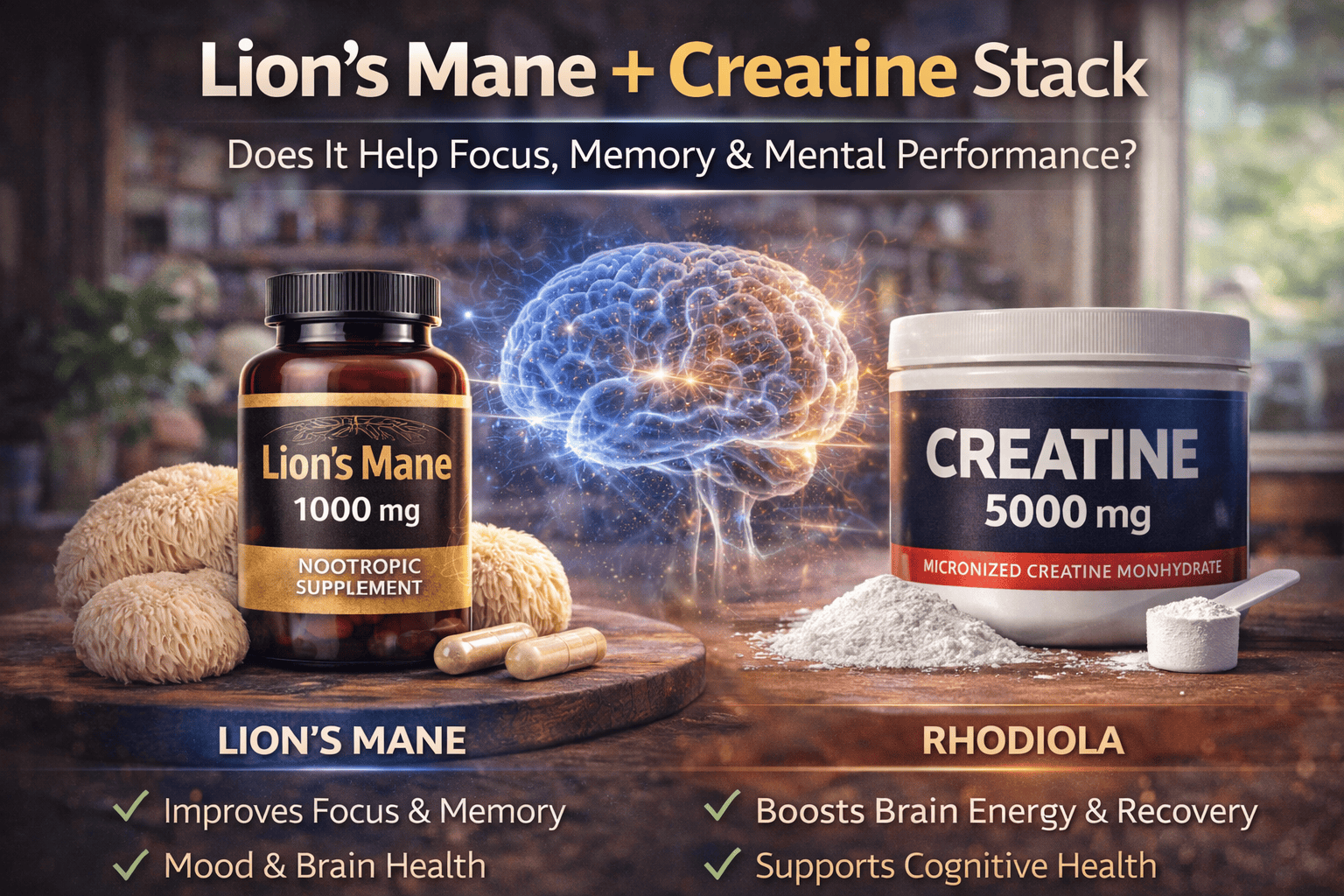
This stack can make sense, but the two ingredients are not carrying equal evidence weight. Creatine is the stronger evidence anchor for mental performance, while lion’s mane is the slower, less certain add-on that may be worth testing if you want a low-stimulant second layer.
That means the smartest way to use this stack is not to treat it like two equally proven nootropics. It is better to think of it as creatine first, lion’s mane second, especially if your goal is better memory, steadier output, or less mental fade under stress and fatigue.
This page is for the specific lion’s mane plus creatine stack decision, not a full standalone deep-dive on either ingredient by itself.
Key terms: creatine monohydrate, lion’s mane, Hericium erinaceus, memory, processing speed, mental fatigue, working memory, focus
Quick Take
If you want the highest-probability mental-performance stack, make creatine monohydrate the base and treat lion’s mane as optional. The stack is reasonable, but creatine is doing most of the evidence-backed heavy lifting.
TL;DR decision
Start with creatine monohydrate 3–5 g daily. Add lion’s mane only if you want a slower, lower-stimulation second layer and you are willing to judge it over 4–8 weeks instead of expecting a quick same-day boost.
Evidence standard: human trials, dose ranges, guideline-level sources when available
Who this is for: people who want a non-stimulant or low-stimulant mental performance stack for memory, mental stamina, or stress-related cognitive drag
Who this is not for: anyone with kidney disease, mushroom allergy, a complex medication setup, pregnancy, or severe mood, sleep, or neurological symptoms that need actual medical evaluation
Reviewed by: VerifiedSupps Editorial Team
Last reviewed: April 15, 2026
Parent Hub
The Complete Calm + Focus Stack
Use the hub if you want to zoom out from this one stack and compare broader calm-focus options, stimulants, and non-stimulant lanes more cleanly.
Quick decision table: when does this stack actually make sense?
Most people do not need a fancy stack first. They need to know whether creatine alone is enough, or whether lion’s mane deserves a spot beside it.
| If your real goal is… | Best move | Why | What to expect |
|---|---|---|---|
| The simplest evidence-based mental performance upgrade | Start with creatine alone | Creatine has the stronger human cognition data and cleaner daily-use playbook | A fair read usually takes 2–4 weeks |
| A lower-stim second layer after creatine is already in place | Add lion’s mane | Lion’s mane may offer slower-burn support for mood, stress, or cognition, but the evidence is smaller and mixed | Judge it over 4–8 weeks, not a few days |
| Help during sleep loss or heavy mental fatigue | Creatine is more plausible | Acute creatine data exist in sleep deprivation; lion’s mane acute data are much weaker | Think “damage control,” not a miracle brain boost |
| A very sensitive stomach or mushroom concern | Keep it simple | Lion’s mane has reported GI and rash issues in some people, while creatine is usually easier to test cleanly | Less confusion, better readout |
Best next step (today): Start creatine monohydrate 3–5 g daily first, keep sleep and caffeine steady, and only layer in lion’s mane if you want a slower second-stage experiment.
Does lion’s mane + creatine actually help mental performance?
It can be a reasonable stack, but the evidence is uneven. Creatine is the ingredient with the clearer human signal for mental performance, while lion’s mane is the slower, lower-certainty add-on that may help some people but is not nearly as dependable.
That matters because “mental performance” is broad. If you mean memory, processing speed under fatigue, or better function during mentally costly periods, creatine makes the stronger case. If you mean a gentler, longer-horizon cognition-and-mood experiment without leaning on stimulants, lion’s mane becomes more reasonable, but still less proven.
Mechanism
- Creatine supports brain energy buffering through phosphocreatine and ATP-related pathways, which is one reason it looks more useful under fatigue, stress, or sleep loss.
- Lion’s mane is studied for neurotrophic and neuroplasticity-related pathways, but the human translation is still much less settled than the marketing usually implies.
- Putting them together is biologically reasonable, but a reasonable theory is not the same thing as robust direct stack proof.
What would change my recommendation: if you only want one supplement, choose creatine first. If you are already taking creatine consistently and want a lower-stimulation second layer, lion’s mane becomes easier to justify.
How much lion’s mane and creatine should you take for mental performance?
For most people, the cleanest version of this stack is simple: creatine monohydrate 3–5 g daily, plus lion’s mane at one steady label-based serving rather than a random mega-dose. Creatine has the better-established dosing lane; lion’s mane is the messier one because products vary so much.
Creatine dose
Use creatine monohydrate. A steady 3–5 g/day works well for most adults. Loading is optional, not required, and mostly useful only if you want faster saturation.
Practical move: take 3–5 g daily for 2–4 weeks before deciding it “isn’t working.”
Lion’s mane dose
Lion’s mane studies use different forms and different preparations. Human trials have tested up to 3 g/day of fruiting body, but there is not one universally settled supplement dose.
Practical move: start with one consistent serving from a product that clearly states the form used, then judge over several weeks instead of chasing bigger doses too early.
When should you take lion’s mane + creatine for focus?
For daily mental-performance use, consistency matters more than perfect timing. Creatine can be taken any time you will reliably remember it, while lion’s mane is usually best tested earlier in the day if the goal is focus rather than sleep support.
A simple setup is breakfast or lunch. That keeps the routine stable, reduces the odds of stomach irritation on an empty stomach, and makes it easier to tell whether lion’s mane helps or does nothing for you. It also avoids the common mistake of treating lion’s mane like an immediate-focus booster when the human data do not support that kind of confidence.
The one important exception is sleep deprivation. Acute creatine research suggests a high single dose may help during sleep loss, but that is a specific fatigue context, not a reason to reinvent your normal daily plan around exact timing.
Is lion’s mane + creatine safe to take every day?
For healthy adults, this can be a reasonable daily stack, but creatine and lion’s mane do not have the same depth of safety data. Creatine monohydrate is much better studied. Lion’s mane looks generally well tolerated in small human trials, but the long-term supplement data are still limited and product quality varies more.
Creatine watch-outs
- Possible side effects include nausea, diarrhea, bloating, headache, and temporary water-weight gain.
- Creatine monohydrate is the form with the deepest evidence base.
- If you have kidney disease, are under kidney monitoring, or take medications that complicate self-experimentation, get clinician input before using it daily.
Lion’s mane watch-outs
- Reported issues in clinical summaries include abdominal discomfort, nausea, and skin rash.
- Supplement formats vary a lot, so label transparency matters more than usual.
- If you have a mushroom allergy history or develop a rash or GI symptoms, stop the experiment instead of pushing the dose higher.
If your goal is a clean, low-risk start, creatine alone is easier to justify. Add lion’s mane only if you want a slower second layer and you can monitor how you respond without introducing five other variables.
What should you do if lion’s mane + creatine is not working?
The most common reason this stack “fails” is that people expect the wrong ingredient to do the wrong job. Creatine is not caffeine, and lion’s mane is not a same-day cognitive switch you flip on before work.
Common mistakes
- Expecting lion’s mane to feel acute and obvious within the first few days.
- Judging creatine too early before daily saturation has had time to build.
- Changing sleep, caffeine, workload, and two supplements at the same time, then pretending the result means something.
Clean test protocol
| Inputs | Creatine monohydrate only for 2–4 weeks first, stable caffeine, stable sleep schedule, stable workload if possible; add lion’s mane only after the creatine baseline is clear |
|---|---|
| Duration | Creatine: 2–4 weeks. Lion’s mane after that: 4–8 weeks. |
| 3 metrics | Working memory under pressure, afternoon mental fade, and how easily you start and sustain cognitively demanding tasks |
| Stop conditions | Rash, meaningful GI distress, worsening sleep, palpitations, severe agitation, or any symptom that makes daily function worse instead of better |
How to tell it’s working
The real sign is not a dramatic “smart drug” feel. It is easier recall, steadier attention, less mental drop-off across the day, and fewer moments where cognitive work feels harder than it should.
Red flags / seek care
Stop and get medical help for allergic-type reactions, chest pain, fainting, severe palpitations, major insomnia, rapid mood worsening, or neurological symptoms that go beyond a mild supplement side effect.
Who is most likely to notice this stack?
The people most likely to notice something useful are not always the people buying the most nootropics. Creatine tends to look better in people with higher mental strain, lower dietary creatine intake, older age, or fatigue-heavy conditions.
That means this stack makes the most sense if you are mentally taxed, low on recovery, eating little meat, or trying to protect performance when your brain feels under-fueled. Lion’s mane becomes easier to justify when you want a lower-stim, longer-horizon layer and are realistic enough to judge it over time.
If you are already well-rested, well-fed, low-stress, and expecting a dramatic productivity surge, the stack may feel underwhelming. That is not failure. It is often just a mismatch between your baseline and what these ingredients are actually good at.
Is creatine or lion’s mane doing most of the work in this stack?
For mental performance, creatine is doing most of the evidence-backed work. Lion’s mane may still be useful, but it is the supporting ingredient, not the lead ingredient.
That is the clearest way to keep the stack honest. If you remove lion’s mane and keep creatine, the stack still makes sense. If you remove creatine and keep lion’s mane, you now have a much less reliable mental-performance setup.
So the right mental model is not “two brain boosters.” It is “one ingredient with the stronger cognition case, plus one lower-certainty add-on that may fit some people better than others.”
Selected Professional References
These are the most useful sources for the stack logic, dose choices, safety notes, and conservative mental-performance framing used in this page.
Single-Dose Creatine During Sleep Deprivation
A strong reminder that creatine can matter more in fatigue-heavy conditions than people assume.
Used for: acute mental fatigue and sleep-loss context
Creatine and Memory in Healthy Individuals
Useful for the broader memory picture, especially the stronger signal in older adults and some low-creatine populations.
Used for: why creatine is the stack anchor
Creatine and Cognitive Function in Adults
A wider adult cognition review that supports a cautious but still more favorable creatine case.
Used for: adult mental-performance framing
EFSA on Creatine and Cognitive Function
Important because it keeps claims disciplined and prevents the stack from becoming a sales page.
Used for: anti-overclaim guardrail
Common Questions About Creatine Supplementation
One of the best practical references for dose basics, loading, misconceptions, and routine-use clarity.
Used for: creatine dose, safety, and loading logic
Lion’s Mane in Healthy Young Adults
Helpful because it suggests possible benefits without justifying an oversized confidence level.
Used for: lion’s mane’s tentative upside
Acute Lion’s Mane Fruiting Body Trial
Useful because it shows why immediate-focus claims for lion’s mane should stay conservative.
Used for: why lion’s mane is not the lead ingredient here
ADDF Cognitive Vitality: Lion’s Mane
A good high-level reality check on mixed cognitive effects, safety limits, and why dosage claims are still messy.
Used for: lion’s mane evidence quality and dose restraint
Memorial Sloan Kettering: Lion’s Mane Mushroom
Practical for adverse effects and for keeping the mushroom side of the stack medically grounded.
Used for: lion’s mane tolerability and watch-outs
Go Deeper (VerifiedSupps Guides)
Use these next if you want to compare this stack against simpler single-ingredient or alternative focus-support options.
Creatine Benefits for Mental Focus
Best next read if you want to understand the evidence anchor in this stack before adding anything else.
Creatine Monohydrate Benefits, Science, and Dosage
Use this if you want the cleanest dose, safety, and form-selection guidance before stacking creatine with anything.
Focus + Productivity Stack
Read this if your real goal is sharper work output and you want to compare a more acute focus stack against this slower one.
L-Theanine Benefits
Helpful when you want a calmer, more immediate-feeling alternative and need to compare it against lion’s mane honestly.
Final Takeaway
Lion’s mane plus creatine can be a sensible mental-performance stack, but only if you keep the hierarchy clear. Creatine is the evidence-based base. Lion’s mane is the optional, slower, more uncertain second layer. If you want the smartest version of this stack, start with creatine monohydrate 3–5 g daily, judge it cleanly, then add lion’s mane only if you still want a gentler non-stimulant layer to test over time.
FAQ
Is lion’s mane + creatine better than caffeine for focus?
Not necessarily. Caffeine is more acute and noticeable, while creatine and lion’s mane are slower and less dramatic. This stack makes more sense when you want lower-stimulation support, not a fast stimulant effect.
Can you take lion’s mane and creatine together every day?
Many healthy adults probably can, but creatine has much deeper routine-use data than lion’s mane. If you want a cleaner test, start creatine first and add lion’s mane later.
How long does lion’s mane + creatine take to work?
Creatine deserves about 2 to 4 weeks of steady use. Lion’s mane deserves more like 4 to 8 weeks if you are testing it fairly.
Should you load creatine for mental performance?
Usually no. Loading is optional. Daily 3 to 5 grams of creatine monohydrate is the simpler and more sustainable approach for most people.
Is 3 grams of lion’s mane enough?
It can be within the range used in some human research, but lion’s mane products vary a lot. The better move is to use one consistent product and one consistent serving instead of chasing the highest number.
What form of creatine is best for brain and mental performance?
Creatine monohydrate is the best default because it has the deepest evidence base. Most of the mental-performance discussion still sits on monohydrate, not exotic forms.
Can lion’s mane make you tired or feel off?
It can in some people, especially if the product does not agree with you. GI discomfort, nausea, or a generally off feeling are better reasons to stop than to keep increasing the dose.
Will creatine make you gain fat?
No. Any short-term scale increase is usually water-related, not body-fat gain.
Does this stack help during sleep deprivation?
Creatine is the more plausible contributor there. Acute creatine research under sleep deprivation is more promising than acute lion’s mane research for that use case.
Who should avoid this stack or ask a clinician first?
People with kidney disease, mushroom allergy, complex medication use, pregnancy, or significant mood, sleep, or neurological symptoms should not casually self-experiment without guidance.
VerifiedSupps Medical Disclaimer
This content is for educational purposes only and is not medical advice. Lion’s mane and creatine are dietary supplements, not treatments for ADHD, major depression, burnout, dementia, or other medical causes of cognitive decline. Creatine monohydrate is generally well studied, but people with kidney disease or medically complex situations should not self-prescribe it casually. Lion’s mane appears generally well tolerated in small trials, but supplement safety and quality vary, and GI discomfort, nausea, or rash can occur. Stop use and seek medical care for allergic-type reactions, chest pain, fainting, severe palpitations, major mood ::contentReference[oaicite:19]{index=19} changes, or neurological symptoms.