By VerifiedSupps Editorial Team
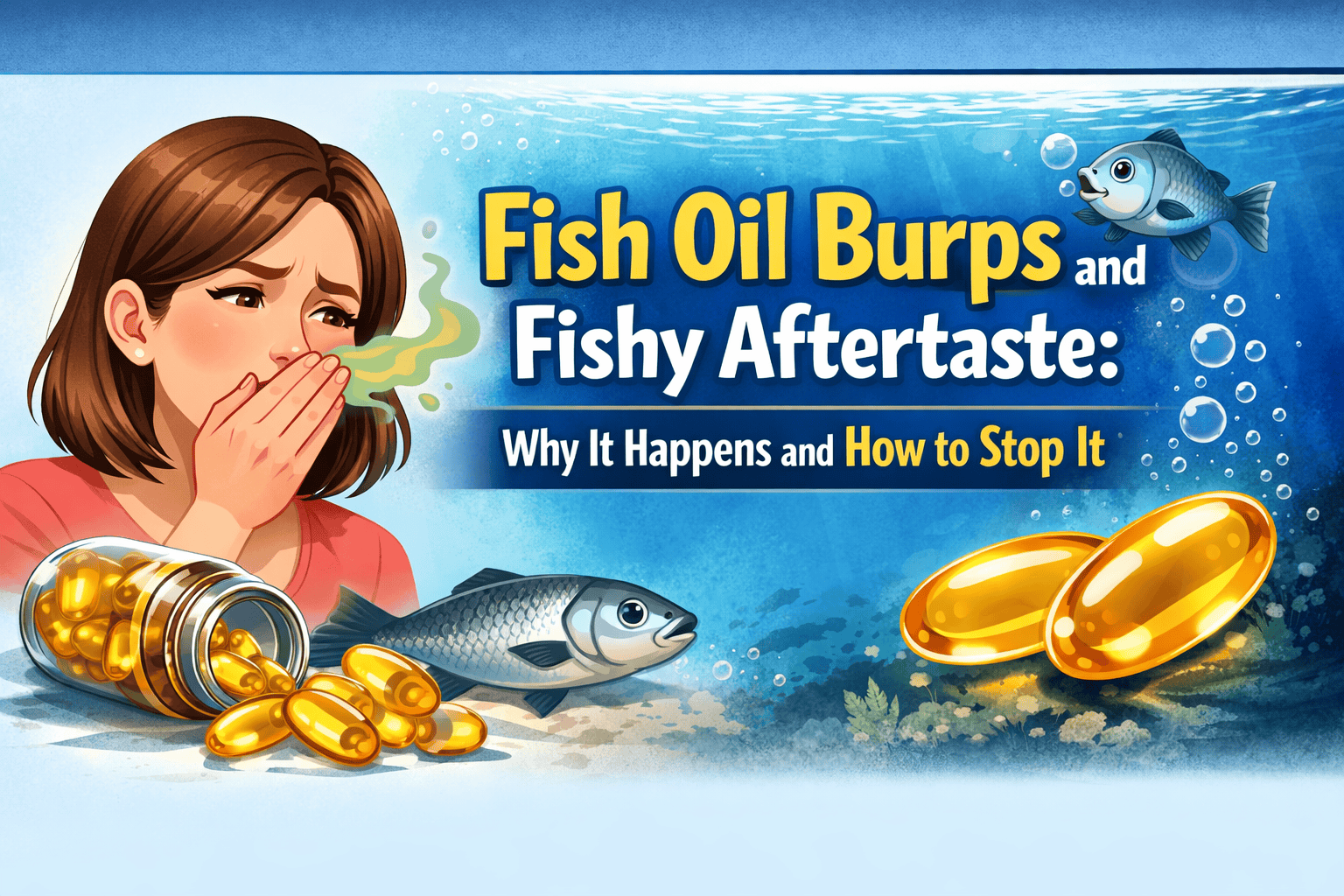
Fish Oil Burps / Fishy Aftertaste: Why It Happens (and How to Stop It)
Fish oil burps usually happen because the oil comes back up after you swallow it, not because fish oil “doesn’t agree with everyone” in some mysterious way. In practice, the biggest drivers are reflux or regurgitation, taking it under the wrong conditions for your stomach, taking too much at once, or using a product that tastes or smells more fishy than it should.
The good news is that fishy burps are often fixable. The bad news is that not every popular trick works equally well, and a fishy aftertaste does not automatically prove that your supplement is rancid. This page keeps it practical: why it happens, what actually helps, when to switch products, and when the problem is probably reflux rather than the oil itself.
This page covers fish oil burps, fishy aftertaste, and tolerability fixes. It does not re-cover the broader “fish oil side effects” or “omega-3 benefits” topics except where they directly change the burp / aftertaste decision.
Key terms: fishy burps, fishy aftertaste, reflux, regurgitation, oxidation, enteric-coated, omega-3 tolerability
Quick Take
Best first fixes: take fish oil with a real meal, lower the per-dose amount, consider splitting the dose, and switch products if the smell or taste seems persistently off. Most common wrong assumption: every fishy burp means the oil is bad. Sometimes it does. Often it just means the oil came back up.
TL;DR decision
If fish oil keeps repeating on you, first try taking it with a substantial meal and using a smaller per-dose amount. If the problem persists, switch products rather than endlessly forcing hacks. If you also get heartburn or reflux, treat that as part of the problem, because fish oil burps are often a reflux-style tolerability issue more than an omega-3 issue.
Evidence standard: human trials, dose ranges, guideline-level sources when available
Who this is for: people who want omega-3 benefits but keep getting fish oil burps, fishy taste, or reflux-like side effects.
Who this is not for: anyone with fish allergy, persistent reflux symptoms, vomiting, trouble swallowing, or medication-related concerns who needs more than a supplement-fix article.
Reviewed by: VerifiedSupps Editorial Team
Last reviewed: March 10, 2026
Parent Hub
Omega-3 Complete Guide
Use the broader omega-3 guide if you want the full map of benefits, dosing, timing, forms, and safety. This page stays tightly focused on fish oil burps and fishy aftertaste.
Fish oil burps quick decoder
This is the fastest way to decide what to try first.
| If your pattern is… | Most likely reason | Best next step | What not to assume |
|---|---|---|---|
| You mainly burp it when you take it fasted or with coffee | Reflux/regurgitation timing issue | Take it with a real meal and reduce the per-dose amount | That the product is automatically rancid |
| You get fishy taste plus heartburn or reflux | Upper-GI reflux pattern | Lower dose, take with food, or switch product | That more hacks will fix persistent reflux |
| It tastes fishy even before or right after swallowing | Sensory issue or product-quality issue | Switch product and check storage/freshness | That all fish oil products are like this |
| You already tried food, splitting, and freezing and still burp it | Poor fit, product issue, or underlying reflux tendency | Switch products or stop forcing the same one | That the answer is always “freeze it harder” |
Best next step today: if fish oil burps keep happening, stop taking it fasted and stop testing random tricks one by one without changing the actual product or meal timing.
Why do fish oil burps happen?
Fish oil burps usually happen because some of the oil comes back up into the esophagus or mouth after you swallow it. That makes the taste and smell obvious. In other words, the problem is often regurgitation or reflux of the oil, not the omega-3s themselves doing something exotic inside your body.
Mechanism
- Oil reflux: if the capsule opens in the stomach and some contents come back up, you taste it.
- GI sensitivity: heartburn, reflux, or taking it under the wrong stomach conditions can make this more likely.
- Product smell/taste: if the oil is more odor-active or oxidized, the aftertaste can be more obvious.
How do you stop fish oil burps?
The highest-ROI fixes are boring: take it with food, use a smaller per-dose amount, split the dose, and switch products if needed. Those changes solve more real-world fish oil burp problems than most supplement “hacks.”
What would change my recommendation?
- If you also have frequent heartburn, throat burn, or reflux symptoms, I would think more about upper-GI tolerance than about supplement tricks.
- If the product smells off before you take it, I would switch products faster rather than trying to “make it work.”
- If you only burp fish oil when you take a very high single dose, I would split the dose before doing anything else.
- If you have tried food, smaller dose, and product switching already, I would stop treating it like a minor hack problem and assume this product category may just not fit your stomach well.
- Take it with a real meal: this is still the cleanest first adjustment.
- Reduce the per-dose oil load: smaller doses are often easier to tolerate.
- Split the dose: morning and evening can be easier than one large slug.
- Switch brands or forms: if the product tastes fishy even before you swallow it, stop trying to rescue it.
Should you take fish oil with food or on an empty stomach?
If fish oil burps are your problem, take it with food. That is the most sensible real-world default, even though the small pilot data on food versus no food versus milk versus freezing did not show a strong statistically significant tolerability winner overall.
- Why food still makes sense: it is a cleaner reflux and stomach-tolerance strategy.
- Why I would not oversell it: the human evidence for “take with food and the burps vanish” is limited.
- Best practical rule: if fasted dosing gives you fishy burps, stop doing that first.
Does freezing fish oil capsules work?
Sometimes anecdotally, but the best direct trial evidence does not show a clear overall advantage. Freezing is not crazy, but it is also not the magic answer the internet makes it sound like.
- Why people try it: the capsule may open later, which might reduce regurgitation for some users.
- What the trial found: no significant reduction in adverse effects compared with other administration methods overall.
- Best use of this trick: try it once if you want, but do not keep doing it forever if the real fix is clearly dose, food, or a different product.
Does a fishy aftertaste mean your fish oil is bad or rancid?
Not automatically. A fishy aftertaste can happen simply because the oil comes back up. But oxidation can contribute to fishy odor and off-flavor, so a persistently strong, stale, or unpleasant smell is one reason to stop forcing the same product.
- Why oxidation matters: oxidized omega-3 oils generate volatile odor compounds that smell fishy or off.
- Why you should not overdiagnose it: not every burp means the product is oxidized.
- Useful rule: if the capsule smells unpleasant before use or the oil tastes obviously stale, switch rather than rationalize it.
Are enteric-coated or “burpless” fish oil supplements better?
They might help some people, especially if the main issue is where the capsule opens, but the comparative evidence is still thinner than the marketing language. “Burpless” is a reasonable product feature to try — not a guarantee.
- Most honest framing: possible benefit, limited proof.
- Good reason to try: you already know your main issue is repeat-back or reflux-style taste.
- Do not forget basics: food, smaller per-dose amount, and switching stale-tasting products still matter more.
Why am I still getting fish oil burps after trying everything?
Usually because the problem is no longer a simple “supplement trick” problem. At that point, the likely answers are: this product is a poor fit, your reflux tendency is real, or the actual dose/setup is still not as stable as you think.
Common mistakes
- Taking a large single dose and calling it “the same” as a split dose
- Trying freezing or food without ever switching the actual product
- Ignoring obvious reflux or heartburn symptoms
- Assuming a fishy smell always means “normal for fish oil”
- Forcing a product that clearly makes you feel worse when a different formula or food-based omega-3 strategy would be easier
Clean test protocol
| Inputs | One product, one meal timing strategy, smaller per-dose amount, and no extra hacks changing every day |
|---|---|
| Duration | 3–7 days is enough for a tolerability test |
| 3 metrics | Fishy burps, fishy aftertaste, and any heartburn/reflux symptoms |
| Stop conditions | Persistent reflux, nausea, vomiting, clear intolerance, or obvious product-quality concerns |
How to tell it’s working
For this topic, “working” means the sensory problem becomes small enough that you stop thinking about it. That is the real win. If you are still negotiating with every dose, the setup is still wrong.
Red flags / seek care
Persistent heartburn, trouble swallowing, repeated vomiting, black stools, suspected allergy, or ongoing upper-GI symptoms should be treated as more than a simple fish oil burp problem.
Selected Professional References
External links only. These are rendered as premium clickable tabs so you can audit the claims quickly.
Omega-3 Fatty Acids — Health Professional Fact Sheet
Best official source for the common mild side effects list, including unpleasant taste and GI symptoms.
Used for: baseline side-effect framing
Omega-3 Supplements: What You Need To Know
Useful because it plainly lists unpleasant taste, bad breath, heartburn, nausea, and diarrhea as common mild side effects.
Used for: user-facing tolerability guidance
Effect of Fish Oil Supplement Administration Method on Tolerability
Best direct source for the popular hacks question because it compared food, milk, empty stomach, and frozen capsules and did not find a strong overall tolerability winner.
Used for: freezing / food / hack realism
Taste Perception of Nutrients Found in Nutritional Supplements
Best explanation for why oxidation matters to odor and off-flavor, because it discusses volatile odor compounds and the fishy smell problem directly.
Used for: fishy aftertaste and oxidation logic
Australian and New Zealand Fish Oil Products in 2016 Meet Label Claims and Are Not Oxidized
Useful because it keeps the discussion honest: fishy burps do not automatically prove that all fish oil supplements are oxidized or low quality.
Used for: not-every-burp-means-rancid framing
Go Deeper (VerifiedSupps Guides)
These are the cleanest next reads if you want to fix the bigger omega-3 setup instead of just the burps.
Fish Oil Side Effects: What’s Normal (and How to Fix It)
Best next read if you want the full side-effect map beyond fishy burps.
Best Time of Day to Take Omega-3
Best next read if timing and meal pairing are the real issue.
Triglyceride vs Ethyl Ester Fish Oil
Best next read if formulation and absorption are part of the tolerability question.
Is Fish Oil Safe to Take Every Day?
Best next read if you want the broader daily-use safety context.
Final Takeaway
Fish oil burps are usually a tolerability problem, not a mystery and not automatic proof that fish oil “isn’t for you.” Start with food, smaller per-dose amounts, and a better product. If the problem persists after a clean test, stop forcing the same setup. A supplement that keeps repeating on you is not a good long-term routine, even if the label looks impressive.
FAQ
Why do fish oil burps happen?
They usually happen because some of the oil comes back up after swallowing, especially when reflux, stomach sensitivity, or strong product odor are part of the picture.
How do you stop fish oil burps?
The highest-ROI fixes are taking it with food, lowering the per-dose amount, splitting the dose, and switching products if needed.
Should you take fish oil with food or on an empty stomach?
If fish oil burps are your problem, taking it with a real meal is the more sensible default, even though strong trial evidence for a perfect timing fix is limited.
Does freezing fish oil capsules work?
Sometimes anecdotally, but the best direct trial evidence does not show a clear overall advantage.
Does a fishy aftertaste mean fish oil is rancid?
Not automatically. It can simply mean the oil came back up, but oxidation can contribute to stale or fishy smell and taste.
Are enteric-coated or burpless fish oil supplements better?
They might help some people, especially if capsule opening location matters, but the evidence is thinner than the marketing usually suggests.
Why does fish oil give me heartburn?
Fish oil can trigger reflux-style symptoms in some people, which is why fishy burps and heartburn often show up together.
Should I switch brands if fish oil burps don’t stop?
Yes. If meal timing, smaller doses, and a clean trial do not help, switching products is often smarter than endlessly forcing the same one.
When should I stop taking fish oil and get medical advice?
Persistent reflux, trouble swallowing, vomiting, black stools, suspected allergy, or ongoing upper-GI symptoms deserve medical evaluation rather than more supplement hacks.
VerifiedSupps Medical Disclaimer
This content is for informational and educational purposes only and does not constitute medical advice. Fish oil and omega-3 supplements can cause mild side effects and may interact with certain medications, especially blood thinners and some cardiovascular treatments. Consult a qualified healthcare professional before starting or changing supplementation, especially if you have fish allergy, reflux disease, trouble swallowing, bleeding-risk conditions, or significant gastrointestinal symptoms. Seek medical evaluation for severe or persistent symptoms.