GHK-Cu Copper Peptide: The Complete 2026 Guide to Benefits, Science & Best Skincare Serums
GHK-Cu, also called copper tripeptide-1, is a copper-binding peptide used in skincare for firmness, texture, fine lines, and skin repair support. The science is promising, especially for tissue repair and visible skin aging, but it is not a miracle ingredient and should not replace sunscreen, retinoids, or a basic barrier-supportive routine.
The best GHK-Cu skincare serums are usually leave-on formulas that combine copper peptides with hydrating or barrier-friendly ingredients, rather than aggressive actives. Results are typically gradual and depend heavily on formulation, consistency, and skin tolerance.
This guide focuses on topical GHK-Cu skincare serums and cosmetic use, not injectable GHK-Cu, medical wound care, or gray-market peptide products.
Who this is for: Readers considering a copper peptide serum for fine lines, firmness, texture, or skin barrier support.
Who this is not for: Anyone looking for injectable GHK-Cu protocols, scar treatment plans, or a replacement for dermatologist-directed care.
Reviewed by VerifiedSupps Editorial Team • Last reviewed: May 15, 2026
The practical answer: GHK-Cu is one of the more interesting cosmetic peptides, but it works best as a supportive skin-health ingredient. It may help improve the look of firmness, fine lines, skin texture, and recovery over time, but it is not as proven as daily sunscreen for aging prevention or prescription retinoids for collagen remodeling.
The strongest case for GHK-Cu is its biological role in tissue repair, extracellular matrix signaling, and wound-healing pathways. The weaker part is consumer skincare translation: many finished serums do not publish independent clinical data, and ingredient lists rarely tell you enough about stability, delivery, or real skin penetration.
A smart routine treats copper peptides as a gentle “repair support” layer. If your skin is already irritated from acids, retinoids, over-cleansing, or too many actives, simplifying the routine may matter more than adding another serum.
For a broader peptide-safety overview, read our guide on whether peptides are safe. For a related skin and hair angle, see our article on GHK-Cu for skin and hair.
Key Takeaways
- GHK-Cu is a copper-bound tripeptide used in skincare for visible firmness, texture, fine lines, and repair support.
- The evidence is strongest for biological plausibility, wound-healing pathways, and small cosmetic studies, not dramatic anti-aging transformation.
- The best copper peptide serum is not always the strongest one; stability, delivery, and skin tolerance matter more than chasing a high percentage.
- Use GHK-Cu on clean skin before moisturizer, and consider separating it from strong acids, retinoids, and low-pH vitamin C unless the product instructions say otherwise.
- Topical copper peptides are generally well tolerated, but irritation, dryness, stinging, breakouts, or sensitivity can happen.
- Injectable GHK-Cu is a different safety category and should not be treated like a normal skincare serum.
Does GHK-Cu copper peptide actually work for skin?
GHK-Cu appears to have real biological activity in skin-related pathways, but the cosmetic evidence is still moderate rather than definitive. It is best understood as a supportive repair and healthy-aging ingredient, not a fast wrinkle eraser.
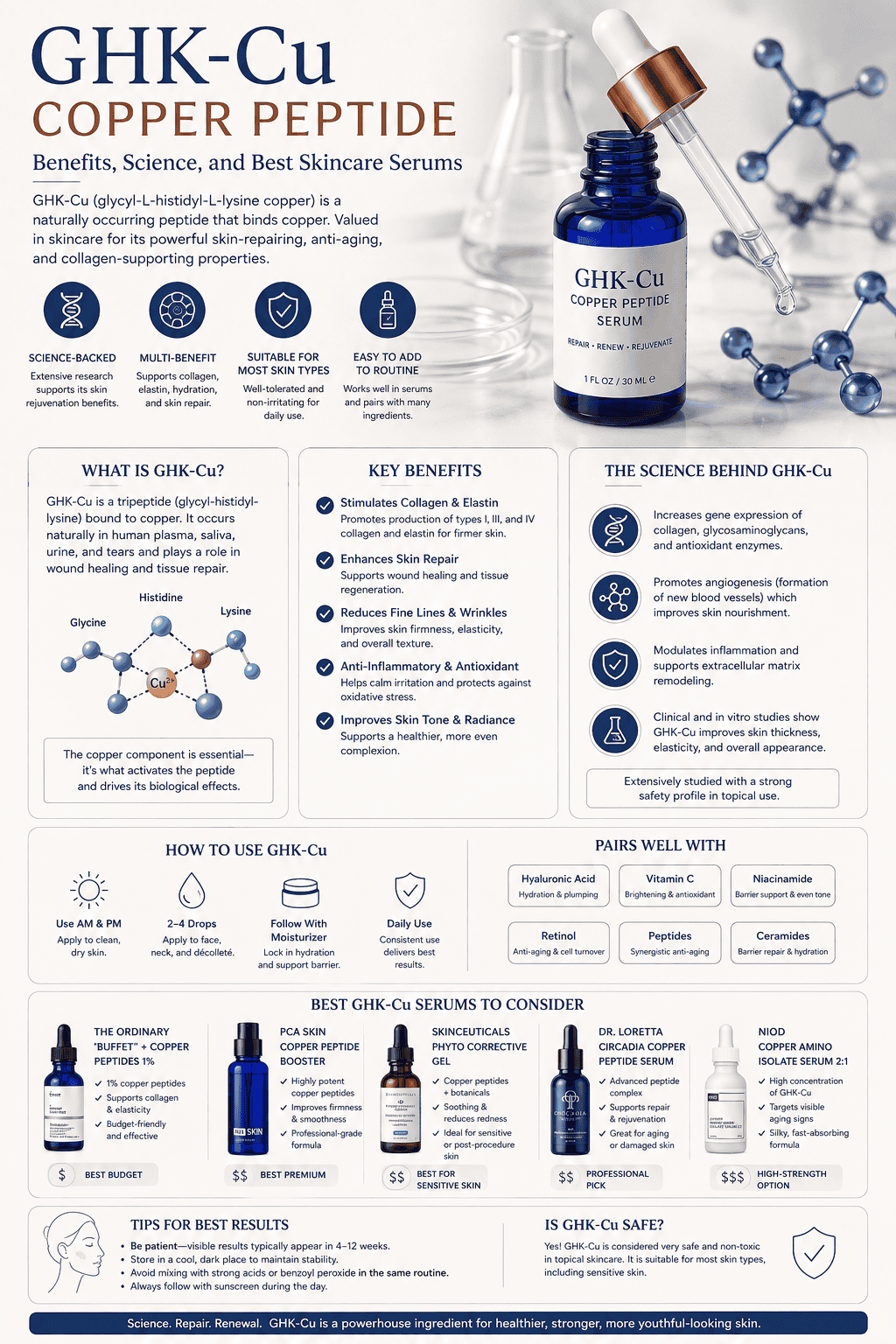
GHK-Cu stands for glycyl-L-histidyl-L-lysine copper. In skincare ingredient lists, it may appear as copper tripeptide-1, GHK-Cu, copper peptide, or a copper peptide complex.
Mechanism
- GHK binds copper ions, which may help support normal tissue-repair signaling and extracellular matrix remodeling.
- Laboratory and review data suggest GHK-Cu can influence collagen, elastin, glycosaminoglycans, antioxidant defenses, and inflammatory signaling.
- Small cosmetic studies suggest potential improvements in skin density, firmness, fine lines, and wrinkle appearance.
- Mechanism does not guarantee visible results. Finished product formulation, delivery, consistency, and baseline skin health all matter.
This is similar to how many peptide topics should be interpreted: mechanism first, outcome second. A peptide can look biologically interesting without being proven as a major real-world intervention. The same caution applies to other repair-focused peptides covered on VerifiedSupps, including BPC-157, TB-500, and KPV peptide.
What are the main GHK-Cu benefits for wrinkles, firmness, and skin repair?
The most realistic GHK-Cu benefits are gradual improvements in skin texture, hydration support, visible firmness, and the appearance of fine lines. The strongest claims are about supporting repair pathways, not reversing aging.
For everyday skincare, GHK-Cu may be useful when your goal is to support healthier-looking skin without relying only on strong exfoliants or retinoids.
- Fine lines: Some studies and product data suggest copper peptides may reduce the appearance of fine lines over several weeks, especially when paired with good hydration.
- Firmness: GHK-Cu is often studied in the context of collagen, elastin, and dermal density, which may support a firmer look over time.
- Skin texture: A well-formulated copper peptide serum may help skin look smoother and more even, especially when barrier irritation is under control.
- Repair support: GHK-Cu has a long research history in tissue repair and wound-related models, but cosmetic use is not the same as medical wound treatment.
- Barrier-friendly aging support: Copper peptides may fit people who do not tolerate frequent acids or high-strength retinoids.
The conservative takeaway: GHK-Cu can be a useful supporting ingredient, but it should sit behind the fundamentals. Sunscreen, gentle cleansing, moisturizer, sleep, adequate protein, and overall nutrition still matter. For nutrition support that overlaps with skin health, see our guides to omega-3 for skin and hair and zinc benefits.
What is the best GHK-Cu serum in 2026?
The best GHK-Cu serum is the one your skin can tolerate consistently. For most people, that means a leave-on serum with copper tripeptide or copper peptides, a gentle base, hydrating ingredients, and clear usage instructions.
Because most brands do not publish independent head-to-head clinical trials, “best” should be judged by formula transparency, skin feel, compatibility, packaging, and whether the product fits your routine.
| Best fit | What to look for | Example serum type | Main caution |
|---|---|---|---|
| Budget-friendly copper peptide serum | Clear copper peptide labeling, simple water-based texture, no heavy fragrance | The Ordinary Multi-Peptide + Copper Peptides 1% Serum | Follow compatibility guidance; not every skin type tolerates it daily at first |
| Advanced copper peptide focus | Dedicated copper peptide system, stability-focused formulation, lightweight layering | NIOD Copper Amino Isolate Serum 3 1:1 | More expensive and may be more than a beginner routine needs |
| Dry or dehydrated skin | Copper peptide plus humectants, squalane, or barrier-friendly hydration support | Biossance Squalane + Copper Peptide Rapid Plumping Serum | Hydration can make skin look smoother quickly, but that is not the same as deep wrinkle correction |
| Sensitive or reactive skin | Minimal fragrance, slower introduction, barrier-supportive moisturizer, patch testing | A gentle peptide serum used 2–3 nights per week at first | Copper peptides can still sting or irritate compromised skin |
A good rule: do not buy a serum only because it says “GHK-Cu” on the front. Check the full ingredient list, whether the brand gives clear directions, whether the formula contains known irritants for your skin, and whether it fits around the rest of your actives.
If you tend to overbuild routines, our guide on how to choose supplements without guesswork has the same basic lesson for skincare: start with the problem, then choose the tool. Do not collect actives just because they sound advanced.
How do you use GHK-Cu serum for best results?
Use GHK-Cu serum after cleansing and before moisturizer, usually once daily or a few times per week at first. The best routine is consistent, gentle, and not overloaded with strong actives in the same step.
A simple routine is usually enough:
- Step 1: Cleanse with a gentle cleanser.
- Step 2: Apply a thin layer of GHK-Cu serum to dry or slightly damp skin, depending on product directions.
- Step 3: Apply moisturizer to reduce dryness or irritation risk.
- Step 4: Use sunscreen in the morning. Copper peptides do not replace UV protection.
- Start 2–3 times per week if your skin is sensitive, then increase only if your skin stays calm.
Most people should judge results over 8–12 weeks, not a few days. Early “plumping” may come from hydration. Changes in firmness, texture, or fine lines are usually slower and less dramatic.
If your skin barrier is already irritated, pause the extra actives and rebuild tolerance first. A copper peptide serum works better in a stable routine than in a routine that is already causing redness, peeling, burning, or tightness.
What should you not mix with copper peptides?
The conservative approach is to separate copper peptides from strong acids, high-strength retinoids, and low-pH vitamin C unless the product instructions specifically allow the combination. This is partly about ingredient stability and partly about reducing irritation.
Different brands give different compatibility advice, so the label should come first. When in doubt, alternate routines rather than stacking everything at once.
| Ingredient | Best approach | Why it matters |
|---|---|---|
| AHA/BHA acids | Use on alternate nights or separate routines | Low-pH acids can increase irritation and may not be ideal with peptide formulas |
| Retinoids | Separate if your skin is sensitive or the brand advises against combining | Both can be useful, but combining too many actives can impair tolerance |
| Pure vitamin C or low-pH ascorbic acid | Use vitamin C in the morning and copper peptide at night, or alternate days | Some brands recommend avoiding strong antioxidants in the same routine |
| Benzoyl peroxide | Separate routines | Can be drying and may increase irritation when layered with multiple actives |
| Moisturizer and hyaluronic acid | Usually compatible | Hydration and barrier support can improve comfort and consistency |
A simple schedule might be copper peptide on recovery nights, retinoid on separate nights, and acids only when your skin actually needs exfoliation. More actives do not automatically mean better skin.
Is GHK-Cu safe, and what are the side effects?
Topical GHK-Cu skincare is generally considered low risk for many people, but it can still cause irritation. The most common issues are stinging, redness, dryness, tightness, breakouts, or sensitivity, especially when layered with other strong actives.
The bigger safety issue is confusing topical skincare with injectable peptide use. Injectable GHK-Cu is not the same category as a cosmetic serum.
- Topical cosmetic use: Usually applied in small amounts to the skin and regulated as skincare when sold as a cosmetic product.
- Injectable use: Carries a different risk profile, including sterility, dosing, impurities, immune reactions, and lack of adequate human safety data.
- Overuse: Too much product or daily use too soon may make skin feel worse, not better.
- Compromised skin: Burning, peeling, open wounds, eczema flares, or recent procedures should be handled with a clinician’s guidance.
The FDA has specifically flagged compounded injectable GHK-Cu as a potential safety concern because of limited human safety data and possible immunogenicity risks from aggregation or peptide-related impurities. That warning is about injectable compounded drug products, not ordinary over-the-counter cosmetic serums.
For a broader look at how anti-aging peptide claims can outrun the evidence, see our article on Epitalon peptide. Different peptide, same principle: separate mechanism from proven outcomes.
Who should avoid GHK-Cu or be cautious?
People with very reactive skin, active dermatitis, recent skin procedures, copper metabolism disorders, or unexplained irritation should be cautious with GHK-Cu. Most users should patch test before applying it to the full face.
GHK-Cu is not automatically unsafe, but it is not automatically necessary either. The decision should depend on your skin goal, current routine, and tolerance.
- Avoid during active irritation: If your skin is burning, peeling, or inflamed, simplify first.
- Be cautious after procedures: Ask your dermatologist before using copper peptides after lasers, microneedling, peels, or surgery.
- Patch test if sensitive: Apply a small amount to one area for several days before full-face use.
- Do not use as medical wound care: Cosmetic GHK-Cu serums are not substitutes for proper wound treatment.
- Avoid injectable gray-market products: Sterility, identity, purity, and dosing are not guaranteed.
The best candidate for a GHK-Cu serum is someone with stable skin who wants a gentle support ingredient for firmness, texture, and visible repair. The worst candidate is someone already using too many actives and hoping one more product will fix a damaged barrier.
Is GHK-Cu better than retinol, vitamin C, or other peptides?
GHK-Cu is not clearly better than retinol or vitamin C. It is better viewed as a different tool: gentler, repair-oriented, and potentially useful for people who want peptide-based support without relying only on stronger actives.
Retinoids have stronger evidence for photoaging and collagen remodeling. Vitamin C has stronger evidence for antioxidant support, pigmentation support, and photodamage-related routines. GHK-Cu has a more repair-signaling and skin-density angle, but finished-product evidence is less mature.
- Choose GHK-Cu if: you want a gentle serum for firmness, texture, and recovery support.
- Choose retinoids if: your main goal is stronger evidence-based anti-aging and your skin tolerates them.
- Choose vitamin C if: your main goals are antioxidant support, dullness, uneven tone, or morning photoprotection support.
- Combine carefully: It may be smarter to rotate actives than to layer them all at once.
A steady, non-irritating routine usually beats an advanced routine that your skin cannot tolerate. That same principle applies across supplement and skincare decisions: the best ingredient is the one that fits the real problem and can be used consistently.
References
- Pickart L, Vasquez-Soltero JM, Margolina A. Regenerative and Protective Actions of the GHK-Cu Peptide in the Light of the New Gene Data. International Journal of Molecular Sciences. 2018.
This review supports the biological plausibility of GHK-Cu in tissue repair, skin remodeling, antioxidant signaling, and anti-inflammatory pathways. It also summarizes older cosmetic studies on skin appearance and density.
- Pickart L, Vasquez-Soltero JM, Margolina A. GHK Peptide as a Natural Modulator of Multiple Cellular Pathways in Skin Regeneration. BioMed Research International. 2015.
This source supports the discussion of GHK-Cu as a signaling peptide involved in skin regeneration, collagen-related pathways, and wound-healing biology.
- Badenhorst T, Svirskis D, Merrilees M, Bolke L, Wu Z. Effects of GHK-Cu on MMP and TIMP Expression, Collagen and Elastin Production, and Facial Wrinkle Parameters. Journal of Aging Science. 2016.
This study supports the article’s cautious discussion of small clinical data, including reduced wrinkle volume and depth after topical GHK-Cu in a nano-carrier system. The study is useful but should not be treated as definitive evidence for all commercial serums.
- Hostynek JJ, Dreher F, Maibach HI. Human Skin Penetration of a Copper Tripeptide in vitro as a Function of Skin Layer. Inflammation Research. 2010.
This source supports the skin-penetration discussion and the importance of formulation and delivery for copper tripeptide products.
- Mortazavi SM, et al. Topically Applied GHK as an Anti-Wrinkle Peptide. BioImpacts. 2024/2025.
This review supports the balanced framing that GHK-Cu and related GHK derivatives are promising anti-wrinkle ingredients, while clinical and permeability data remain limited.
- Borkow G. Using Copper to Improve the Well-Being of the Skin. Current Chemical Biology. 2014.
This review supports the broader context for copper in skin biology, including copper-dependent processes related to collagen, elastin, antioxidant enzymes, and tissue repair.
- U.S. Food and Drug Administration. Certain Bulk Drug Substances for Use in Compounding That May Present Significant Safety Risks. Updated 2026.
This FDA source supports the caution that compounded injectable GHK-Cu may pose immunogenicity concerns and has limited human safety data. This is separate from ordinary topical cosmetic serums.
- The Ordinary. Multi-Peptide + Copper Peptides 1% Serum.
This product source supports the article’s example of a widely available copper peptide serum and its usage and compatibility guidance.
- NIOD. Copper Amino Isolate Serum 3 1:1.
This product source supports the article’s example of a copper peptide-focused serum designed around GHK-Cu and skin appearance support.
- Biossance. Squalane + Copper Peptide Rapid Plumping Serum.
This product source supports the article’s example of a copper peptide serum paired with hydration-focused ingredients for dry or dehydrated skin routines.
FAQ
What is GHK-Cu copper peptide?
GHK-Cu is a copper-bound tripeptide also known as copper tripeptide-1. In skincare, it is used to support the look of firmness, texture, fine lines, and skin repair.
Does GHK-Cu reduce wrinkles?
It may help reduce the appearance of fine lines and wrinkles over time, especially in well-formulated serums. The evidence is promising but not as strong as the evidence for sunscreen, retinoids, or dermatologist-directed treatments.
How long does GHK-Cu take to work?
Most people should judge topical GHK-Cu over 8–12 weeks. Hydration-related plumping may appear sooner, but firmness and texture changes are usually gradual.
Can you use GHK-Cu every day?
Many people can use copper peptide serums daily, but sensitive skin should start 2–3 times per week. Increase only if your skin stays calm.
Can you use copper peptides with retinol?
Some people tolerate both, but it is often smarter to separate them into different nights, especially if your skin is sensitive. Follow the specific product directions.
Can you use copper peptides with vitamin C?
It is usually best to separate copper peptides from low-pH pure vitamin C unless the brand says the formula is compatible. A simple option is vitamin C in the morning and copper peptide at night.
Is GHK-Cu better than retinol?
No, not in a broad evidence-based sense. Retinoids have stronger data for photoaging, while GHK-Cu may be a gentler repair-support ingredient for people who want peptide-based skin support.
Is injectable GHK-Cu safe?
Injectable GHK-Cu should not be treated like skincare. The FDA has flagged compounded injectable GHK-Cu as a potential safety concern because of limited human safety data and possible immunogenicity risks.
Medical Disclaimer
This article is for educational purposes only and does not provide medical advice, diagnosis, or treatment. Topical GHK-Cu skincare products may cause irritation or sensitivity, especially when combined with strong actives. Do not use cosmetic copper peptide serums as medical wound care or after skin procedures unless advised by a qualified clinician. Injectable GHK-Cu and gray-market peptide products carry different safety risks and should not be used without appropriate medical oversight and regulatory safeguards.