By VerifiedSupps Editorial Team
KPV Peptide Benefits: Inflammation, Gut Health, Wound Healing, and What the Evidence Actually Shows
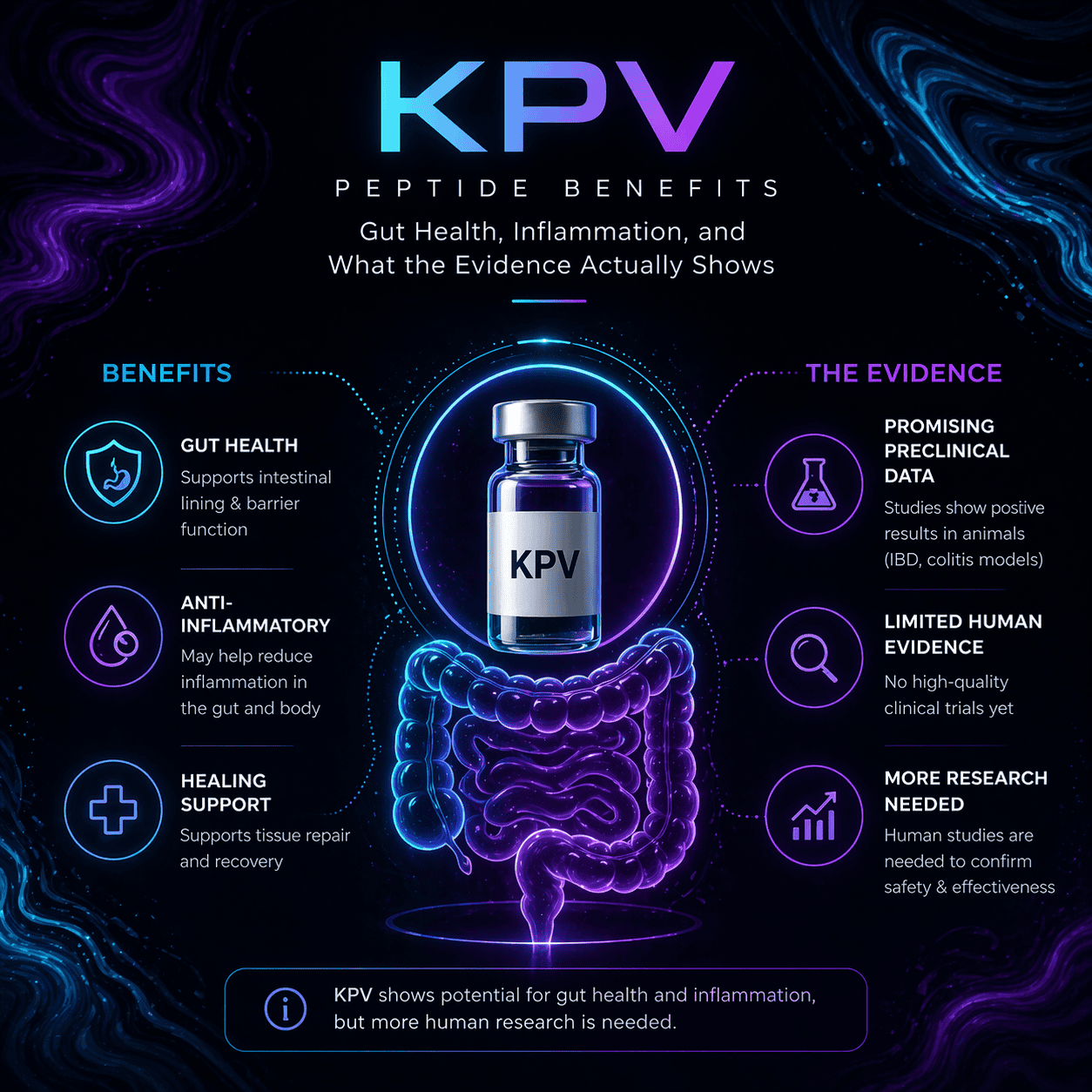
KPV is a real anti-inflammatory tripeptide with an interesting research story. It comes from the C-terminal sequence of alpha-melanocyte-stimulating hormone and has shown anti-inflammatory activity in cell, animal, gut-inflammation, and wound-healing models.
The problem is not that KPV has no biological rationale. The problem is that the human evidence is far thinner than the online claims. The strongest current case is “promising preclinical anti-inflammatory peptide,” not “proven treatment for ulcerative colitis, skin disease, leaky gut, or systemic inflammation.”
This page focuses on what KPV is, what it may help with, where the evidence is strongest, what is still unproven, and why the current FDA compounding and safety picture matters.
Key terms: KPV, Lys-Pro-Val, alpha-MSH, melanocortin peptide, PepT1, NF-κB, MAPK, inflammatory bowel disease, wound healing, inflammatory conditions
Quick Take
KPV looks most interesting for inflammation biology, especially gut inflammation and epithelial repair models. But it is not a clinically settled peptide. The biggest evidence gap is simple: strong lab and animal data have not yet become strong human treatment data.
TL;DR decision
KPV is worth watching, especially for inflammatory bowel disease, skin inflammation, and wound-healing research. It is not worth treating like a proven anti-inflammatory therapy or a routine injectable wellness peptide.
Evidence standard: human trials, dose ranges, guideline-level sources when available
Who this is for: people hearing about KPV for inflammation, gut health, wound healing, skin issues, or immune balance and wanting a careful evidence-based read
Who this is not for: anyone looking for gray-market sourcing, injection protocols, or reassurance that KPV is already a proven treatment
Reviewed by: VerifiedSupps Editorial Team
Last reviewed: April 20, 2026
Parent Hub
VerifiedSupps Articles
Browse the broader article hub if you want a calmer framework before treating every peptide with a repair or inflammation story as equally proven.
KPV evidence decoder: what is strong, weak, and still unknown?
This is the fastest way to see why KPV is interesting without turning it into a proven human therapy.
| If your real goal is… | Best current answer | Why | Best honest framing |
|---|---|---|---|
| Reducing inflammatory signaling | Strong preclinical signal | Cell and animal studies show effects on NF-κB, MAPK, and inflammatory cytokine pathways | Mechanistically credible |
| IBD, ulcerative colitis, or gut inflammation | Promising but not proven | Mouse colitis and targeted-delivery studies are encouraging, but human clinical treatment data are not strong | Research interest, not replacement care |
| Wound healing or skin inflammation | Biologically plausible | KPV and related melanocortin peptides are being evaluated for wound healing and inflammatory conditions | Interesting, still early |
| A routine approved peptide therapy | No | FDA says it has not identified human exposure data on drug products containing KPV and is still reviewing KPV-related bulk substances | Safety and status remain unsettled |
Best next step (today): Treat KPV as a promising inflammation-research peptide, not as a proven human treatment for gut, skin, or systemic inflammatory conditions.
Does KPV peptide actually work for inflammation?
KPV clearly has anti-inflammatory activity in research models. The more careful answer is that it has not yet proven itself as a mainstream human anti-inflammatory treatment.
The most repeated research story is that KPV can reduce inflammatory signaling in intestinal epithelial and immune-cell models, including pathways such as NF-κB and MAPK. In animal colitis models, KPV and KPV-based delivery systems have reduced inflammation and supported mucosal healing. That is meaningful biology, but it is still not the same as a reliable clinical outcome in people.
Mechanism
- KPV is the Lys-Pro-Val tripeptide sequence associated with alpha-MSH’s anti-inflammatory activity.
- In gut models, KPV can be transported through PepT1 and appears to reduce inflammatory signaling inside epithelial and immune cells.
- KPV may reduce inflammatory cytokine output and support barrier or mucosal repair in preclinical models, but human translation remains the open question.
What would change my recommendation: well-controlled human trials showing meaningful improvement in a defined inflammatory condition, with clear route, dose, safety monitoring, and clinical outcomes.
What is KPV and how is it supposed to work?
KPV is a three-amino-acid peptide: lysine, proline, and valine. It is commonly described as the C-terminal tripeptide fragment of alpha-MSH, a melanocortin peptide with broad immunomodulatory activity.
That origin matters because KPV is often discussed as a smaller way to capture some of alpha-MSH’s anti-inflammatory effects without carrying every effect of the full parent peptide. The appeal is simplicity: a tiny peptide with a focused anti-inflammatory signal.
What makes it interesting
It can affect inflammatory signaling in models using very small concentrations and has been studied in gut, skin, antimicrobial, and epithelial repair contexts.
What limits the story
A peptide can look impressive in cells and animals while still failing to become a safe, practical, effective human therapy.
Is KPV better supported for gut inflammation, skin, or wound healing?
The gut-inflammation story is the most developed scientifically. Skin and wound healing are plausible and actively discussed, but the direct human confidence is still low.
Gut inflammation
KPV has been studied in colitis models, PepT1-mediated delivery, and nanoparticle systems designed to target inflamed intestinal tissue. This is the strongest mechanistic lane.
Wound healing
KPV-related melanocortin research suggests possible roles in epithelial repair, inflammatory-cell modulation, and wound biology. FDA is also reviewing KPV-related substances for wound healing and inflammatory conditions.
Skin inflammation
The skin case is mostly an extension of anti-inflammatory and wound-repair biology. It is not yet a settled clinical dermatology use.
So the cleanest ranking is: gut inflammation has the strongest preclinical depth, wound healing has active scientific and regulatory interest, and skin-inflammation claims should stay the most cautious unless better human data appear.
What dose or form of KPV is proven in humans?
There is no proven public-use KPV dose that can honestly be treated as clinically established. That is one of the most important practical points.
Much of the research uses cell models, animal models, or engineered delivery systems such as targeted nanoparticles, microneedle or iontophoresis delivery, and other experimental platforms. Those are not the same thing as a validated oral, nasal, topical, or injectable human protocol.
| Route or form | Evidence reality |
|---|---|
| Oral KPV | Most compelling research involves targeted delivery concepts, not a simple validated oral supplement-style protocol. |
| Topical or transdermal KPV | Experimental delivery work exists, but routine clinical use is not settled. |
| Injectable KPV | FDA says it has not identified human exposure data on drug products containing KPV administered by any route, so confidence should remain low. |
The practical takeaway: delivery is part of the science, not a side detail. A peptide that works in a targeted mouse gut model does not automatically work as an online injection, spray, capsule, or cream.
Is KPV safe right now?
KPV’s safety story is not settled. FDA has said it has not identified human exposure data on drug products containing KPV administered by any route, and that it lacks important information about whether KPV would cause harm in humans.
The current policy picture also is active. FDA’s April 2026 category update says KPV was being removed from Category 2 because the nomination was withdrawn, but FDA also announced that it intends to consult the Pharmacy Compounding Advisory Committee on July 23, 2026 about KPV-related bulk drug substances for possible inclusion on the 503A bulks list.
That is not the same thing as approval. It means KPV is still being evaluated in the compounding-policy context, with wound healing and inflammatory conditions listed as reviewed uses. The safest honest answer is: biologically interesting, human safety not established, current regulatory status not settled.
What should you do before trying KPV?
The smartest move is to stop treating “anti-inflammatory peptide” as a complete answer. KPV may have a real biological signal, but the route, indication, product quality, and human safety evidence matter just as much.
Common mistakes
- Using mouse colitis data as proof that KPV treats human ulcerative colitis or Crohn’s disease.
- Assuming any peptide that reduces NF-κB signaling is automatically safe to inject or take long term.
- Ignoring the route of administration and delivery problem.
- Treating FDA review or PCAC discussion as if it were the same thing as approval.
Clean test protocol
| Inputs | A clearly defined problem, a medical diagnosis when symptoms are significant, and a clear distinction between preclinical anti-inflammatory data and human clinical proof |
|---|---|
| Duration | Reassess when controlled human trials or clearer FDA decisions become available. Until then, treat the evidence as promising but incomplete. |
| 3 metrics | Whether the claim is human or preclinical, whether the delivery route matches the evidence, and whether the use case is a real medical condition rather than vague “inflammation” |
| Stop conditions | Any gray-market product, any claim that KPV replaces medical treatment for IBD or serious wounds, or any decision based mainly on peptide-clinic marketing rather than clinical evidence |
How to tell it’s working
Right now, the better test is whether your framework got cleaner. A good evidence-based read should leave you less impressed by vague “inflammation support” language and more focused on the actual condition, route, evidence tier, and safety status.
Red flags / seek care
Seek medical care for bloody diarrhea, persistent abdominal pain, fever, rapid wound worsening, spreading redness, pus, severe swelling, trouble breathing, or strong reactions after any unverified peptide product.
Selected Professional References
These are the most useful sources for understanding KPV’s anti-inflammatory rationale, gut-delivery research, wound-healing policy context, and current safety status.
FDA Risk Language for KPV
The key official source for why KPV’s human safety story is not settled.
Used for: lack of identified human exposure data and unresolved safety questions
July 2026 PCAC Meeting on KPV-Related Substances
Useful for the current compounding-policy context and the listed evaluated uses.
Used for: wound healing, inflammatory conditions, and current FDA review status
April 2026 503A Category Update
Helpful for understanding why KPV’s policy status is in motion rather than settled.
Used for: KPV category removal notice and planned PCAC consultation
PepT1-Mediated KPV Uptake Reduces Intestinal Inflammation
One of the core papers behind the KPV gut-inflammation mechanism.
Used for: PepT1 transport, NF-κB, MAPK, and cytokine signaling
Melanocortin-Derived Tripeptide KPV in Colitis Models
Important for the preclinical IBD story and why KPV keeps being discussed for gut inflammation.
Used for: murine colitis and anti-inflammatory effects
Hyaluronic Acid KPV Nanoparticles for Ulcerative Colitis Models
Useful because it shows that delivery is central to the KPV gut-health story.
Used for: targeted delivery, mucosal healing, and inflammation reduction in models
KPV and Corneal Epithelial Wound Healing
Helpful for the wound-healing plausibility layer, while keeping the evidence in its proper preclinical context.
Used for: epithelial repair and wound-healing plausibility
The Melanocortin System in Inflammatory Bowel Diseases
A useful review for placing KPV inside the broader melanocortin and gut-inflammation context.
Used for: broader IBD mechanism and research context
Go Deeper (VerifiedSupps Guides)
These are the best next reads if you want the peptide-inflammation and safety cluster to make more sense after the KPV evidence picture is clear.
Are Peptides Safe?
Best next read if you want the broader safety framework before trusting any peptide clinic claim.
BPC-157: What Does It Do?
Useful if you want another gut-and-repair peptide where the evidence is often overstated.
TB-500 for Recovery
Helpful if your next question is how repair peptides differ when the mechanism is wound healing rather than inflammation signaling.
Gut Health Guide
Best next read if your real concern is gut symptoms, barrier support, and inflammation without jumping straight to experimental peptides.
Final Takeaway
KPV is one of the more interesting inflammation peptides because the mechanism is coherent and the preclinical gut-inflammation data are genuinely worth watching. But the gap between “interesting research peptide” and “proven human therapy” is still large. The calm answer is not to dismiss KPV or hype it. It is to place it where it belongs: promising anti-inflammatory biology, incomplete human evidence, and an unsettled safety and regulatory picture.
FAQ
What is KPV peptide?
KPV is a three-amino-acid peptide made of lysine, proline, and valine. It is commonly described as the C-terminal tripeptide fragment of alpha-MSH and is studied for anti-inflammatory activity.
Does KPV actually reduce inflammation?
KPV reduces inflammatory signaling in cell and animal models, including pathways such as NF-kappaB and MAPK. It is not yet proven as a mainstream human anti-inflammatory treatment.
Is KPV good for gut health?
KPV is most interesting in gut-inflammation research, especially colitis and targeted-delivery models. Human clinical evidence for gut conditions is still not strong enough to treat it as established care.
Does KPV help ulcerative colitis or Crohn’s disease?
Animal and delivery studies are promising, but KPV is not a proven treatment for ulcerative colitis or Crohn’s disease and should not replace medical care.
Does KPV help wound healing?
KPV and related melanocortin peptides have wound-healing and epithelial-repair plausibility, but routine human wound-healing use is not settled.
What dose of KPV is proven?
There is no validated public-use KPV dose that can honestly be treated as clinically established. Much of the evidence comes from cell, animal, and experimental delivery-system research.
Is KPV safe?
KPV’s human safety story is not settled. FDA says it has not identified human exposure data on drug products containing KPV administered by any route and lacks important safety information.
Is KPV FDA-approved?
KPV is not a routine approved therapy. FDA is reviewing KPV-related bulk drug substances in the compounding-policy context, but that is not the same as approval.
What is the biggest problem with KPV claims online?
The biggest problem is that preclinical anti-inflammatory data are often presented as if they already prove human clinical benefit.
What is the safest way to think about KPV right now?
Treat KPV as a promising inflammation-research peptide with strong preclinical interest but incomplete human efficacy and safety evidence.
VerifiedSupps Medical Disclaimer
This content is for educational purposes only and is not medical advice. KPV is not a proven or routine FDA-approved therapy for inflammatory bowel disease, wound healing, skin disease, or systemic inflammation. Do not use unverified peptide products as a substitute for diagnosis, prescribed treatment, wound care, or urgent medical attention. Seek care promptly for bloody diarrhea, persistent abdominal pain, fever, rapid wound worsening, spreading redness, pus, trouble breathing, severe swelling, or strong reactions after any peptide product.