By VerifiedSupps Editorial Team
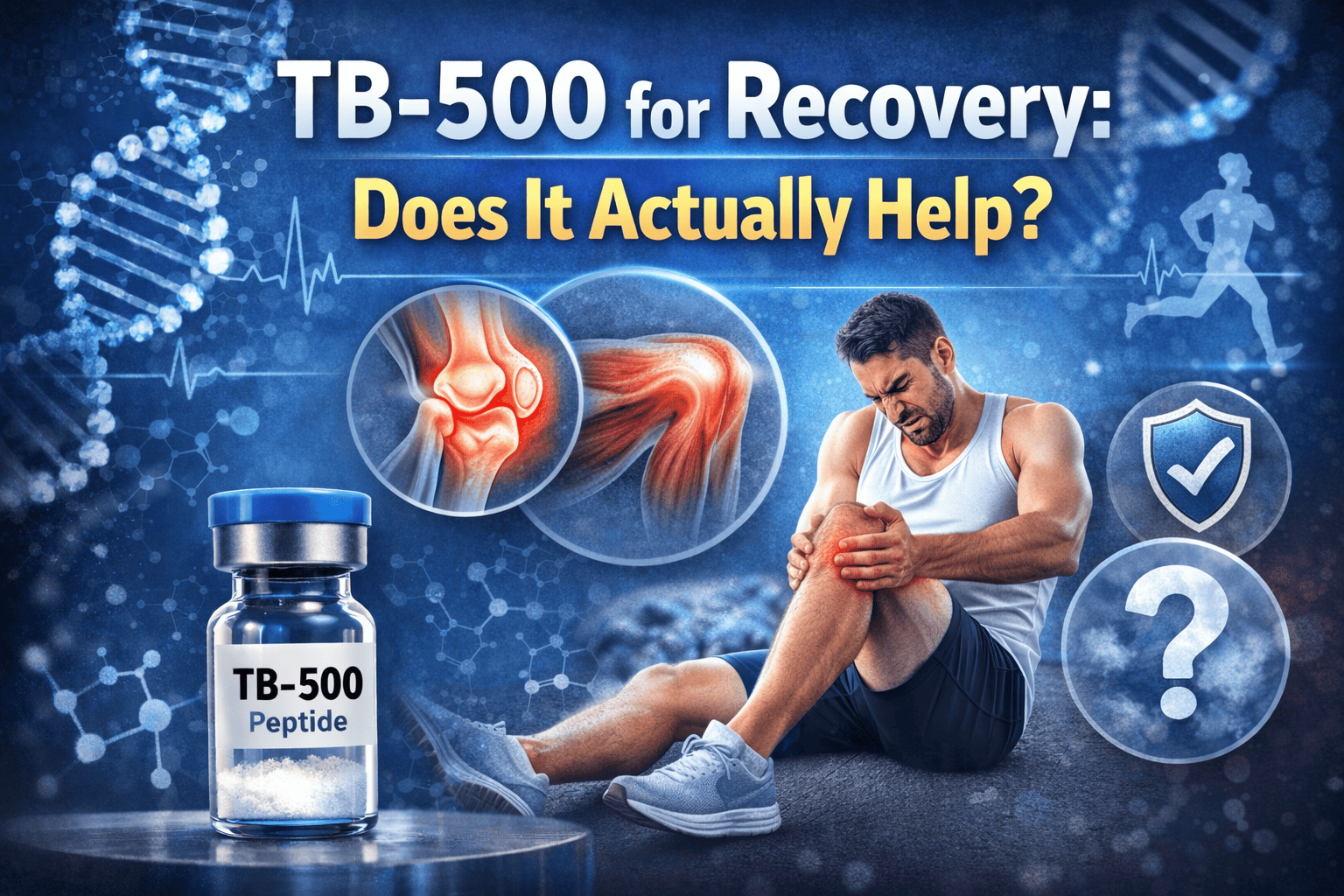
TB-500 (Thymosin Beta-4): Does It Actually Help Recovery?
Maybe in theory. Not proven in the way recovery culture often makes it sound. The current evidence is much stronger for preclinical tissue-repair mechanisms than for real human recovery outcomes.
That distinction matters because TB-500 is easy to misread. Some of the more encouraging human data in this area belong to full-length thymosin beta-4 topical eye or wound-healing programs, while TB-500 itself is usually discussed as a thymosin beta-4 fragment sold into a much grayer recovery and performance market.
This page is for the real recovery question: whether TB-500 has convincing human evidence for tendon, muscle, ligament, or soft-tissue recovery, and how to separate that from broader thymosin beta-4 biology and online hype.
Key terms: TB-500, thymosin beta-4, thymosin beta-4 fragment, LKKTETQ, tissue repair, tendon healing, ligament recovery, recovery peptides
Quick Take
TB-500 has a plausible recovery story and interesting preclinical biology, but it does not have strong human orthopaedic proof. If you are treating it like a proven tendon-or-muscle recovery tool, you are leaning harder on theory, animal models, and peptide marketing than on solid clinical evidence.
TL;DR decision
Treat TB-500 as an experimental recovery peptide, not a settled human therapy. The most honest reading right now is: promising mechanism, weak direct human musculoskeletal evidence, and a much messier safety-and-regulatory picture than the internet usually admits.
Evidence standard: human trials, dose ranges, guideline-level sources when available
Who this is for: anyone looking at TB-500 for tendon, ligament, muscle, or soft-tissue recovery and trying to separate real evidence from peptide-culture certainty
Who this is not for: anyone looking for injection instructions, underground sourcing, or reassurance that an experimental peptide is “basically proven”
Reviewed by: VerifiedSupps Editorial Team
Last reviewed: April 16, 2026
Parent Hub
VerifiedSupps Articles
Use the main article hub if you want to zoom out from peptides and compare more established recovery strategies before betting on an experimental one.
Quick decision table: when does TB-500 make less sense than the internet says?
This is the cleanest way to keep the peptide story in proportion before you get pulled into route, dose, or clinic language.
| If your real goal is… | Best reading of TB-500 | Why | Confidence |
|---|---|---|---|
| A proven tendon, muscle, or ligament recovery tool | Not there yet | Human orthopaedic data are lacking | Low |
| An interesting repair-related experimental peptide | Yes | Preclinical angiogenesis, cell-migration, and tissue-repair signals are real | Moderate for theory, low for human outcomes |
| A peptide with decent human data somewhere in the thymosin beta-4 family | Partly true | Some human data belong to full-length Tβ4 topical eye or wound-healing programs, not clearly to TB-500 recovery use | Moderate for distinction, low for transferability |
| A low-risk option for tested athletes | No | TB-500 sits inside the WADA-prohibited thymosin-β4 derivative lane | High |
Best next step (today): Before you think about dose or injection timing, decide whether you are looking at real human musculoskeletal evidence or just a promising peptide theory with weak clinical translation.
Does TB-500 actually help recovery?
It might help recovery in theory, but it has not been convincingly shown to help musculoskeletal recovery in humans. That is the answer most people need, and it is much less dramatic than the one often repeated online.
The recovery case for TB-500 is built mainly from preclinical work around thymosin beta-4 biology and from broader tissue-repair logic. That is not nothing. But it is also not the same thing as having multiple clean human studies showing faster tendon healing, better muscle recovery, or improved return-to-function after injury.
Mechanism
- TB-500 is linked to actin-related cell movement, which is one reason it is discussed in migration and repair pathways.
- The broader thymosin beta-4 family is associated with angiogenesis and tissue-remodeling signals in preclinical research.
- Biological plausibility is useful, but it is not the same as proven human recovery benefit.
What dose of TB-500 has actually been studied for recovery?
There is no settled, evidence-based human recovery dose that you can honestly call established. That is not a small detail. It is one of the clearest signs that TB-500 is still an experimental recovery idea, not a mature therapy.
The current sports-medicine review literature is blunt on this point: indications, dosing, frequency, and duration remain unknown. That is why forum charts and clinic-style dosing language sound more confident than the evidence base actually is.
So the right move here is not to hunt for a “best dose.” It is to recognize that the lack of a reliable human dosing standard is part of the reason the recovery claim remains unproven.
When should you take TB-500 for healing and recovery?
There is no evidence-based timing rule you can lean on with confidence. If the route, frequency, and dose are not well-established in humans, then precise timing advice is mostly borrowed certainty.
This is where peptide culture often becomes misleading. People move straight to cycle structure and timing language because it sounds advanced and practical, but that practical language can hide how little direct human recovery guidance actually exists.
That does not prove TB-500 cannot matter. It just means the strongest claim we can make is that timing discussions currently outrun the quality of the human evidence.
Is TB-500 safe and legal to use?
It is not a clean “yes.” TB-500 is not a proven, approved recovery drug, and the safety picture is weaker than many buyers assume.
FDA’s current safety-risk page for “Thymosin Beta-4, Fragment (LKKTETQ)” says compounded products containing the fragment may pose immunogenicity risk because of aggregation and peptide-related impurities, and FDA says it has not identified any human exposure data for drug products containing the fragment. That is a serious uncertainty signal, not a technicality.
FDA has also issued warning letters to websites selling TB-500 as injectable or intranasal products for human use while using “research purpose only” or “not for human consumption” language. In one 2023 warning letter, FDA said those TB-500 products were unapproved new drugs and highlighted risks tied to injectable and intranasal routes.
For athletes, the answer is even simpler: WADA’s 2026 Prohibited List still includes thymosin-β4 and its derivatives such as TB-500, and USADA sanction reporting has continued to treat TB-500 as a prohibited non-specified substance.
One current regulatory nuance matters too: in FDA’s April 15, 2026 503A categories update, “Thymosin Beta-4, Fragment (LKKTETQ),” also known as TB-500, is slated to be removed from category 2 after the nomination was withdrawn, but FDA also announced a July 23, 2026 PCAC consultation on possible inclusion of TB-500-related bulk substances on the 503A bulks list. That is an administrative compounding update, not an approval or a clean safety signal.
What should you do if you are thinking about trying TB-500 anyway?
Slow the whole process down. The main mistake here is acting like the only open question is dose, when the bigger question is whether TB-500 has earned enough human trust to justify using it at all.
Common mistakes
- Treating thymosin beta-4 biology, TB-500 fragment claims, and real human recovery outcomes as if they are one evidence package.
- Assuming clinic language or forum dosing charts somehow solve the human-evidence problem.
- Ignoring route, source, sterility, and product-quality uncertainty because the peptide sounds “medical.”
- Using TB-500 as a substitute for diagnosis, rehab, load management, or proven recovery basics.
Clean test protocol
| Inputs | Exact diagnosis, clear recovery goal, stable rehab plan, and a brutally honest look at whether you are leaning on proof or on peptide momentum |
|---|---|
| Duration | Do the evidence and source check before the first dose. Reassess before every decision that adds route complexity, product changes, or dose escalation. |
| 3 metrics | Objective function, symptom trend that clearly beats normal recovery expectations, and whether the product still looks trustworthy once you strip away the marketing |
| Stop conditions | Research-only source, unclear concentration, injection-site reaction, rash, chest pain, palpitations, shortness of breath, fever, or any uncertainty that makes you question what exactly you are using |
How to tell it’s working
Real recovery should show up in function, tolerance to load, pain trend, or actual rehab progress. “I think I feel something” is too weak a signal for a peptide that still has this many evidence and product-quality gaps.
Red flags / seek care
Seek medical care urgently for trouble breathing, severe rash or swelling, fainting, chest pain, severe palpitations, signs of infection after injection, or any strong reaction after a possible dosing or product-quality mistake.
Is TB-500 the same as thymosin beta-4?
Not exactly, and that distinction matters more than most people realize. TB-500 is usually discussed as a thymosin beta-4 fragment, not simply as interchangeable full-length thymosin beta-4.
That is important because some of the more encouraging human clinical data in this broader area come from full-length thymosin beta-4 topical programs, including dry-eye and dermal-healing work. Those data do not automatically prove that TB-500 injections help human musculoskeletal recovery.
This is one of the biggest reasons the topic feels more established than it really is. People often borrow confidence from full-length thymosin beta-4 research and then transfer it to TB-500 as if the translation is already settled.
Why does TB-500 sound more proven online than it really is?
Because it sits in a perfect hype zone. The mechanism story is interesting, the recovery use case is emotionally persuasive, some broader thymosin beta-4 research sounds promising, and the market language around injections makes it feel more advanced than the actual evidence supports.
That combination creates a common illusion: if the biology is plausible and people say they recovered faster, the therapy must already be clinically validated. But that is not how good evidence works. The better question is whether human outcomes have actually caught up to the theory. For TB-500 recovery use, they have not.
This is also why online sellers lean so heavily on animal-model and repair-language claims. FDA warning-letter examples show exactly that pattern: products presented with “research only” language while still being marketed to people with route and dosing instructions.
Selected Professional References
These are the key sources behind the fragment-versus-full-length distinction, the human-evidence gap, and the current safety and sports-prohibited status.
Thymosin Beta-4, Fragment (LKKTETQ) Safety Risk Entry
The most important official source for the current FDA safety-risk framing around the TB-500 fragment.
Used for: immunogenicity, impurities, and lack of human exposure data
Injectable Peptide Therapy: A Primer for Orthopaedic and Sports Medicine Physicians
One of the clearest current summaries of the musculoskeletal peptide evidence gap.
Used for: human orthopaedic data lacking, and dosing/timing unknown
WADA Prohibited List
The current official source for athlete compliance and TB-500’s prohibited status.
Used for: thymosin-β4 and derivatives e.g. TB-500 prohibited at all times
Identification of the 17-23 Thymosin Beta-4 Fragment in TB-500
Useful for understanding why TB-500 should not be treated as casually interchangeable with full-length thymosin beta-4.
Used for: fragment identity and composition context
Warrior Labz SARMS Warning Letter
Shows how TB-500 has been marketed with human-use dosing language while still hiding behind “research only” disclaimers.
Used for: route-risk and unapproved-drug reality check
Thymosin β4 Eye Drops in Severe Dry Eye
One of the more relevant examples of real human thymosin beta-4 clinical data that should not be over-transferred to TB-500 recovery claims.
Used for: full-length Tβ4 human data distinction
Thymosin Beta 4 Ophthalmic Solution for Dry Eye
A second human topical Tβ4 reference that helps keep the clinical signal in the right lane.
Used for: why “some human data” does not equal proven TB-500 recovery use
Thymosin Beta 4 Dermal-Healing Trial Summary
Useful because it reminds readers that some positive human Tβ4 history exists, but in a very different clinical lane.
Used for: dermal-healing data versus recovery-peptide overreach
503A Categories Update for April 2026
Important current context on TB-500-related compounding status and the planned 2026 FDA consultation.
Used for: current regulatory snapshot, not as an approval signal
Go Deeper (VerifiedSupps Guides)
Use these next if your real goal is recovery, better supplement decisions, or stronger evidence before you drift toward experimental peptides.
How to Choose Supplements Without Guesswork
Best next read if you want a cleaner decision framework before chasing a complicated recovery peptide.
Muscle Growth + Recovery Stack
A lower-uncertainty place to start if your real goal is better recovery support with more established ingredients.
Creatine Monohydrate Benefits, Science, and Dosage
Helpful if you want a more evidence-based performance and recovery ingredient before experimenting with a peptide.
Omega-3 for Athlete Recovery
Useful if you want recovery support that lives in a more conventional and better-characterized evidence lane.
Final Takeaway
TB-500 is one of those compounds where the mechanism story is ahead of the human story. The recovery theory is plausible. The direct human orthopaedic evidence is weak. The safety and regulatory picture is not clean. And some of the more encouraging human thymosin beta-4 data belong to topical full-length programs, not obviously to the fragment being sold for recovery. If you want the most honest answer, it is this: TB-500 may be interesting, but it is still much less proven than it is sold as.
FAQ
Does TB-500 actually help recovery?
It may help recovery in theory, but there is not strong human orthopaedic evidence proving it improves tendon, muscle, or ligament recovery in real patients.
Is TB-500 the same as thymosin beta-4?
Not exactly. TB-500 is generally discussed as a thymosin beta-4 fragment, while some of the more encouraging human clinical data in this broader area come from full-length thymosin beta-4 topical programs.
Is there a proven TB-500 dose for recovery?
No. Current sports-medicine review literature does not support a settled human recovery dose, timing schedule, or treatment duration.
Does TB-500 work for tendon or ligament healing?
The strongest support is still preclinical. Human orthopaedic data are currently too limited to call it a proven tendon or ligament recovery tool.
Is TB-500 safe to inject?
That is not established. FDA’s current risk language for the thymosin beta-4 fragment points to immunogenicity and impurity concerns and notes a lack of human exposure data for drug products containing the fragment.
Is TB-500 legal for athletes?
No. WADA’s current prohibited list includes thymosin-β4 and its derivatives such as TB-500, so it is not a low-risk option for tested athletes.
Why do some people think TB-500 is proven if it is not?
Because interesting mechanism data, positive preclinical studies, human thymosin beta-4 topical research, and peptide-market anecdotes often get blended together into a much stronger story than the direct human recovery evidence supports.
Does TB-500 have any real human clinical data?
Direct human musculoskeletal evidence is weak. Some human data in the broader thymosin beta-4 area exist, especially in topical eye and dermal-healing programs, but that should not be treated as direct proof for TB-500 recovery use.
Can TB-500 replace rehab or standard medical care?
No. It should not be treated as a substitute for diagnosis, load management, physical therapy, or established treatment when those are indicated.
What is the safest mindset before trying TB-500?
Treat it as experimental, not proven. The safest mindset is to assume the recovery story is still much less settled than peptide marketing implies.
VerifiedSupps Medical Disclaimer
This content is for educational purposes only and is not medical advice. TB-500 is not a standard approved recovery therapy, and the current human evidence does not justify treating it like a proven solution for tendon, ligament, muscle, or soft-tissue healing. Be especially cautious with any injectable or “research only” peptide product, because route, source, sterility, impurities, and concentration all matter. Seek urgent medical care for allergic reactions, chest pain, fainting, severe palpitations, trouble breathing, fever, or signs of infection after injection.