By VerifiedSupps Editorial Team
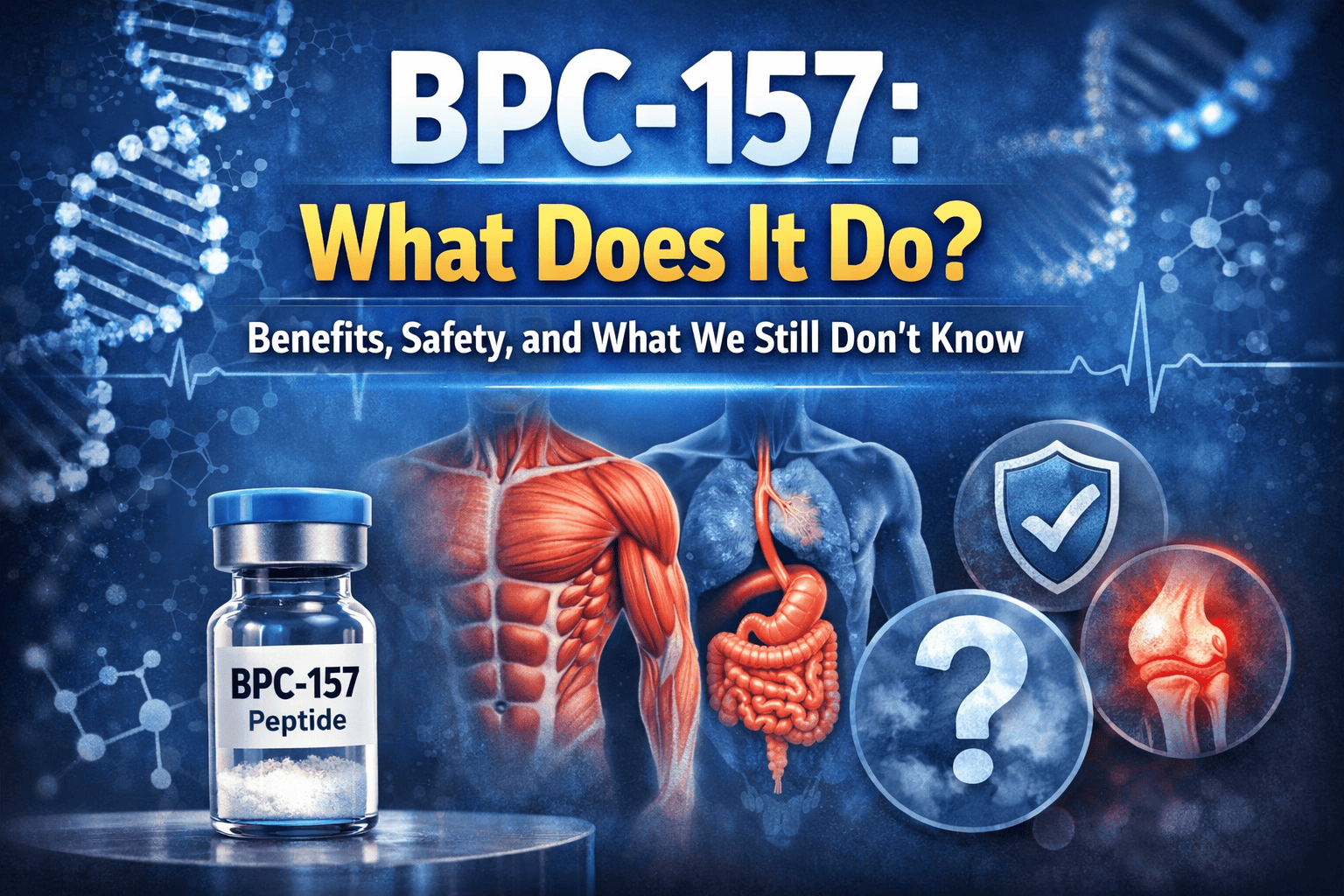
BPC-157: What It Actually Does (and What We Don’t Know)
BPC-157 appears genuinely interesting in preclinical research. In animal models, it has been linked to tissue repair, angiogenesis-related healing signals, reduced inflammatory signaling, and improved outcomes in muscle, tendon, ligament, bone, and gastrointestinal injury models.
But that does not mean it is proven in humans. The online reputation of BPC-157 runs far ahead of the actual human evidence. Right now, the clearest honest summary is: promising in animals, weak and limited in humans, not FDA-approved, and still surrounded by real safety and product-quality uncertainty.
This page is for the broad BPC-157 decision: what the peptide seems to do mechanistically, where the strongest claims actually come from, and which parts of the story still are not settled in real patients.
Key terms: BPC-157, body protection compound, tendon healing, ligament recovery, oral vs injectable BPC-157, peptide safety, research peptides, sports doping
Quick Take
BPC-157 may influence repair-related pathways and healing outcomes in animals, but it has not been robustly proven to speed tendon, ligament, joint, or muscle recovery in humans. If you only know it from social media or peptide clinics, you almost certainly know a more confident version of the story than the evidence supports.
TL;DR decision
Treat BPC-157 as an experimental peptide with interesting preclinical data, not as a proven recovery tool. The smartest default is skepticism, especially for unapproved injectable products and gray-market “research” sources.
Evidence standard: human trials, dose ranges, guideline-level sources when available
Who this is for: anyone considering BPC-157 for tendon, ligament, muscle, gut, joint, or general injury recovery and trying to separate research from hype
Who this is not for: anyone looking for underground sourcing help, informal injection protocols, or reassurance that a research peptide is “basically proven”
Reviewed by: VerifiedSupps Editorial Team
Last reviewed: April 15, 2026
Parent Hub
VerifiedSupps Articles
Use the article hub if you want to zoom out from peptides and compare lower-risk, better-established options before chasing an experimental recovery compound.
Quick reality check: what people say BPC-157 does vs what the evidence actually supports
This is the fastest way to keep the claims in proportion. Most BPC-157 conversations blur animal data, clinic anecdotes, and real human proof into one thing.
| If you want BPC-157 for… | What the research actually says | Best reading of the evidence | Confidence |
|---|---|---|---|
| Tendon, ligament, or muscle healing | Animal models often look impressive | Interesting preclinical signal, not robust human proof | Low in humans |
| Joint pain or knee pain relief | One small uncontrolled human case series is often cited | Too weak to treat as proof | Very low |
| Gut protection or ulcer-related support | Old GI development claims exist, but modern published human efficacy data remain sparse | Historically interesting, still not a broadly validated therapy | Low |
| A safe recovery shortcut | Not FDA-approved, limited human safety information, product-quality risk matters | This is not the confident lane the internet makes it sound like | Low |
Best next step (today): If your belief in BPC-157 is based mostly on injury anecdotes, assume you are leaning on animal data plus clinic marketing until proven otherwise.
Does BPC-157 actually work for healing and recovery?
In animals, BPC-157 appears to do quite a bit. In humans, we still do not know enough to say it reliably works for common recovery goals like tendon healing, ligament repair, joint pain, or faster return to sport.
That distinction matters. The musculoskeletal literature does suggest a coherent preclinical story: BPC-157 has been linked to improved functional, structural, and biomechanical outcomes in animal injury models. But when reviewers narrowed the published literature to studies relevant to sports medicine and orthopaedics, almost all of the evidence was still preclinical.
Mechanism
- It appears to influence angiogenesis-related signaling and growth-factor pathways in preclinical work.
- It has been linked to reduced inflammatory cytokine signaling and tissue-repair processes in animal models.
- It may also affect fibroblast-related and other repair pathways that make it biologically plausible for tendon and soft-tissue healing.
What would change my recommendation: multiple independent randomized human trials showing clear benefit for a specific indication. Right now, that is not where the evidence sits.
What dose of BPC-157 has actually been studied?
There is no well-established consumer dose for BPC-157 that is backed by robust human evidence. That is one of the most important things to understand before you get pulled into clinic protocols or internet dosing charts.
What exists instead is a patchwork: older oral development references, a tiny intravenous pilot, and a large amount of non-human literature. None of that creates a reliable everyday dose for injury recovery. It especially does not justify copying “units” from online forums, because those numbers often mix different concentrations, different routes, and different products.
For a page like this, the safest and most accurate answer is not to pretend we have a settled dose. We do not. The right takeaway is that dosing confidence is much lower than the online peptide ecosystem suggests.
Is oral BPC-157 better than injectable BPC-157?
We do not have strong enough human evidence to say one route is proven better for real-world recovery outcomes. What we can say is that injection adds another layer of risk that people often underestimate.
Oral BPC-157 shows up in older development discussions and phase-I planning, while injectable BPC-157 is much more prominent in current recovery culture. But popularity is not proof. The main reason injections look more powerful online is often because they look more “medical,” not because the human evidence is cleaner.
Injectables also bring sterility, measurement, compounding, and source-quality problems into the picture. That means an injectable route can look more serious while actually becoming harder to use safely and interpret honestly.
Is BPC-157 safe to use?
The honest answer is that we do not have enough human safety data to call BPC-157 clearly safe for self-use, especially in the way it is commonly marketed online. This is one of the biggest places where caution matters more than enthusiasm.
FDA currently lists BPC-157 among bulk substances that may present significant safety risks for compounding. The agency specifically points to potential immunogenicity for certain routes, complexities related to peptide impurities and active pharmaceutical ingredient characterization, and says it has identified no or only limited safety-related information for the proposed routes of administration.
That is very different from saying “it is proven dangerous.” But it is also very different from saying “people have used it for years so it must be fine.” Right now, the safer interpretation is that the risk picture remains incompletely defined, especially when product quality, source, and route are uncertain.
The tiny human safety pilot that is often cited involved only 2 healthy adults receiving IV BPC-157. That is nowhere near enough to settle long-term, route-specific, or population-level safety questions.
Why is BPC-157 banned in sports?
Because it is treated as an unapproved substance, not as a proven legitimate recovery medication. If you are a tested athlete, that matters more than how common BPC-157 sounds on social media.
WADA’s current prohibited-list materials include BPC-157 under S0 non-approved substances, and WADA states the 2026 list is in force from January 1, 2026. USADA also states that BPC-157 is prohibited under the WADA Prohibited List in the category of S0 Unapproved Substances.
So even if someone tells you it is “just a healing peptide,” that does not change its sports-governance status. For athletes, BPC-157 is not simply a safety question. It is also a compliance and sanction risk.
What don’t we know about BPC-157 yet?
Quite a lot. That is the real center of this topic. The uncertainty is not some tiny footnote attached to an otherwise settled treatment. The uncertainty is the story.
- Which indications actually work in humans: tendon, ligament, muscle, gut, and joint claims do not yet have robust indication-specific proof.
- Which route makes the most sense: oral and injectable enthusiasm outpace the comparative human data.
- What the real long-term safety profile is: we do not have enough high-quality human exposure data to answer that confidently.
- How much product quality changes the risk: with research-market or compounding variability, the label alone does not settle what you are actually getting.
- Who should clearly avoid it: outside obvious caution groups, the boundaries are still blurrier than they should be for a widely discussed self-use compound.
What should you do before trying BPC-157?
Before you think about route, frequency, or clinic protocol, answer the more important question: what problem are you actually solving, and is BPC-157 really the most evidence-based answer? In many cases, it will not be.
Common mistakes
- Treating animal studies as if they are already human proof.
- Assuming clinic availability means the evidence is strong.
- Copying forum or influencer dosing without knowing the actual concentration or route.
- Using BPC-157 as a substitute for diagnosis, rehab, load management, or a real treatment plan.
Clean test protocol
| Inputs | Exact diagnosis, clear reason for use, route, concentration, product source, clinician oversight if applicable, and a baseline plan for symptoms or function |
|---|---|
| Duration | Do the evidence and safety check before the first dose. Reassess after the first doses and again at every change in product, concentration, or route. |
| 3 metrics | Objective symptom change, actual functional improvement, and whether any benefit is clearly bigger than normal rehab, time, or placebo expectation |
| Stop conditions | Research-only source, unclear concentration, rash, swelling, severe nausea, chest pain, palpitations, worsening symptoms, spreading injection-site redness, fever, or any uncertainty that makes you question what you are actually using |
How to tell it’s working
“I felt something” is not enough. If the benefit is real, it should match the actual problem you started with and show up in function, pain, or recovery markers that make sense. Vague feelings and hype-driven expectation are not the same thing as evidence.
Red flags / seek care
Seek medical care right away for trouble breathing, severe rash or swelling, chest pain, fainting, severe palpitations, signs of infection after injection, or any major reaction after a possible dosing or product-quality mistake.
Selected Professional References
These are the most useful sources for the approved-status question, the human-evidence gap, sports-prohibited status, and the current FDA safety position.
Certain Bulk Drug Substances That May Present Significant Safety Risks
The most important official source for BPC-157’s current FDA risk framing in compounding.
Used for: immunogenicity, impurity, and limited-safety-information language
OPSS: BPC-157 Is an Unapproved Drug
A concise official summary that BPC-157 is not a dietary ingredient and not in FDA’s approved-drug database.
Used for: legal/status framing in the U.S.
WADA Prohibited List
The current official starting point for athlete compliance and prohibited-status questions.
Used for: current WADA 2026 list status
USADA: BPC-157 Experimental Peptide Prohibited
Helpful for the practical athlete-facing explanation of why BPC-157 matters beyond pure safety.
Used for: S0 non-approved substances context
Emerging Use of BPC-157 in Orthopaedic Sports Medicine
One of the clearest recent summaries of the musculoskeletal literature, including how little human evidence actually exists.
Used for: 35 preclinical studies, 1 clinical study, and the weak human-proof problem
Injectable Peptide Therapy: A Primer for Orthopaedic and Sports Medicine Physicians
A useful newer clinical review that explicitly says the BPC-157 human findings are largely unvalidated.
Used for: current clinician-level caution around human evidence
Safety of Intravenous Infusion of BPC157 in Humans
Worth reading mainly to see how tiny the published human safety database still is.
Used for: why 2-person pilot data do not settle the safety question
WADA’s 2022 Prohibited List Update on BPC-157
Useful historical context for why BPC-157 entered the anti-doping discussion in the first place.
Used for: BPC-157’s addition to the prohibited list after re-evaluation
Go Deeper (VerifiedSupps Guides)
Use these next if your real goal is recovery, performance, or smarter supplement choices without drifting into experimental peptide territory.
How to Choose Supplements Without Guesswork
Start here if you want a cleaner framework before reaching for a complicated or experimental recovery product.
Muscle Growth + Recovery Stack
A better next read if your real target is recovery support with ingredients that are more established and easier to use safely.
Creatine Monohydrate Benefits, Science, and Dosage
Useful if you want a more evidence-based performance and recovery ingredient before experimenting with a peptide.
Omega-3 for Athlete Recovery
Helpful if you are trying to support recovery while staying inside a more conventional and regulated evidence lane.
Final Takeaway
BPC-157 looks biologically interesting and genuinely promising in animal research. That part is real. What is not real yet is the level of confidence often projected onto it for human recovery. The cleanest way to think about it is this: BPC-157 may do more than nothing, but the human proof is still too thin to treat it like a settled tool, and the safety, route, and product-quality questions remain much less defined than the internet usually admits.
FAQ
Is BPC-157 FDA approved?
No. Official U.S. sources say BPC-157 is not in FDA’s approved-drug database, and FDA currently lists it among substances that may present significant safety risks in compounding.
Does BPC-157 work for tendon or ligament healing?
It may in animal models, but that is not the same as proven benefit in humans. The human evidence for tendon and ligament healing is still weak and limited.
Has BPC-157 been proven in humans?
Not in the way the online recovery world often implies. Recent reviews still show that most of the literature is preclinical, with very little human evidence.
Is oral BPC-157 safer than injectable BPC-157?
We do not have strong enough human data to say one route is clearly safer or more effective. Injectable products add sterility, source, and measurement risks that people often underrate.
Why do people say BPC-157 works if the evidence is weak?
Because the animal data are interesting, the anecdotes are persuasive, and the jump from “promising mechanism” to “proven in humans” happens very fast online.
Is BPC-157 legal to buy as a supplement?
No. Official U.S. sources state that BPC-157 is not a dietary ingredient and is an unapproved drug.
Is BPC-157 banned in sports?
Yes. WADA includes BPC-157 under S0 non-approved substances, and USADA also states that it is prohibited.
Do we know the long-term risks of BPC-157?
No. Long-term human safety is one of the biggest unresolved parts of the entire topic.
Can BPC-157 replace rehab, diagnosis, or standard medical care?
No. It should not be treated as a shortcut around finding the real problem or following an evidence-based treatment plan.
Who should definitely avoid casual self-experimenting with BPC-157?
Tested athletes, people using research-market products, people who do not fully understand the concentration or route, and anyone with a medically complex situation should not treat this casually.
VerifiedSupps Medical Disclaimer
This content is for educational purposes only and is not medical advice. BPC-157 is not an approved dietary supplement ingredient, and it is not a substitute for diagnosis, rehab, or prescription treatment. The human evidence is limited, and safety questions remain unresolved, especially for compounded or research-market products. Do not use gray-market peptide products as a shortcut around proper medical evaluation. Seek urgent medical care for allergic reactions, chest pain, fainting, severe palpitations, or signs of infection after injection.