By VerifiedSupps Editorial Team
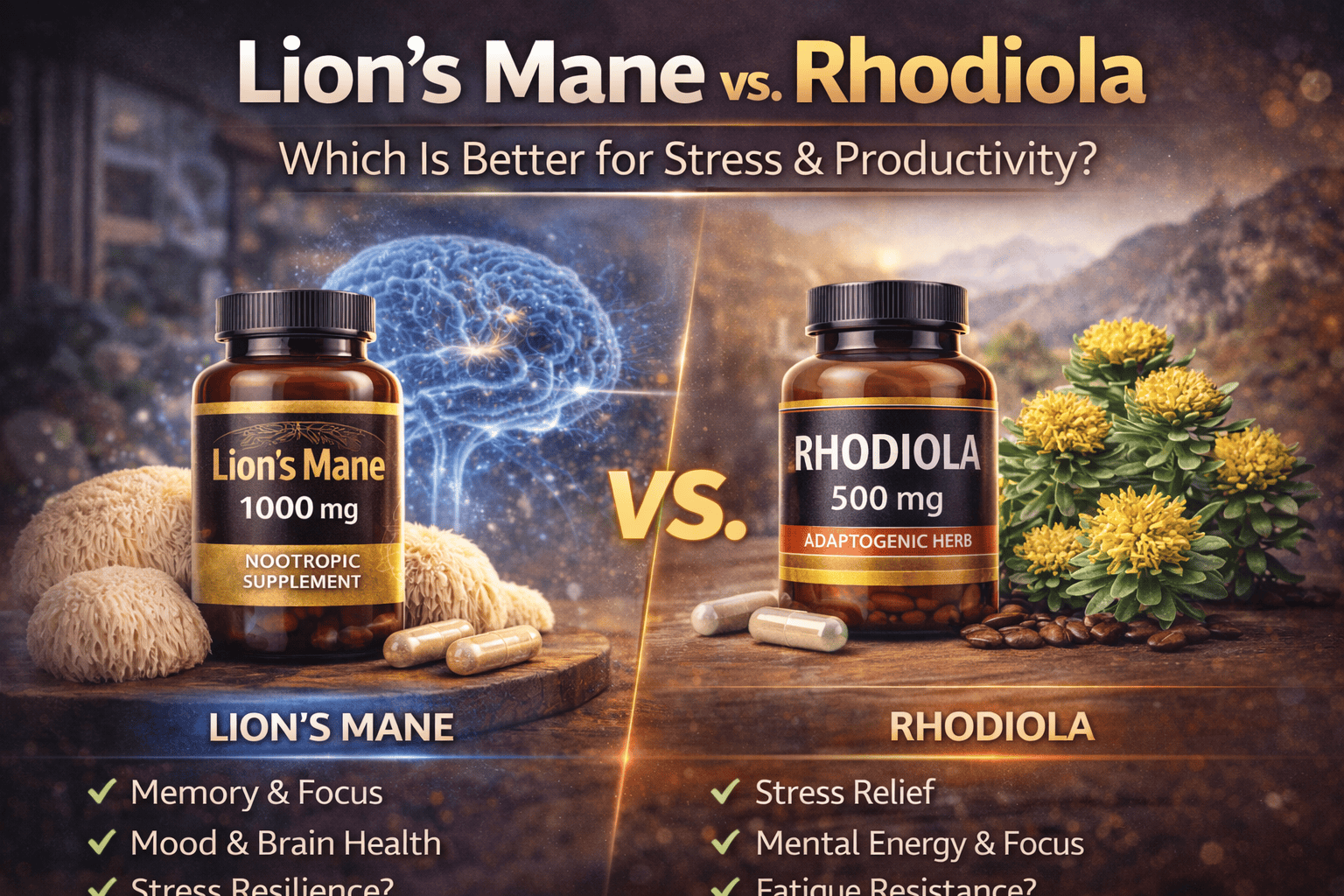
Lion’s Mane vs Rhodiola for Stress & Productivity
If your main problem is stress-driven fatigue, mental overload, or getting less done because your nervous system feels taxed, rhodiola is usually the better first test. If your main goal is gentler, slower-burn cognitive support and you do not need a noticeable same-day lift, lion’s mane makes more sense.
Neither is a magic productivity supplement. Rhodiola has the more directly practical human data for stress and fatigue-type work impairment, while lion’s mane looks more like a long-game cognition and mood option with interesting but still mixed human evidence.
This page is for choosing between lion’s mane and rhodiola when the real question is work function under stress, not for full standalone deep-dives on either ingredient.
Key terms: lion’s mane mushroom, Hericium erinaceus, Rhodiola rosea, stress-related fatigue, attention, mood, focus, productivity
Quick Take
For stress-heavy productivity problems, rhodiola is the stronger first-choice test. For gentler, longer-horizon cognitive support that is less about a performance push and more about steady brain support, lion’s mane is the better fit.
TL;DR decision
Choose rhodiola first if stress, fatigue, and concentration under pressure are the real bottleneck. Choose lion’s mane first if you want a slower, less activating cognitive-support experiment and you are willing to judge it over weeks, not hours.
Evidence standard: human trials, dose ranges, guideline-level sources when available
Who this is for: people comparing two non-stimulant-leaning options for stress load, focus, mental stamina, and real-world work output
Who this is not for: anyone with severe depression, suicidal thinking, major insomnia, uncontrolled palpitations, pregnancy, or a medication-heavy setup that has not been reviewed by a clinician
Reviewed by: VerifiedSupps Editorial Team
Last reviewed: April 7, 2026
Parent Hub
The Complete Calm + Focus Stack
Start here if your broader goal is calmer focus, steadier work blocks, and smarter supplement choices beyond a single ingredient showdown.
Quick decision table: which one actually fits your bottleneck?
Most people do not need a generic mushroom-versus-adaptogen debate. They need a cleaner first choice based on what is really dragging performance down.
| If your real problem is… | Better first pick | Why | What to expect |
|---|---|---|---|
| You feel mentally tired, pressured, and less productive when stress is high | Rhodiola | Human trials are more directly aimed at stress-related fatigue, attention, and mental performance | Often a faster readout, sometimes within days to 2 weeks |
| You want steadier long-game cognitive support and do not want a pushy feel | Lion’s mane | Small human studies point toward mood, memory, and stress support, but the signal is more gradual and mixed | Judge it over weeks, not on day one |
| You are very sensitive to insomnia, jitteriness, or medication interactions | Lion’s mane or neither until reviewed | Rhodiola has the messier interaction and activation profile in public clinical summaries | Safety review first beats a bad experiment |
| You want one ingredient that might help both stress load and work output right now | Rhodiola | It fits the “stress is hurting my productivity” use case better than lion’s mane | Still subtle, but more decision-relevant for this specific goal |
Best next step (today): If stress is the reason your output drops, test rhodiola first; if you want a gentler long-horizon cognition experiment, test lion’s mane first and judge it slowly.
Is lion’s mane or rhodiola better for stress and productivity?
For most people using these supplements to work better under pressure, rhodiola is the better first pick. Lion’s mane makes more sense when the goal is gentler, longer-horizon cognitive support rather than a faster reduction in stress drag.
That recommendation is not based on hype. It is based on fit. Rhodiola’s human studies are imperfect, but they are more directly aimed at stress-related fatigue, attention, concentration, and mental performance. Lion’s mane has small human trials suggesting possible memory, mood, and subjective stress benefits, but the overall picture is still mixed and less clearly tied to real-world productivity.
Mechanism
- Lion’s mane is usually framed as a neurotrophic, slow-burn support tool, with interest around erinacines, hericenones, and nerve-growth-related pathways.
- Rhodiola is usually framed as an adaptogen-style option for stress resilience, fatigue, and mental performance under load.
- Mechanism is not outcome. The only mechanism that matters for you is whether work feels easier, calmer, and more consistent in real life.
What would change my recommendation: if you already know you dislike anything that feels even mildly activating, or you care more about a longer memory-and-focus experiment than a faster stress readout, lion’s mane becomes the better first test.
Which works faster for focus: lion’s mane or rhodiola?
Rhodiola is more likely to matter sooner. Lion’s mane is not the supplement I would choose when the question is, “What has the better chance of helping my work this week?”
A practical way to think about it is this: rhodiola is the better tool when productivity is being crushed by stress load and mental fatigue. Lion’s mane is the better tool when you are willing to wait for a subtler cognition-and-mood experiment and do not need an early signal to stay motivated.
That does not mean lion’s mane has no acute signal at all. One 2023 pilot found a faster speed-of-performance result on a Stroop task and a trend toward lower subjective stress after 28 days, but a newer 2025 acute trial did not show a significant overall improvement in cognition or mood. That is exactly why lion’s mane should be framed conservatively here.
How much lion’s mane vs rhodiola should you take?
Rhodiola dosing is cleaner in the human literature. Lion’s mane dosing is messier because products and study formats vary more than most people realize.
Lion’s mane
Human studies have used everything from around 1.8 g/day capsule regimens to multi-gram powder equivalents. That makes label quality and consistency more important than pretending there is one universal perfect dose.
Practical move: start at the low end of the product label once daily, use one product format only, and give it a fair multi-week test before escalating.
Rhodiola
Human trials more often land in the standardized-extract range of roughly 200 to 600 mg/day, sometimes split into morning and lunch dosing. That is a more usable evidence lane for real-world testing.
Practical move: use a standardized extract, start lower, and do not combine it with a new caffeine plan or three other “focus” products at the same time.
When should you take lion’s mane vs rhodiola?
Rhodiola is usually best earlier in the day. Lion’s mane timing matters less than daily consistency, but breakfast or lunch is a practical default.
If you are using rhodiola because stress is crushing productivity, morning is the cleanest place to test it. If you are sensitive to sleep disruption, do not start with afternoon or evening doses. That is an easy way to confuse a useful supplement with a bad schedule.
Lion’s mane is less about timing precision and more about steady intake. Taking it with food is reasonable if your stomach is sensitive. During a comparison test, keep caffeine, sleep timing, and workload as steady as possible so the readout is not fake.
Is lion’s mane or rhodiola safer for daily use?
Lion’s mane usually looks simpler on paper, but some of that may reflect thinner interaction mapping rather than proof of zero risk. Rhodiola deserves more caution if you take prescription medications, tend toward insomnia, or already feel wired.
Lion’s mane watch-outs
- Reported adverse effects in clinical summaries include abdominal discomfort, nausea, and skin rash.
- Food use is not the same as concentrated supplement use.
- If you get a rash, significant GI trouble, or feel worse, stop and reassess instead of “pushing through.”
Rhodiola watch-outs
- Public safety summaries list dizziness, headache, insomnia, dry mouth, and excess saliva among possible issues.
- Use more caution if you take losartan, warfarin, phenytoin, antidepressants, antihypertensives, or CNS stimulants.
- If you are prone to palpitations, agitation, or poor sleep, rhodiola is not the supplement to test casually.
If you are comparing the two purely on safety, lion’s mane often wins by default. If you are comparing them on usefulness per unit risk for stress-driven productivity, rhodiola can still win, but only when the medication and sleep picture is clean.
Can you take lion’s mane and rhodiola together?
Some people probably can, but you should not start them together. If you do, you lose the ability to tell what is helping, what is hurting, and whether the issue is dose, timing, or ingredient fit.
A reasonable logic for a stack is rhodiola earlier in the day for stress-heavy periods and lion’s mane as the slower daily background experiment. But that is a second-step move, not the first one. First run a clean single-ingredient test.
In real life, most people do better by choosing the one that best matches the bottleneck. If stress is killing output, start with rhodiola. If you want a gentler long-game cognition lane, start with lion’s mane. Cleaner data beats more capsules.
What should you do if lion’s mane or rhodiola is not working?
Most failed tests are not failed because the ingredient is “bad.” They fail because the bottleneck was misread, the product was weak, or the test was too messy to mean anything.
Common mistakes
- Using lion’s mane when the real problem is stress-driven fatigue and expecting a same-week performance shift.
- Taking rhodiola too late in the day, then blaming the ingredient for sleep disruption you created.
- Changing caffeine, sleep, workload, and two supplements at once, which makes the result useless.
Clean test protocol
| Inputs | One ingredient only, one product only, stable caffeine, stable sleep window, stable work routine if possible |
|---|---|
| Duration | Rhodiola: 10 to 14 days for an early read, 4 weeks for a fairer test. Lion’s mane: 4 to 8 weeks before making a serious call. |
| 3 metrics | Task initiation, noon-to-afternoon mental stamina, and how much stress or irritability bleeds into your work |
| Stop conditions | Insomnia, palpitations, agitation, rash, meaningful GI distress, mood worsening, or any medication concern that shows up during the trial |
How to tell it’s working
The real sign is not a dramatic “brain boost.” It is easier task initiation, steadier attention, less stress spillover into work, and fewer days where pressure instantly wrecks performance.
Red flags / seek care
Chest pain, fainting, severe palpitations, major insomnia, suicidal thoughts, clear mania or agitation, allergic-type rash, or any rapid worsening after combining rhodiola with antidepressants or other medications is medical territory, not supplement tinkering territory.
Selected Professional References
These are the sources that matter most for the stress-versus-productivity comparison, dose logic, and safety cautions used in this page.
Lion’s Mane in Young Adults (Nutrients, 2023)
Small double-blind pilot suggesting a possible subjective stress signal and some limited cognitive findings, but not a slam-dunk productivity result.
Used for: realistic expectations on lion’s mane and why it reads as a slower, mixed-evidence option
Acute Lion’s Mane Fruiting Body Trial (2025)
A newer acute study that did not find a significant overall improvement in cognition or mood in healthy younger adults.
Used for: why immediate-focus claims for lion’s mane should stay conservative
Lion’s Mane in Mild Cognitive Impairment (Phytother Res, 2009)
One of the more cited human trials showing why lion’s mane is discussed more as a cognition-support ingredient than as a short-fuse productivity tool.
Used for: longer-horizon cognition framing
Rhodiola for Stress-Related Fatigue (Planta Med, 2009)
Randomized human data showing signal for burnout symptoms, attention measures, and cortisol response under stress-related fatigue.
Used for: why rhodiola fits the stress-plus-productivity use case better
Rhodiola for Life-Stress Symptoms (Phytother Res, 2012)
Open-label data using 200 mg twice daily for 4 weeks, helpful mainly for dose realism and stress-symptom context.
Used for: practical rhodiola dosing range and trial duration
NCCIH Rhodiola Fact Sheet
Useful for the big-picture reality check: the evidence is still limited, and side effects plus interaction cautions matter.
Used for: evidence-quality framing, 12-week safety window, and side-effect caution
Memorial Sloan Kettering: Lion’s Mane Mushroom
A clinically useful summary of lion’s mane’s possible benefits, its still-limited human data, and the main adverse effects reported.
Used for: safety, mood-and-memory framing, and conservative interpretation
Memorial Sloan Kettering: Rhodiola
Helps clarify why rhodiola has a more useful stress-and-fatigue profile but also deserves more interaction caution.
Used for: antidepressant, warfarin, phenytoin, blood-pressure, and stimulant caution
Go Deeper (VerifiedSupps Guides)
Use these next if you want to zoom out from this head-to-head and choose the broader calm-focus lane that actually matches your problem.
Rhodiola Rosea Benefits
Go deeper on stress, fatigue, endurance, and where the real human signal is stronger than the average marketing claim.
Adaptogens: A Simple Science-Based Guide
Helpful when your real question is whether an adaptogen-style strategy even makes sense before you pick one herb.
Focus + Productivity Stack
Better if your goal is reliable work performance and you want a more direct stack than a mushroom-versus-herb comparison.
Best Supplements for Stress Relief
Use this if stress is clearly the main issue and you want to see whether rhodiola is actually the best first pick versus other options.
Final Takeaway
If I had to choose one first for stress and productivity, I would pick rhodiola, assuming the medication and sleep picture is clean. If I wanted a gentler, slower, longer-game cognition experiment, I would pick lion’s mane. Test one at a time, use a real product, and judge success by calmer work output and less stress drag, not by whether you feel an immediate “boost.”
FAQ
Is lion’s mane or rhodiola better for anxiety-related stress?
Rhodiola has more direct human data for stress-related fatigue and mild stress symptoms, but it can feel too activating for some people. Lion’s mane is usually the gentler choice, but it is also the slower and less directly proven option for this exact use case.
Which one is better for work productivity?
If stress and mental fatigue are reducing your output, rhodiola is usually the better first test. If you want slower, gentler cognitive support and can judge it over weeks, lion’s mane is the better fit.
Does lion’s mane work immediately?
Usually not in a clearly noticeable way. Some small studies suggest limited acute signals, but the overall human evidence for immediate cognitive or mood benefits is mixed.
Can rhodiola feel stimulating?
Yes. Some people tolerate it well, but others may notice insomnia, restlessness, or a too-wired feel, especially if they dose it late or combine it with other stimulating inputs.
Can you take lion’s mane and rhodiola together?
Possibly, but do not start them together. Test one at a time first so you can judge benefit, side effects, and fit cleanly.
Should you take rhodiola at night?
Usually no. Morning or early-day dosing is the cleaner starting point because rhodiola can be too activating for some people.
How long should you test lion’s mane before deciding?
Give lion’s mane at least 4 to 8 weeks if the goal is cognitive or mood support. Judging it too early is one of the main reasons people misread it.
How long should you test rhodiola before deciding?
Many people can get an early read within 10 to 14 days, but a 4-week test is more fair if stress and mental performance are the main targets.
Who should be more careful with rhodiola?
People taking antidepressants, warfarin, phenytoin, blood-pressure medication, or other stimulating compounds should use more caution. Anyone prone to insomnia, palpitations, or agitation should also be careful.
Can either supplement replace treatment for burnout or depression?
No. Supplements may support stress or mood in some cases, but they are not substitutes for diagnosis, therapy, or prescription treatment when symptoms are significant.
VerifiedSupps Medical Disclaimer
This content is for educational purposes only and is not medical advice. Lion’s mane and rhodiola are dietary supplements, not treatments for burnout, major depression, panic disorder, or serious heart symptoms. Rhodiola deserves added caution if you take antidepressants, blood thinners, blood-pressure medications, phenytoin, or other stimulating compounds. Stop use and seek medical care for chest pain, fainting, severe palpitations, allergic-type reactions, suicidal thoughts, or major mood worsening.