By VerifiedSupps Editorial Team
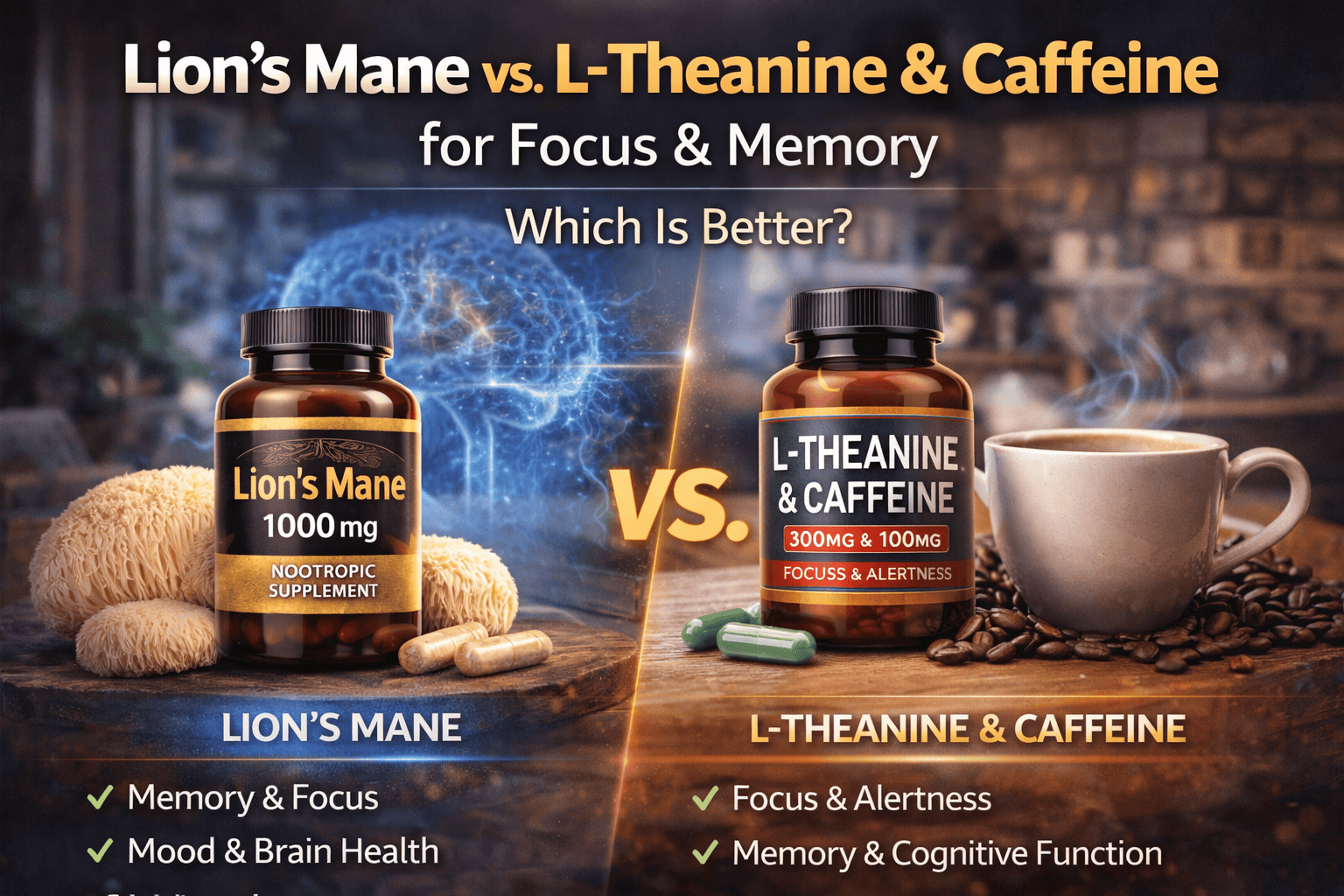
Lion’s Mane for Focus & Memory (vs L-Theanine & Caffeine)
If your goal is fast, obvious focus right now, caffeine still wins. If your goal is calmer attention with less edge, L-theanine—especially with caffeine—usually makes more sense. If your goal is longer-game memory support, Lion’s Mane is the more interesting ingredient, but the human evidence is slower, smaller, and less decisive than the marketing usually implies.
That is the clean comparison in one line: caffeine for immediate focus, L-theanine for smoother focus, Lion’s Mane for cautious memory support. The mistake people make is expecting Lion’s Mane to behave like caffeine. It usually does not. Lion’s Mane is much more of a “maybe over time” ingredient than a “feel it in an hour” ingredient.
This page focuses on focus-and-memory intent specifically. It is not the broad Lion’s Mane overview page, and it is not a general stimulant guide.
Key terms: Lion’s Mane, Hericium erinaceus, L-theanine, caffeine, focus, memory, attention, calm attention, working memory, nootropic comparison
Quick Take
Choose caffeine if you want the most reliable acute attention boost. Choose L-theanine if you want focus to feel calmer and less jittery, especially when paired with caffeine. Choose Lion’s Mane if your main interest is memory support or longer-term brain-health positioning and you are comfortable with smaller, slower, less certain effects.
TL;DR decision
For work, study, reaction speed, or getting mentally “on”, start with caffeine or a caffeine + L-theanine combo. For memory support, Lion’s Mane is more relevant—but much less immediate and much less proven in healthy adults. For calm focus, L-theanine is the most intuitive middle ground.
Evidence standard: human trials, dose ranges, guideline-level sources when available
Who this is for: adults choosing between Lion’s Mane, L-theanine, and caffeine for focus, memory, or calmer attention
Who this is not for: anyone using supplements to self-treat major memory decline, severe anxiety, ADHD, depression, or neurologic symptoms without appropriate care
Reviewed by: VerifiedSupps Editorial Team
Last reviewed: April 6, 2026
Parent Hub
Lion’s Mane Benefits: The Complete Science-Backed Guide
Use the parent hub if you want the full Lion’s Mane map first, including memory, mood, dosage, timing, and safety beyond this direct comparison.
Focus and memory comparison table
This is the fastest way to choose the right ingredient for the right mental job.
| If your main goal is… | Best first pick | Most likely feel | Why |
|---|---|---|---|
| Fast focus and alertness right now | Caffeine | Most noticeable acute effect | Caffeine’s human evidence is the most consistent for alertness, attention, and psychomotor vigilance. |
| Calmer, less jittery focus | L-theanine or L-theanine + caffeine | Smoother attention, less mental edge | Theanine has a modest attention case, and the combo with caffeine is more convincing than theanine alone for acute task performance. |
| Longer-game memory support | Lion’s Mane | Usually subtle and gradual | The better Lion’s Mane signal is in memory/cognition support over time, especially in older or higher-risk groups, not acute focus. |
| One ingredient that “feels” like it is working quickly | Caffeine | Most immediate | Lion’s Mane is usually too subtle for that job, and L-theanine is more smoothing than energizing. |
Best next step (today): Ask one question first: do you want something that helps right now, or something that might help over time? That usually answers the comparison by itself.
Is Lion’s Mane, L-theanine, or caffeine best for focus and memory?
The clean answer is: caffeine is best for acute focus, L-theanine is best for calmer attention, and Lion’s Mane is most interesting for longer-game memory support. No single ingredient cleanly wins all three jobs.
Mechanism
- Caffeine mainly works as an adenosine antagonist, which is why it consistently feels more immediate and more obvious.
- L-theanine is more about calmer attentional control and smoothing, and its best acute evidence is often with caffeine rather than on its own.
- Lion’s Mane is the ingredient most tied to neurotrophic and memory-support narratives, but the human outcome data are slower, smaller, and more population-specific.
What would change my recommendation
If you are caffeine-sensitive, anxious, or sleep-fragile, I would lean harder toward L-theanine and away from caffeine. If you are older, worried about memory, or thinking in “brain health” rather than “productivity,” Lion’s Mane becomes more relevant. If you want something you can reliably feel on day one, caffeine is still the default.
Does Lion’s Mane actually improve focus and memory?
It may help memory and some cognition outcomes, but the best human evidence is still narrower than the marketing. The strongest clinical signals come from older adults with mild cognitive impairment and from small early-Alzheimer’s-type studies—not from broad, definitive data in healthy people.
That is why Lion’s Mane is easier to justify for memory support over time than for acute focus. The classic 2009 MCI study suggested benefit after 16 weeks, the 2019 older-adult trial showed MMSE improvement after 12 weeks, and the 2020 erinacine A-enriched mycelia pilot in early Alzheimer’s disease reported better CASI, MMSE, and functional outcomes after long-term use.
Healthy younger adults are where the story gets less impressive. The 2023 pilot tentatively suggested improved speed of performance and lower subjective stress, but the 2025 acute study in healthy younger adults found no significant overall improvement in global cognition or mood after a 3 g 10:1 extract, even though a few task-level signals looked interesting.
The honest summary: Lion’s Mane looks more useful for supporting cognition where there is already some vulnerability than for turning a healthy adult into a noticeably sharper version of themselves overnight.
Is L-theanine better than Lion’s Mane for calm focus?
For calm focus, yes—L-theanine is usually the better fit. Lion’s Mane is more about memory-support positioning and neurotrophic interest. L-theanine is more immediately aligned with the “I want to focus without feeling too keyed up” question.
A recent 2025 review described the L-theanine cognition literature as promising but not completely conclusive, while also pointing to evidence that pure L-theanine at about 200–400 mg/day can reduce stress and support sleep quality in some groups. A 2021 trial in middle-aged and older adults also suggested L-theanine may improve attention, working memory, and executive function.
That is the right way to separate them: Lion’s Mane is the more interesting “brain-health over time” ingredient, but L-theanine is the more practical “calm, usable attention” ingredient.
Is caffeine still better than Lion’s Mane for fast focus?
Yes. If the question is acute focus, alertness, reaction speed, or mental “on-switch”, caffeine still beats Lion’s Mane by a wide margin in practical use and in the consistency of the evidence. Reviews describe caffeine as modestly but consistently improving alertness and fatigue, with its clearest mental-performance effects landing on attention and psychomotor vigilance more than on complex memory.
That does not mean caffeine is automatically the smarter daily choice. It means caffeine is the cleaner acute tool. Lion’s Mane simply does not have equally convincing acute healthy-adult data. In fact, the 2025 acute Lion’s Mane study is a good reminder of that gap: 3 g of a 10:1 extract did not improve overall cognition or mood in healthy younger adults 90 minutes after dosing.
So if you are comparing these as “what helps me focus this morning,” caffeine is the right answer. If you are comparing them as “which one is more interesting for memory support over months,” Lion’s Mane is the more relevant comparison.
How much Lion’s Mane vs L-theanine vs caffeine should you take?
Lion’s Mane: the human studies used very different products, which makes dosing messy. The older cognition trials often clustered around about 3.0–3.2 g/day of fruiting-body-style material, while the 2023 healthy-young-adult pilot used 1.8 g/day and the 2025 acute study used 3 g of a 10:1 extract. That means extract milligrams and powder grams are not interchangeable.
L-theanine: the clearest standalone pattern sits around 200–400 mg/day in the recent review literature. When the goal is acute calm focus with caffeine, the classic combo trials used around 100 mg theanine + 50 mg caffeine or 97 mg theanine + 40 mg caffeine.
Caffeine: you do not need a huge dose to see an acute focus effect. Reviews describe benefits with low-to-moderate intake, but response is highly individual. Moderate intake in healthy adults is generally described as safe in the 200–400 mg/day range, but many people will feel the focus effect well below that.
Can you stack Lion’s Mane with L-theanine or caffeine?
Yes, that is a reasonable idea—but the smartest way to understand the stack is by roles. Caffeine tends to dominate the acute feel. L-theanine tends to smooth and focus that feel. Lion’s Mane is the ingredient that makes more sense as the quieter long-game addition.
The best-supported acute pairing here is still caffeine + L-theanine. The 2008 and 2010 studies found the combination improved speed and accuracy on demanding attention tasks and reduced distractibility or helped maintain focus better than placebo.
Lion’s Mane stacks more logically with those two than it directly competes with them. The practical rule is simple: if you want an acute focus stack, start with caffeine + theanine. If you want to experiment with Lion’s Mane, add it as the slower memory-support layer—not as the part you expect to feel immediately.
Why isn’t Lion’s Mane helping my focus or memory?
Usually because the goal was too vague, the expectation was too immediate, or the wrong ingredient was chosen for the job. Lion’s Mane is one of the easiest supplements to judge badly because people often compare it against caffeine-level expectations instead of memory-support expectations.
Common mistakes
- Using Lion’s Mane for acute focus when caffeine or caffeine + L-theanine was the more logical tool
- Switching between extracts, powders, and blends so quickly that the trial never meant anything
- Expecting a stimulant-like sensation from an ingredient whose better evidence is slower and more memory-oriented
- Trying to solve sleep debt, high stress, and poor basics with a mushroom supplement first
Clean test protocol
| Inputs | Pick one goal only: memory, focus, or stress resilience. Use one Lion’s Mane product only. Keep caffeine intake stable while testing. |
|---|---|
| Duration | Give it 4–8 weeks unless side effects stop the trial earlier. A few days is usually not enough to judge Lion’s Mane fairly. |
| 3 metrics | Track one primary cognitive target, one daily-life target, and one tolerance target. Example: memory slips, task follow-through, and GI or allergy symptoms. |
| Stop conditions | Stop if you develop breathing symptoms, rash, obvious allergic-type symptoms, persistent GI issues, or if it is clearly the wrong tool for the job. |
How to tell it’s working
The signs are usually quieter than people expect: fewer minor memory slips, steadier thought flow, better follow-through, or less mental drag over time. If the only thing you are waiting for is a sharp buzz or an instant-on feeling, Lion’s Mane will usually feel like a miss even when that was never its best job.
Red flags / seek care
Seek medical care for breathing difficulty, facial swelling, chest symptoms, or a significant rash. Seek clinician input if you are trying to self-manage meaningful memory decline, worsening mood, panic, neurologic symptoms, or major functional impairment with supplements alone.
Selected Professional References
These are the main sources behind the focus, memory, dose, and safety comparison used in this guide.
Benefits, Side Effects, and Uses of Hericium erinaceus as a Supplement
Best big-picture source for the current human Lion’s Mane story: interesting, promising, but still limited and heterogeneous.
Used for: overall evidence level, side effects, anti-overclaim guardrails
Acute Effects of a Standardised Extract of Hericium erinaceus on Cognition and Mood in Healthy Younger Adults
Most important recent reality-check paper: acute Lion’s Mane did not improve overall cognition or mood in healthy younger adults.
Used for: why Lion’s Mane loses the “fast focus” comparison
Improving Effects of the Mushroom Yamabushitake on Mild Cognitive Impairment
Still one of the cornerstone clinical papers for the idea that Lion’s Mane may be more relevant to memory support than to acute focus.
Used for: memory-support positioning, older-adult context
Promising, but Not Completely Conclusive—The Effect of L-Theanine on Cognitive Function
Useful because it lands in the same place this comparison does: L-theanine looks helpful, but modest and cleaner for calm focus than for big memory claims.
Used for: 200–400 mg pattern, calm-focus framing, anti-hype guardrail
The Combined Effects of L-Theanine and Caffeine on Cognitive Performance and Mood
Classic evidence that the caffeine + L-theanine combo can improve attention-task performance better than placebo.
Used for: why the combo beats Lion’s Mane for acute calm focus
Mental Performance and Sport: Caffeine and Co-consumed Bioactive Ingredients
Useful for the practical point that caffeine’s clearest acute mental-performance advantages sit in alertness, fatigue, attention, and vigilance.
Used for: why caffeine still wins the immediate-focus comparison
Go Deeper (VerifiedSupps Guides)
If this comparison helped narrow the field, these are the best next reads to place each ingredient correctly in your routine.
L-Theanine Benefits Guide
Go here if the calmer-focus side of the comparison matters more to you than the memory side.
Focus & Productivity Stack
Open this if the real winner for you is caffeine + L-theanine and you want the practical stack version.
Creatine for Mental Focus
Use this if your interest is broader cognitive support and you want to compare Lion’s Mane with another slower-build ingredient.
Calm Focus Stack
Go here if you want focused attention without turning the day into a stimulant experiment.
Final Takeaway
If you want the clearest practical answer, it is this: caffeine is still the best acute focus tool, L-theanine is the best calmer-focus partner, and Lion’s Mane is the most relevant memory-support ingredient of the three—but also the one with the slowest, softest, and least certain effect pattern in healthy adults. Choose by time horizon and job, not by hype level.
FAQ
Is Lion’s Mane, L-theanine, or caffeine best for focus?
For fast acute focus, caffeine is usually best. For calmer attention, L-theanine is often the cleaner fit, especially with caffeine. Lion’s Mane is usually the weakest of the three for immediate focus.
Which one is best for memory?
Lion’s Mane is the most relevant of the three for memory support, especially in older or higher-risk groups, but the human evidence is still limited and slower-moving than the acute caffeine literature.
Does Lion’s Mane help healthy young adults focus better?
Possibly in some narrow ways, but the evidence is mixed. Newer acute data in healthy younger adults did not show an overall cognitive benefit.
Is L-theanine better than Lion’s Mane for calm focus?
Yes, in most practical situations. Lion’s Mane is more of a longer-game memory-support ingredient, while L-theanine is more aligned with calm, usable focus.
Is caffeine still better than Lion’s Mane for fast focus?
Yes. Caffeine has much more consistent acute evidence for alertness and attention than Lion’s Mane does.
Can you combine Lion’s Mane with L-theanine or caffeine?
Yes. The most evidence-backed acute pair is still caffeine plus L-theanine. Lion’s Mane makes more sense as the slower background layer rather than the part you expect to feel right away.
How much Lion’s Mane should I take for memory support?
Human studies used very different forms and doses, but many cognition-oriented trials clustered around roughly 3 grams per day of fruiting-body-style material or similar dosing patterns.
How much L-theanine should I take for focus?
A common standalone range in the human literature is about 200 to 400 mg per day, while combination trials with caffeine often used around 100 mg of theanine with 40 to 50 mg of caffeine.
How much caffeine should I take for focus?
Lower to moderate doses are often enough for a noticeable effect, and response is highly individual. Moderate intake in healthy adults is generally described as safe in the 200 to 400 mg per day range.
Why might Lion’s Mane not work for me?
Common reasons include expecting an acute stimulant effect, using the wrong product format, inconsistent use, or testing it for a goal it is not especially well suited for.
VerifiedSupps Medical Disclaimer
This content is for educational purposes only and is not medical advice. Lion’s Mane, L-theanine, and caffeine are not substitutes for evaluation or treatment of significant memory decline, depression, anxiety disorders, ADHD, insomnia, neurologic symptoms, or any other diagnosed condition. Use extra caution with caffeine if you are very sensitive to stimulants, have sleep disruption, or have been told to limit stimulant use. Seek medical care for breathing difficulty, facial swelling, chest symptoms, or any severe allergic-type reaction after Lion’s Mane use.