By VerifiedSupps Editorial Team
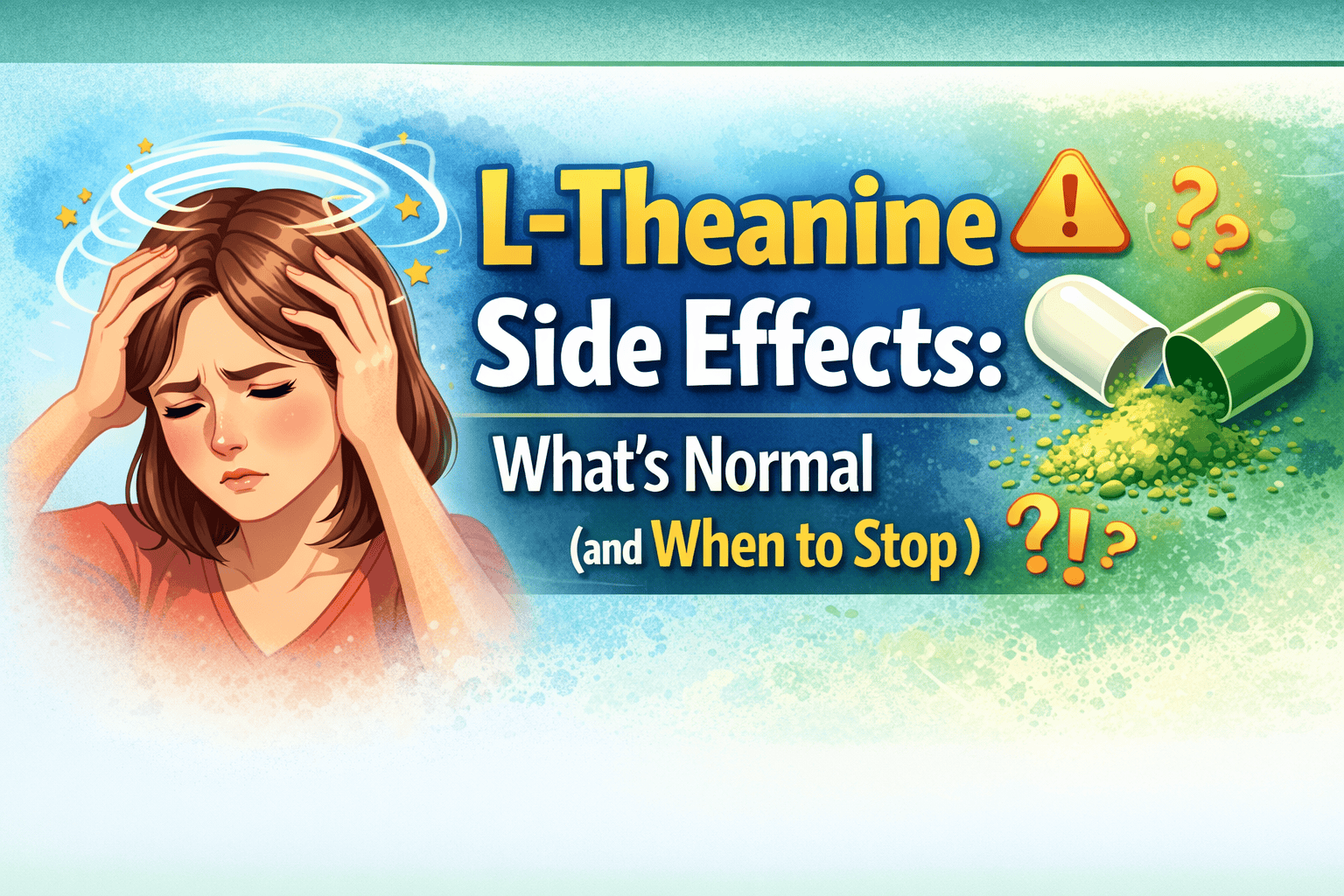
L-Theanine Side Effects: What’s Normal (and When to Stop)
L-theanine usually has a fairly gentle safety profile in the doses studied in humans, but “generally well tolerated” is not the same thing as “nothing can happen.” The most realistic side effects people notice are feeling a little too relaxed, mild headache, stomach discomfort, nausea, or feeling off when the dose, timing, or stack is wrong.
The more important question is not “does L-theanine have side effects at all?” It is “which effects are normal enough to adjust for, and which ones mean I should stop and rethink the whole setup?” That is the gap this guide is built to close.
This page is focused on side effects and stop rules specifically. It is not the general L-theanine benefits page or a broad calm-focus stack page.
Key terms: L-theanine, side effects, sleepiness, headache, nausea, blood pressure, caffeine interaction, when to stop
Quick Take
A little extra calm, mild sleepiness, or subtle headache can be normal enough to troubleshoot. Persistent dizziness, worsening nausea, feeling too sedated, or anything that seems tied to blood pressure, medication interaction, or a severe mood shift is a different category and deserves more caution.
TL;DR decision
If side effects are mild, the fix is often dose, timing, or stack cleanup. If they are persistent, clearly worsening, or linked to low blood pressure, medication use, or feeling unwell in a bigger way, stop and reassess instead of forcing the experiment.
Evidence standard: human trials, dose ranges, guideline-level sources when available
Who this is for: people who felt “off” after taking L-theanine or want a realistic side-effects framework before using it
Who this is not for: anyone trying to self-treat severe anxiety, severe insomnia, or medication-related symptoms without proper medical guidance
Author: VerifiedSupps Editorial Team
Reviewed by: VerifiedSupps Editorial Team
Published: 2026-03-16
Updated: 2026-03-16
Last reviewed: 2026-03-16
Parent Hub
L-Theanine Benefits Guide
Use the main guide if you want the full picture on calm focus, smoother caffeine, dose, timing, and what L-theanine is generally used for. This page stays tightly focused on side effects and stop rules.
L-theanine side-effects decision table
Use this to separate “probably normal enough to adjust” from “pause and stop pushing it.”
| What you notice | Usually means | Best next move | Stop instead if… |
|---|---|---|---|
| Slight calm or mild sleepiness | Often normal dose response | Lower the dose or move it earlier | You feel too sedated to function safely |
| Mild headache or nausea early on | Could be dose, empty stomach, or stack issue | Take with food or lower the dose | Symptoms are persistent or clearly worsening |
| Lightheaded or “too relaxed” feeling | Could be dose too high or blood pressure context | Pause and reassess before retrying | You use BP meds or low blood pressure is already an issue |
| Feeling agitated, off, or worse with caffeine stack | Stack mismatch, not always L-theanine alone | Test L-theanine by itself | The reaction feels strong enough that you do not want to repeat it |
Best next step (today): If you are unsure whether your side effect is “normal,” separate L-theanine from caffeine and from the rest of your stack before deciding anything bigger.
What side effects can L-theanine cause?
The short list is fairly mild for most people: sleepiness, feeling a little too relaxed, headache, nausea, stomach discomfort, or a vague “this feels off” reaction. In human trials and reviews, L-theanine is generally described as safe and well tolerated at commonly studied doses, but that does not mean side effects never happen.
Mechanism
- A calming supplement can feel “wrong” if the dose overshoots what you actually wanted.
- Side effects are often context effects: empty stomach, caffeine stack, low blood pressure tendencies, or poor sleep timing.
- The fact that something is usually tolerated does not make every reaction normal enough to ignore.
Is it normal to feel sleepy or weird after L-theanine?
Yes, mild sleepiness or a “too calm” feeling can be normal enough to troubleshoot, especially if you took a larger dose than you needed or used it at the wrong time of day. L-theanine is often described as relaxing without strong sedation, but real people do not all react the same way.
Usually normal enough to adjust
Slight sleepiness, softer focus than expected, or feeling a little “flat” often improves by lowering the dose, taking it earlier, or not stacking it with other calming agents.
Can L-theanine cause headaches, nausea, or stomach upset?
It can. Reviews and human trial summaries suggest that rare mild effects can include headache, nausea, and similar low-grade side effects, especially at higher doses or in more sensitive people. These are often a “stop, simplify, and retest” problem rather than a “push through and hope” problem.
Most likely if…
You started high, took it fasted, or combined it with other things that already make you feel slightly off.
Can L-theanine lower blood pressure or interact with medications?
Potentially, yes. Some human data and review-level discussion suggest L-theanine may lower the blood-pressure response to stress, and review articles also raise caution around high doses in people using blood pressure medications or other interacting compounds. That does not make it “dangerous” by default, but it does make context matter more.
Use more caution if…
You already run low, take blood pressure medication, use multiple calming supplements, or are combining L-theanine with stimulant-heavy stacks and trying to “balance” them by feel.
What dose of L-theanine is most likely to cause side effects?
There is no single “bad dose” for everyone, but side-effect risk tends to go up when the dose is higher than the job actually requires. Human trials commonly use 200 to 400 mg daily, and review-level summaries suggest those ranges are generally well tolerated for weeks in many adults. Higher-dose review discussions go up further, but that does not mean more is a smarter first move.
Conservative starting logic
100 to 200 mg is often a cleaner place to start than jumping to bigger doses, especially if you are sensitive or already use caffeine, calming supplements, or sleep aids.
When should you stop taking L-theanine?
Stop and reassess if you feel persistently dizzy, clearly nauseated, too sedated, or just worse in a way that does not feel like a small adjustable side effect. The same applies if you notice low-blood-pressure-type symptoms, strong interaction concerns, or any reaction that makes you not want to repeat the experiment. “Natural” is not a reason to override your own stop signal.
Why is L-theanine making you feel worse?
When L-theanine feels worse instead of better, the usual problem is not that you discovered some hidden danger. The usual problem is bad fit: too much dose, wrong timing, wrong stack, or an expectation mismatch.
Common mistakes
- Using a higher dose than you actually need for the goal.
- Taking it too close to bed or too close to something stimulating and assuming the result is “pure.”
- Testing it only inside a caffeine stack instead of by itself first.
- Ignoring low blood pressure tendencies or medication context.
Clean test protocol
| Inputs | Use L-theanine alone, with food if needed, and without adding new caffeine patterns or extra calming agents. |
|---|---|
| Duration | Three to five days is usually enough to tell whether the lower-dose cleaner version feels meaningfully different. |
| 3 metrics | 1) sleepiness level, 2) headache or nausea, 3) steadiness versus feeling “off.” |
| Stop conditions | Stop if symptoms are clearly persistent, getting worse, or feel linked to blood pressure, medication interaction, or marked sedation. |
How to tell it’s working
The “working” version should feel calmer or cleaner without making you feel weak, nauseated, weird, or too sleepy for the job. A cleaner result is usually better than a stronger result here.
Red flags / seek care
Seek medical guidance rather than supplement-guessing if you feel faint, markedly lightheaded, or if your symptoms seem tied to prescription medication use, blood pressure changes, or a worsening mental health state.
Selected Professional References
These are the main external sources behind the human-dose safety discussion, short-term tolerability, sleep-related use, and side-effect caution.
28-day 400 mg/day safety trial
Useful for short-term daily-use tolerability and general safety framing in healthy adults.
Used for: daily-use safety context
Single-dose 200 mg acute-stress trial
Useful for short-term tolerability and the idea that not everyone experiences this as sedating.
Used for: acute-use safety context
Systematic review of sleep trials
Useful for common human dose ranges and the broader “relaxing without heavy sedation” discussion.
Used for: dose and expectation context
Comprehensive review with side-effect discussion
Useful for mild-effect discussion like headache, nausea, irritability, and blood-pressure or stimulant caution at higher-dose use.
Used for: side-effect and caution context
Go Deeper (VerifiedSupps Guides)
If the side-effects question turns into a bigger “should I even be using this?” question, these are the most useful next pages.
L-theanine for anxiety
Use this if the real question is whether L-theanine makes sense at all for anxious-edge patterns.
Caffeine + L-theanine focus stack
Use this if side effects may actually be coming from the stack, not from L-theanine alone.
Best L-theanine supplements
Use this if the concern is poor product choice, unclear labeling, or dose confusion.
The perfect sleep stack
Use this if the side effect question is really a timing or bedtime-stack problem.
Final Takeaway
L-theanine side effects are usually mild enough to troubleshoot, but not always mild enough to ignore. If the reaction is small, lower the dose, change the timing, and clean up the stack. If it is persistent, clearly worsening, or tied to blood pressure, medication, or strong sedation, stop and reassess instead of trying to force it to work.
FAQ
What side effects are normal with L-theanine?
The most common “normal enough to adjust” effects are mild sleepiness, feeling a little too relaxed, or mild headache or nausea.
Can L-theanine make you sleepy?
Yes, it can, especially if the dose is too high for you or the timing is wrong for the job you want it to do.
Can L-theanine cause headaches?
It can for some people, usually as a mild effect that is more likely to matter when dose or context is not a good fit.
Can L-theanine cause nausea or stomach upset?
Yes, it can, especially at higher doses or when taken in a way that already makes you prone to feeling off.
Can L-theanine lower blood pressure?
It may influence the blood-pressure response to stress, which is one reason to be more cautious if you already run low or use blood pressure medication.
Is L-theanine safe with caffeine?
Often yes, but a bad stack setup can still make you feel off. If side effects appear, testing L-theanine by itself is usually cleaner than guessing inside the stack.
What dose is most likely to cause side effects?
Any dose that is too high for your sensitivity can do it, which is why 100 to 200 mg is often a more reasonable starting point than bigger amounts.
Can I take L-theanine every day?
Many people do, but “daily” only makes sense if the dose is tolerated and the reason for using it is still clear.
When should I stop taking L-theanine?
Stop if you feel persistently dizzy, too sedated, clearly worse, or if the reaction feels linked to medication context or low blood pressure rather than a small adjustable effect.
VerifiedSupps Medical Disclaimer
This content is for educational purposes only and is not medical advice. L-theanine side effects are usually mild, but medication use, blood pressure issues, pregnancy, nursing, and complex health situations can change the safety picture. Talk with a qualified healthcare professional before using supplements if you take prescription medications, have significant medical conditions, or develop symptoms that feel persistent, worsening, or medically concerning.