By VerifiedSupps Editorial Team
L-Citrulline for Blood Pressure and Circulation: What It Actually Does
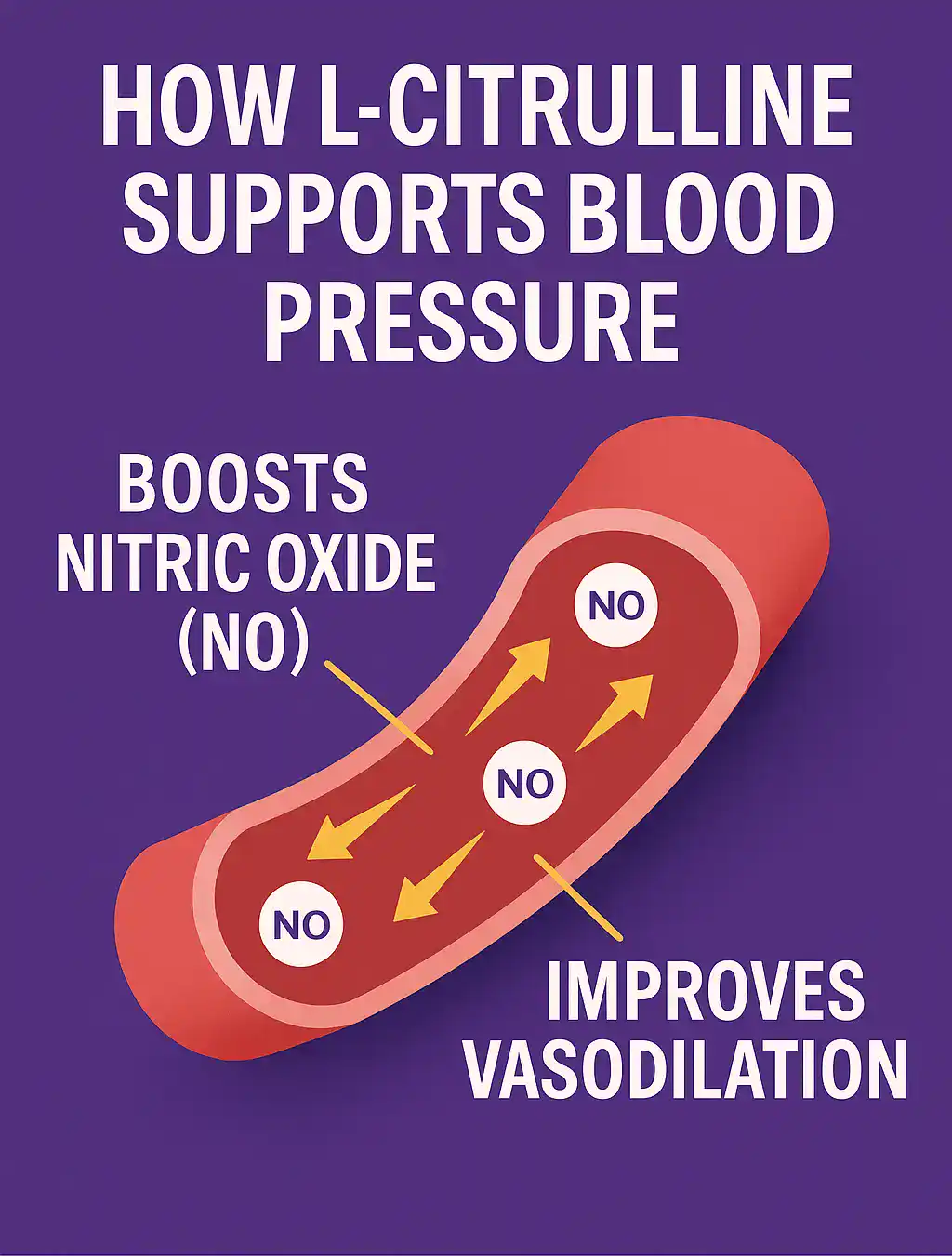
L-citrulline does not look like a “blood pressure raising” supplement. If anything, the human literature points in a more neutral-to-lowering direction, but the effect is not dramatic or guaranteed. The cleanest way to think about it is that L-citrulline may support circulation by improving nitric oxide–related vessel relaxation, which can help blood flow and, in some people, modestly support blood pressure over time.
That does not mean L-citrulline is a replacement for hypertension treatment. It means it can be a reasonable circulation-support experiment when expectations are realistic, dosing is consistent, and you are not ignoring bigger blood pressure drivers like sleep, weight, stress, sodium balance, alcohol, or medication adherence.
This page is specifically about citrulline blood pressure, circulation, and the common question, “does L-citrulline raise blood pressure?” It does not try to become a general hypertension guide or a performance-pump article.
Key terms: nitric oxide, endothelial function, vessel relaxation, systolic blood pressure, diastolic blood pressure, pure L-citrulline
Quick Take
Best fit: you want a circulation-support ingredient with a plausible nitric oxide mechanism, not a miracle blood pressure drop. Main caution: if you already take blood pressure medication, nitrates, or PDE-5 inhibitors, the real concern is not blood pressure going up — it is overlapping vascular effects and the possibility of going too low.
TL;DR decision
If you want to test L-citrulline for circulation or mild blood pressure support, a clean first trial is 3 g/day, then moving toward 6 g/day if tolerated, judged over 2–6 weeks with home blood pressure readings under consistent conditions. If you are on blood pressure-active medication or your readings are clearly hypertensive, treat the supplement as secondary to clinician-guided care.
Evidence standard: human trials, dose ranges, guideline-level sources when available
Who this is for: people searching “citrulline blood pressure” or “does L-citrulline raise blood pressure” who want a practical, non-hyped answer.
Who this is not for: anyone with severe hypertension, hypertensive urgency, chest symptoms, or a medication question that needs a prescribing clinician instead of a supplement article.
Reviewed by: VerifiedSupps Editorial Team
Last reviewed: March 10, 2026
Parent Hub
L-Citrulline Complete Guide
Use the complete citrulline guide if you want the wider benefits, dosing, timing, performance use, and comparison pages. This page stays focused on blood pressure and circulation support.
L-citrulline for blood pressure quick decoder
Use this before you buy into either “it always lowers BP” or “it raises BP” claims.
| If your situation is… | Citrulline odds | What it likely means | Best next step |
|---|---|---|---|
| Mildly elevated readings, poor circulation feel, and no major medication overlap | Reasonable trial | This is the cleanest use case for a nitric-oxide support experiment. | Run a 2–6 week trial with consistent home BP measurement |
| Already on BP-lowering meds, PDE-5 meds, or nitrates | Not casual | The real question becomes interaction risk and hypotension overlap, not supplement hype. | Use clinician guidance before higher-dose use |
| You want a supplement to replace BP treatment | Wrong tool | Citrulline is a support lever, not a replacement for diagnosis, medication, or proven lifestyle treatment. | Treat the medical issue first |
| You are asking whether citrulline raises blood pressure | Usually no | The human data more often point to neutral or modest lowering effects, not consistent increases. | Think more about “could it lower it too much in my context?” |
What should you do first if your main query is “does l-citrulline raise blood pressure?” Reframe the question: ask whether you already run low or whether you use medication that could make the vascular overlap more important.
Does l-citrulline lower blood pressure?
Sometimes, but not dramatically and not for everyone. The fairest summary of the human data is that L-citrulline may produce a modest systolic blood pressure reduction in some settings, while other studies show little or no effect at all. That is why it makes more sense as a support tool than as a “BP fix.”
Mechanism
- NO support: citrulline can increase arginine availability, which supports nitric oxide production.
- Vessel response: nitric oxide helps smooth muscle relax, which can reduce vascular resistance.
- Best-fit population: people with impaired vascular function, higher baseline BP, or obesity may be more likely to notice a signal than healthy low-risk users.
Does l-citrulline raise blood pressure?
No solid human evidence suggests that L-citrulline raises blood pressure as a typical effect. The real debate in the literature is whether it lowers blood pressure a little or does nothing meaningful in some groups—not whether it drives BP upward.
What would change my recommendation?
- If you already run low and get dizzy easily, the more relevant concern is potential BP lowering, not raising.
- If you are using nitrates, PDE-5 drugs, or BP medication, the overlap matters more than average study outcomes.
- If your blood pressure spikes are stress-, caffeine-, or sleep-driven, the supplement may feel irrelevant because the main driver is elsewhere.
- If a future high-quality human trial showed a consistent BP-raising signal, that would change the answer, but current evidence does not point there.
That is why the safer question is not “will it raise BP?” but “in my medication or low-BP context, could it lower vascular tone more than I want?”
How does l-citrulline improve circulation and blood flow?
L-citrulline improves circulation by helping the body make arginine more efficiently after absorption. That matters because arginine is the substrate for nitric oxide, and nitric oxide helps blood vessels relax and dilate more smoothly.
- More usable arginine support: citrulline is often a cleaner oral strategy than arginine itself.
- Better vessel responsiveness: if nitric oxide signaling improves, blood flow can move with less resistance.
- Practical effect: that can show up as circulation support, blood pressure support, or better exercise-related vasodilation depending on the context.
How much l-citrulline should you take for blood pressure support?
A clean first trial is usually 3 g/day, then moving toward 6 g/day if tolerated. That range fits the part of the blood pressure literature where the strongest signal starts to show, while still being easier to tolerate than aggressive dosing.
- Start low: 3 g/day is a cleaner entry point for comfort and adherence.
- Build if needed: 6 g/day is the practical zone where some diastolic BP signal appeared in meta-analysis subgrouping.
- Use pure L-citrulline: it is easier to dose accurately than citrulline malate if circulation support is the goal.
When should you take l-citrulline for circulation?
For circulation support, the best time is the time you will actually repeat. Morning or split dosing tends to be the cleanest because it reduces stomach load and makes the trial easier to standardize.
- Once daily: easiest if adherence is the main issue.
- Split dose: useful if you notice GI fullness or want steadier tolerance.
- Best rule: keep the timing constant so your home BP comparisons actually mean something.
Is l-citrulline safe with blood pressure medication?
This is the real caution zone. Because L-citrulline may support vessel relaxation and blood-pressure lowering in some people, it makes less sense as a casual add-on when you are already using medication or other compounds that affect vascular tone.
- Blood pressure meds: layering in another BP-active supplement deserves clinician guidance.
- PDE-5 inhibitors: there is no blanket ban identical to nitrates, but the overlapping vasodilation question is real enough to take seriously.
- Nitrates: if nitrates are in the picture, do not freestyle nitric-oxide support supplements without explicit medical guidance.
Why isn’t l-citrulline helping my blood pressure?
Usually because the underlying driver is bigger than nitric oxide support, the trial was too noisy, or the effect size was simply too modest to notice under messy real-life conditions.
Common mistakes
- Testing while sleep, caffeine, sodium intake, and stress are all changing wildly
- Using unclear blends instead of pure L-citrulline
- Expecting a dramatic drop instead of a small trend
- Judging a short trial too quickly
- Ignoring major medical contributors like obesity, sleep apnea, kidney disease, medications, or poor BP measurement technique
Clean test protocol
| Inputs | Pure L-citrulline, same daily dose, same timing, stable caffeine, stable sleep, and home BP readings under similar conditions |
|---|---|
| Duration | 2–6 weeks |
| 3 metrics | Systolic trend, diastolic trend, and whether circulation-related symptoms or workout blood-flow feel change in parallel |
| Stop conditions | Dizziness, repeated headaches, GI issues, or obvious medication-overlap concerns |
How to tell it’s working
The believable signal is not a dramatic one-day number. It is a calmer average under the same conditions, or slightly steadier circulation support over several weeks.
Red flags / seek care
Very high readings, symptoms of hypertensive crisis, chest pain, shortness of breath, fainting, neurologic symptoms, or worsening cardiovascular symptoms belong in medical care, not supplement troubleshooting.
Selected Professional References
External links only. These are rendered as premium clickable tabs so you can audit the claims quickly.
Effects of L-Citrulline Supplementation on Blood Pressure
Most useful supportive source because it found a modest systolic BP signal overall and a diastolic signal mainly in studies using at least 6 g/day.
Used for: modest-benefit side of the evidence
Effect of L-Citrulline Supplementation on Blood Pressure
Important counterweight because it found no overall beneficial effect, which keeps expectations realistic.
Used for: “mixed evidence” honesty
Short-Term L-Citrulline Supplementation Does Not Affect Blood Pressure in Older Males
Useful because it shows why short trials and healthy populations often produce neutral results rather than clear BP lowering.
Used for: time-course and null-result realism
L-Citrulline Supplementation Improves Arterial Blood Flow in Hypertensive Postmenopausal Women
Useful because it shows where citrulline may matter most: higher-risk vascular-function contexts rather than healthy low-risk people expecting drama.
Used for: endothelial and circulation-support framing
What Is High Blood Pressure?
Best official reference here for what counts as high blood pressure, why regular measurement matters, and why supplements never replace real treatment.
Used for: diagnostic and safety framing
Go Deeper (VerifiedSupps Guides)
These are the cleanest next reads if you want to zoom in on the part of the citrulline story that matters most.
Citrulline Dosage Guide
Best next read if you want cleaner dose logic for daily circulation use versus workout use.
What L-Citrulline Actually Does
Best next read if you want the mechanism explained without getting lost in supplement jargon.
Is L-Citrulline Safe to Take Daily?
Best next read if the real question is daily safety, interactions, and who should be cautious.
L-Citrulline for ED
Best next read if your circulation question is really about erections rather than blood pressure.
Final Takeaway
L-citrulline is best understood as a circulation support ingredient, not a blood pressure medicine and not a supplement that “raises BP.” The most evidence-aligned view is that it may modestly help or do nothing noticeable depending on the person, the dose, the trial length, and the size of the underlying vascular problem. That is why the cleanest plan is simple: use a real dose, measure correctly, and keep expectations calm.
FAQ
Does l-citrulline lower blood pressure?
Sometimes. The literature suggests a possible modest benefit in some settings, but the overall evidence is mixed rather than definitive.
Does l-citrulline raise blood pressure?
No solid human evidence suggests that L-citrulline typically raises blood pressure. The better concern is whether it could lower BP too much in the wrong context.
How much l-citrulline should you take for blood pressure support?
A practical first trial is often 3 g/day, then moving toward 6 g/day if tolerated and if the trial remains clean.
When should you take l-citrulline for circulation?
Morning or split dosing are the simplest approaches, because consistency matters more than a special time of day for circulation support.
Is l-citrulline safe with blood pressure medication?
This deserves caution because L-citrulline can overlap with blood-pressure-lowering or vasodilating effects.
Can l-citrulline lower blood pressure too much?
That is more plausible than it raising blood pressure, especially if you already run low or use BP-active medication or nitrates.
Is pure l-citrulline better than citrulline malate for blood pressure?
Usually yes for blood pressure or circulation use, because the dose is easier to understand and track.
How long does l-citrulline take to affect blood pressure?
A fair test is usually about 2–6 weeks with consistent dosing and comparable home blood pressure readings.
Why isn’t l-citrulline helping my blood pressure?
The most common reasons are noisy measurement conditions, inconsistent dosing, or bigger lifestyle and medical drivers overshadowing any modest nitric oxide effect.
VerifiedSupps Medical Disclaimer
This content is for informational and educational purposes only and does not constitute medical advice. Supplements can interact with medications and may be inappropriate for certain conditions. Always consult a qualified healthcare professional before starting L-citrulline, especially if you have high blood pressure, low blood pressure, take blood pressure medications, nitrates, PDE-5 inhibitors, or have a cardiovascular condition. Seek urgent medical attention for very high blood pressure, chest pain, shortness of breath, fainting, or neurologic symptoms.