Vitamin D3 + K2: A Calm, Clear Guide That Makes It Simple
If you’re choosing between vitamin D alone and vitamin D plus K2: D3 + K2 (usually MK-7) is the most sensible “complete” option for many people, because D helps your body handle calcium and K2 helps guide calcium toward bone rather than soft tissue. If you want a budget-simple start, vitamin D3 alone can still be useful—K2 just tightens the system.
This page is decision-first: how D3 and K2 work together, which K2 form matters (MK-7 vs MK-4), what a reasonable daily range looks like, what to buy, and what to do if it “doesn’t work.”
Quick Take
- Most people: D3 + K2 (MK-7) in an oil-based softgel, taken with a meal.
- If you’re keeping it simple: D3 alone is still a reasonable starting point (K2 is optional for many, not mandatory for all).
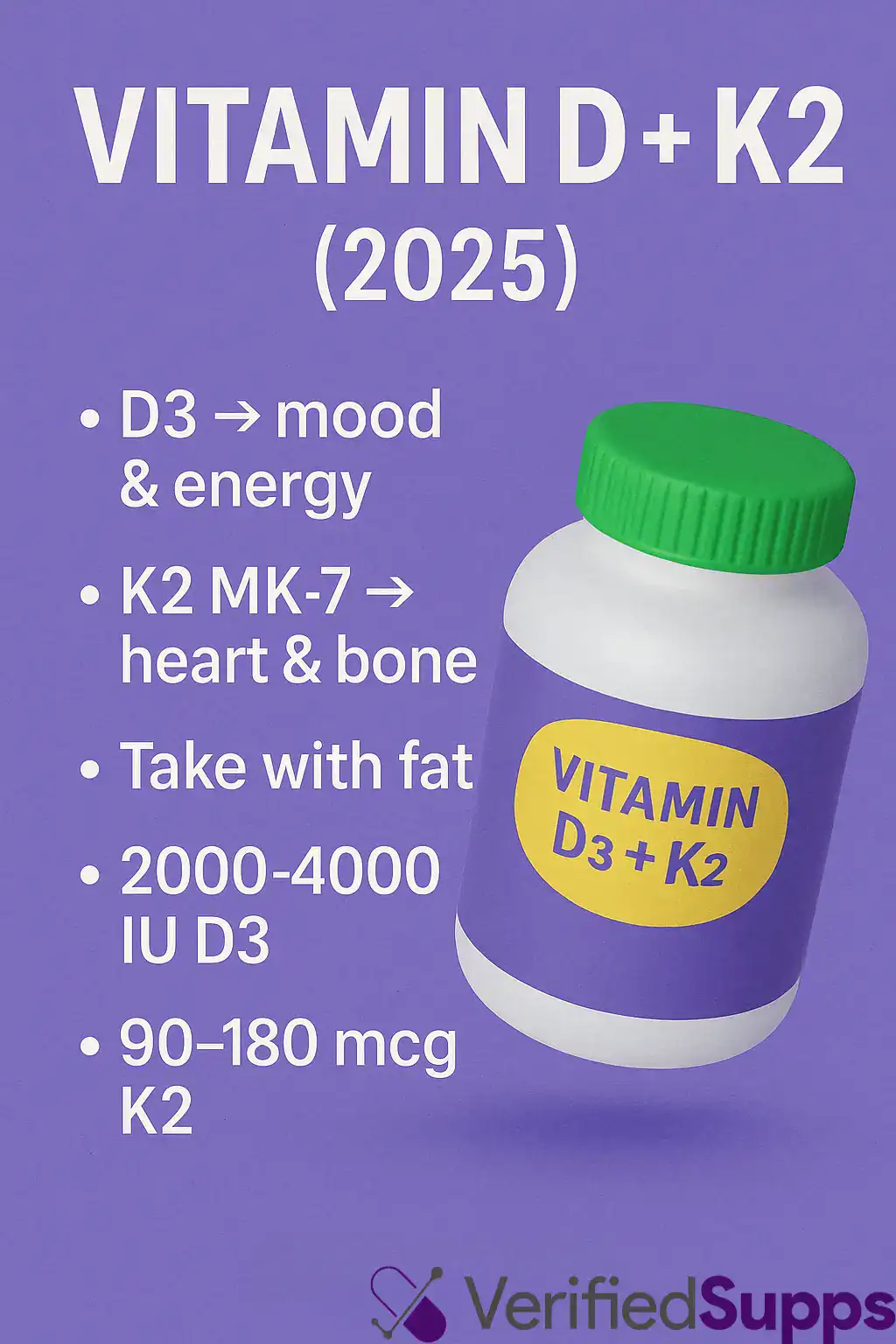
- Common daily range: often around 1,000–2,000 IU D3 plus 90–180 mcg K2 (MK-7) depending on context.
- Big caution: K2 can conflict with warfarin (and other vitamin K–sensitive anticoagulation plans). Confirm with your clinician.
If you’ve been told you have high calcium, granulomatous disease (such as sarcoidosis), kidney disease, or you’re using prescription anticoagulants, do not self-prescribe high-dose D3/K2. Confirm dosing and monitoring with a clinician.
Parent Hub: Want a product-first buyer’s guide (what to look for, what to avoid, and how to pick a quality formula)?
Open: Best Vitamin D + K2 Supplement Guide (VerifiedSupps)
Vitamin D3 + K2 “decoder” (fast decision table)
If you only read one part, read this. It turns the label into a simple choice.
| Your situation | Most sensible pick | Typical label target | Caution flag |
|---|---|---|---|
| Indoor work, low sun exposure | D3 + K2 (MK-7) | D3 in the 1,000–2,000 IU range, MK-7 around 90–180 mcg | Warfarin/anticoagulation plan |
| You want budget-simple and minimal decisions | D3 alone | Oil-based D3 softgel or drops | High-dose use without labs/monitoring |
| You care most about bone strategy and “complete” support | D3 + MK-7 (optional MK-4) | MK-7 listed clearly; MK-4 if included is typically in mg amounts | Adding calcium blindly without a reason |
| You want best absorption odds | Oil-based + taken with meals | Softgel or drops (MCT/olive oil), taken with food | Taking fat-soluble vitamins on an empty stomach |
The biggest “got it” moment: D3 increases calcium handling, while K2 supports calcium placement. That’s why people pair them.
Should you take vitamin D3 with K2?
Often, yes—especially if you supplement D3 long-term and you want a “more complete” approach to calcium metabolism. That said, you don’t have to for D3 to be helpful. K2 is best viewed as a system-supporting add-on, not a mandatory requirement for every person.
The decision is usually about risk and context: if you’re taking moderate D3 doses with food and you’re not also adding unnecessary calcium, many people do fine. If you’re aiming for a more comprehensive bone/vascular approach, K2 becomes more appealing.
What does vitamin K2 do with vitamin D?
The simplest model is this: vitamin D helps your body absorb and use calcium, and vitamin K2 helps activate proteins involved in directing calcium, particularly toward bone and away from soft tissue. That’s why people call D3 + K2 a “pair.”
This is also why people are cautious about adding high-dose calcium and high-dose D without thinking through the system. You want calcium where it belongs, not “floating around” without guidance.
MK-7 vs MK-4: which K2 is better?
For most everyday supplementation, MK-7 is the most practical K2 form because it’s commonly used at microgram doses and is designed for steady daily use. MK-4 is often used differently (typically in milligram doses) and is not required for most people—but some formulas combine both.
A human way to remember it
- MK-7: “steady daily support” (commonly 90–200 mcg).
- MK-4: “different dosing style” (often in mg amounts).
- Most people: MK-7 alone is enough if you want K2 at all.
How much vitamin D3 and K2 should you take per day?
A common daily approach is 1,000–2,000 IU of D3 with 90–180 mcg of K2 (MK-7), taken with food. Some people use higher D3 intakes depending on labs, sun exposure, and clinician guidance—but more is not automatically better.
Three anchors that keep it sane
- Use labs when possible: 25(OH)D is the common marker clinicians use to assess vitamin D status.
- Avoid “forever high-dose” without monitoring: high dosing can backfire in certain medical contexts.
- Take with a meal: D and K are fat-soluble, so food matters for absorption.
Note: if you use warfarin, do not add K2 without clinician guidance. The point is consistency and safety, not improvisation.
When is the best time to take vitamin D3 + K2?
The best time is the time you’ll be consistent—with a meal that contains fat. Many people prefer morning or midday with food so they don’t forget, but evening can also work if it fits your routine.
Simple timing rules
- Take D3/K2 with a meal (fat helps absorption).
- If you’re sensitive, avoid taking it on an empty stomach.
- If you’re using multiple supplements, change one variable at a time so you can judge effects.
What to look for in a vitamin D3 + K2 supplement
A good D3 + K2 product is usually boring in the best way: clear labeling, sensible doses, oil-based delivery, and minimal extras. Your goal is reliability, not novelty.
Aim for
- D3 listed as cholecalciferol
- K2 listed as MK-7 (menaquinone-7)
- Oil-based softgel or drops (MCT/olive oil)
- Reasonable K2 dosing (commonly 90–200 mcg MK-7)
- No unnecessary calcium added unless you have a clear reason
Avoid
- “Vitamin D” that’s actually D2 (unless specifically intended)
- Gummies with low potency
- Blends that hide forms or doses
- Taking high-dose D3 indefinitely without monitoring if you’re in a higher-risk category
Recommended options (affiliate links preserved)
Premium quality (testing-focused)
Good if you prioritize purity, consistency, and brand trust.
View Vitamin D3 + K2 at Nootropics DepotConvenient option (fast shipping)
Good if convenience and easy returns matter most.
View Vitamin D3 + K2 on AmazonIf you choose to purchase through these links, it may support this site at no extra cost to you. Only add what feels right for you and your health.
Why vitamin D3 + K2 isn’t working (common mistakes)
The most common reason people “don’t feel anything” from D3/K2 is that the goal is unclear, the product is underdosed or taken inconsistently, or a larger bottleneck is driving symptoms (sleep, iron status, thyroid function, diet quality, or depression/anxiety patterns). D3/K2 is often a baseline builder, not an acute “feel it in 30 minutes” supplement.
Common mistakes (and fixes)
- Taking it without food: take with a meal containing fat for better absorption.
- Inconsistent use: daily consistency matters more than “perfect dosing.”
- No lab context: if possible, use 25(OH)D testing to guide dosing rather than guessing.
- Expecting mood/energy changes to be immediate: changes, when they happen, are often gradual.
- Missing magnesium: magnesium status can affect vitamin D metabolism in the body; if your diet is magnesium-poor, D support may feel “blunted.”
- Ignoring safety context: if you have high calcium, kidney disease, or take anticoagulants, you need a clinician-guided plan.
A simple 14-day consistency test
- Take the same dose with the same meal each day.
- Track: morning energy, mood stability, muscle aches, and sleep quality.
- If nothing changes, reassess: lab status, dose realism, and whether a different bottleneck is driving symptoms.
Selected Professional References
Go Deeper (VerifiedSupps Guides)
If you want the next step without guesswork, these are the most useful companions to D3 + K2.
Vitamin D benefits
What vitamin D actually influences (mood, muscle, immunity, recovery).
Vitamin K2 benefits
Why K2 matters, how MK-7 differs, and who should be cautious.
How to choose magnesium
Magnesium often supports vitamin D metabolism and overall resilience.
Is fish oil worth taking?
A calm, practical answer with real tradeoffs and who benefits most.
Final Takeaway
Vitamin D3 can be a meaningful foundation when sun exposure is low. Vitamin K2 can make the system feel more “complete” by supporting how the body handles calcium. The clean approach is simple: choose D3 (cholecalciferol), add K2 MK-7 if it fits your context, take it with a meal, and stay consistent. If you’re on anticoagulants or have high-risk medical conditions, use clinician guidance instead of guesswork.
FAQ
Do you really need K2 with vitamin D3?
Not always. D3 can be beneficial on its own. K2 is often used as a “system support” add-on, especially for long-term D3 supplementation and calcium metabolism context.
Which K2 is best: MK-7 or MK-4?
For most everyday use, MK-7 is the most common choice. MK-4 is used differently and often appears in mg doses. Many people do fine with MK-7 alone if they use K2 at all.
Can vitamin D3 + K2 raise calcium too much?
Excess vitamin D intake can contribute to high calcium in certain situations, especially at high doses or in specific medical conditions. If you have a history of high calcium, kidney disease, or granulomatous disease, use clinician-guided dosing and monitoring.
Can I take vitamin D3 + K2 with blood thinners?
K2 can interfere with warfarin management because warfarin is vitamin K–sensitive. If you use prescription anticoagulants, confirm with your clinician before adding K2.
Should I take D3 + K2 in the morning or at night?
Either can work. The best time is the time you’ll be consistent, taken with a meal containing fat for absorption.
What’s a common daily dose of vitamin D3?
Many people use 1,000–2,000 IU daily as a general approach, but the best dose depends on labs, sun exposure, diet, and medical context.
What’s the best way to absorb vitamin D and K?
Take them with a meal containing fat. Oil-based softgels or drops are commonly used for this reason.
Why do I feel nothing from vitamin D3?
Many people don’t feel an obvious “effect.” When benefits show up, they’re often gradual and tied to baseline improvements. If symptoms are significant, labs and broader health factors may matter more than escalating doses.