CoQ10 Dosage Guide: How Much to Take for Energy, Heart Support, and Daily Use
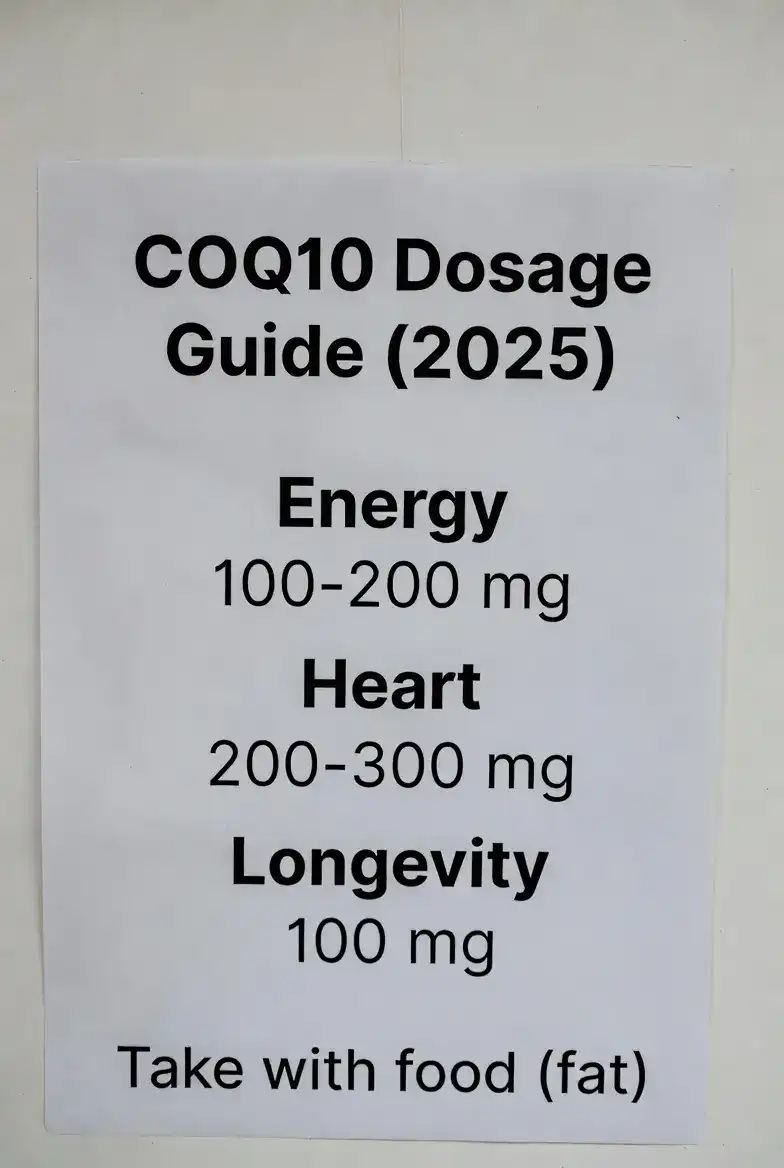
Most people do well starting CoQ10 at 100–200 mg per day taken with a meal that contains fat. If you’re taking CoQ10 specifically for statin support or clinician-directed cardiovascular goals, 200–300 mg per day is a common practical range. Higher dosing can be appropriate in some clinical contexts, but it’s best treated as a clinician-informed decision.
Quick Take: If you want the simplest plan with the best odds of noticing something, do this first.
- Start: 100–200 mg/day
- With food: always take with a fat-containing meal
- Give it time: evaluate over 2–6 weeks
- If on statins: 200–300 mg/day is commonly used in practice (coordinate with your clinician)
Evidence note: absorption and consistency matter more than perfect timing.
Parent Hub: CoQ10 Benefits
What CoQ10 does, who tends to notice it most, and how to think about it as a foundational “cell energy” support.
Open the CoQ10 benefits hub →
How much CoQ10 should I take per day?
For most adults, 100–200 mg per day is a practical starting range. If your goal is statin support or clinician-directed cardiovascular support, 200–300 mg per day is often used.
Constraint: CoQ10 is fat-soluble. A “perfect dose” taken without food can behave like a low dose in real life. Take it with a fat-containing meal before you adjust anything.
CoQ10 Dosage Decoder (fast, practical)
| Goal | Typical daily range | How to take it | What you might notice |
|---|---|---|---|
| Daily energy baseline | 100–200 mg/day | With a meal containing fat | Steadier energy (not a stimulant) |
| Statin support / heart focus | 200–300 mg/day | With fat; consider split dosing if sensitive | Often subtle; judge over weeks |
| Longevity-style stacks | 100 mg/day | With food; keep consistent | More “baseline support” than a feeling |
| If you feel nothing | Do not jump instantly to mega-doses | Fix absorption first (meal + fat), then reassess | Most issues are absorption or expectation mismatch |
Simple rule: if you’re taking CoQ10 fasted, you haven’t really tested CoQ10 yet.
What is the best CoQ10 dosage for energy?
If you’re taking CoQ10 primarily for energy, 100–200 mg/day is the common practical range. This is the “start here” dose for most healthy adults.
Constraint: CoQ10 is not caffeine. If it helps, it often shows up as fewer “draggy” hours and a steadier baseline over time, not a sudden surge.
- If you’re sensitive: start at 100 mg/day for 7–14 days.
- If you want a cleaner test: keep caffeine consistent while you trial CoQ10.
- Give it time: many people evaluate over 2–6 weeks.
What is the best CoQ10 dosage for heart health or statins?
For statin support and heart-focused use, 200–300 mg/day is a common real-world range. CoQ10 has been studied in cardiovascular settings as an adjunct (not a replacement for medical care).
Constraint: if you have cardiovascular disease, dosing should be clinician-informed. CoQ10 may be helpful in some contexts, but it’s not a substitute for prescribed therapy.
- Statins: CoQ10 is frequently used because statins are associated with lower CoQ10 status in the body.
- Practical note: split dosing (e.g., morning + evening with meals) can improve tolerance if you feel GI discomfort.
- Measurement mindset: judge it by symptom trends and clinician markers, not by one day.
Is 400 mg CoQ10 too much?
Not necessarily—higher doses are used in some clinical studies and specialist-guided protocols. But for most people self-supplementing, jumping to 400 mg is usually unnecessary until you’ve confirmed absorption, consistency, and goal clarity.
Constraint: “more” can increase cost and the chance of mild side effects (like stomach upset). If you’re not on a clinician-directed plan, it’s often smarter to optimize meals and consistency first.
- If you’re considering 400 mg: ask why (statins? heart failure adjunct? severe fatigue?). Clarify the goal.
- If your goal is general energy: 100–200 mg/day is the typical starting strategy.
- If you have medical conditions or take anticoagulants: discuss with a clinician before higher dosing.
Ubiquinol vs ubiquinone: does the dosage change?
The “dose” doesn’t change because one form is magically stronger—rather, people often choose ubiquinol when absorption is a concern (commonly with older age). Ubiquinone can still work well in good formulations taken with fat.
Constraint: if you’re taking CoQ10 without fat, changing the form often won’t fix the real problem.
Simple rule of thumb
- Older adults / statin users: ubiquinol is a conservative choice.
- General use: ubiquinone can be fine if you’re consistent and take it with fat.
When should I take CoQ10: morning or night?
Take CoQ10 at the time you’ll remember consistently—with a meal that contains fat. Many people choose morning or lunch. If you notice it feels mildly energizing, take it earlier in the day.
Constraint: timing is less important than absorption. A “perfect” bedtime dose without fat is often less effective than a morning dose with food.
- Best default: with breakfast or lunch (fat-containing meal).
- If sensitive stomach: split the dose across two meals.
- If on multiple medications: check spacing guidance with your clinician/pharmacist.
Why am I not feeling CoQ10?
Most “it did nothing” experiences come down to absorption, timeframe, or expectations. CoQ10 often feels like a baseline smoother—not a stimulant hit.
- You’re taking it fasted: take it with a meal that contains fat for at least two weeks before judging.
- You didn’t give it time: evaluate over 2–6 weeks of daily use.
- Baseline is already strong: the better you already feel, the smaller the noticeable change tends to be.
- Dose is too low for your goal: 100 mg may be subtle; 200 mg/day is a common “clean test” dose.
- Wrong target: if fatigue is driven by sleep debt, iron deficiency, thyroid issues, or under-eating, CoQ10 won’t override the root cause.
- Too many changes at once: add CoQ10 alone so you can actually attribute effects.
Clean test: 200 mg/day with a fat-containing meal for 30 days, with a simple weekly check-in on energy steadiness and training tolerance.
Selected Professional References
External links only. These are reputable starting points for dosing, safety, and clinical context.
- NIH NCCIH: Coenzyme Q10 — overview, uses studied, and safety/interactions.
- Mayo Clinic: Coenzyme Q10 — practical summary of dosing and side effects.
- StatPearls (NCBI Bookshelf): Coenzyme Q10 — clinical overview and interaction cautions.
- Q-SYMBIO trial (PubMed) — adjunct CoQ10 research in chronic heart failure context.
- PubMed search: CoQ10 and statin muscle symptoms (meta-analyses) — mixed results; good for reviewing the current evidence landscape.
Go Deeper (VerifiedSupps Guides)
If you’re building a clean baseline stack, these are the best next reads.
Final Takeaway
CoQ10 dosing doesn’t have to be complicated: 100–200 mg/day is a strong starting point for most people, and 200–300 mg/day is a common range for statin or heart-focused use with clinician awareness.
The biggest performance lever is often absorption. Take it with a meal that contains fat and evaluate it over weeks, not hours.
If you’re on blood thinners or managing cardiovascular disease, treat CoQ10 as a clinician-informed tool—not a guess.
Frequently Asked Questions
What is a good starting dose of CoQ10?
Most people start at 100–200 mg per day with a fat-containing meal. If you’re sensitive, start at 100 mg and reassess after 1–2 weeks.
Should I take CoQ10 in the morning or at night?
Either can work. The key is taking it with food that contains fat. If it feels energizing, take it earlier in the day.
How long does CoQ10 take to work?
Many people evaluate it over 2–6 weeks. It often feels like steadier baseline energy rather than an immediate effect.
Is 200 mg of CoQ10 too much?
For many adults, 200 mg/day is a common dose and is generally well tolerated. If you get GI upset, split it across meals.
Is ubiquinol better than ubiquinone?
Ubiquinol is often chosen when absorption is a concern (commonly with older age). Ubiquinone can still work well if taken with fat consistently.
Can CoQ10 interact with blood thinners?
Potential interactions are commonly noted in clinical references. If you take anticoagulants or antiplatelet medications, discuss CoQ10 with your clinician before starting.
Should I take CoQ10 with food?
Yes. CoQ10 is fat-soluble, and taking it with a meal that contains fat is one of the most important steps for absorption.
Can I take CoQ10 every day long term?
Many people do, especially in heart-focused or statin contexts. If you have medical conditions or take prescription medications, long-term use should be clinician-informed.