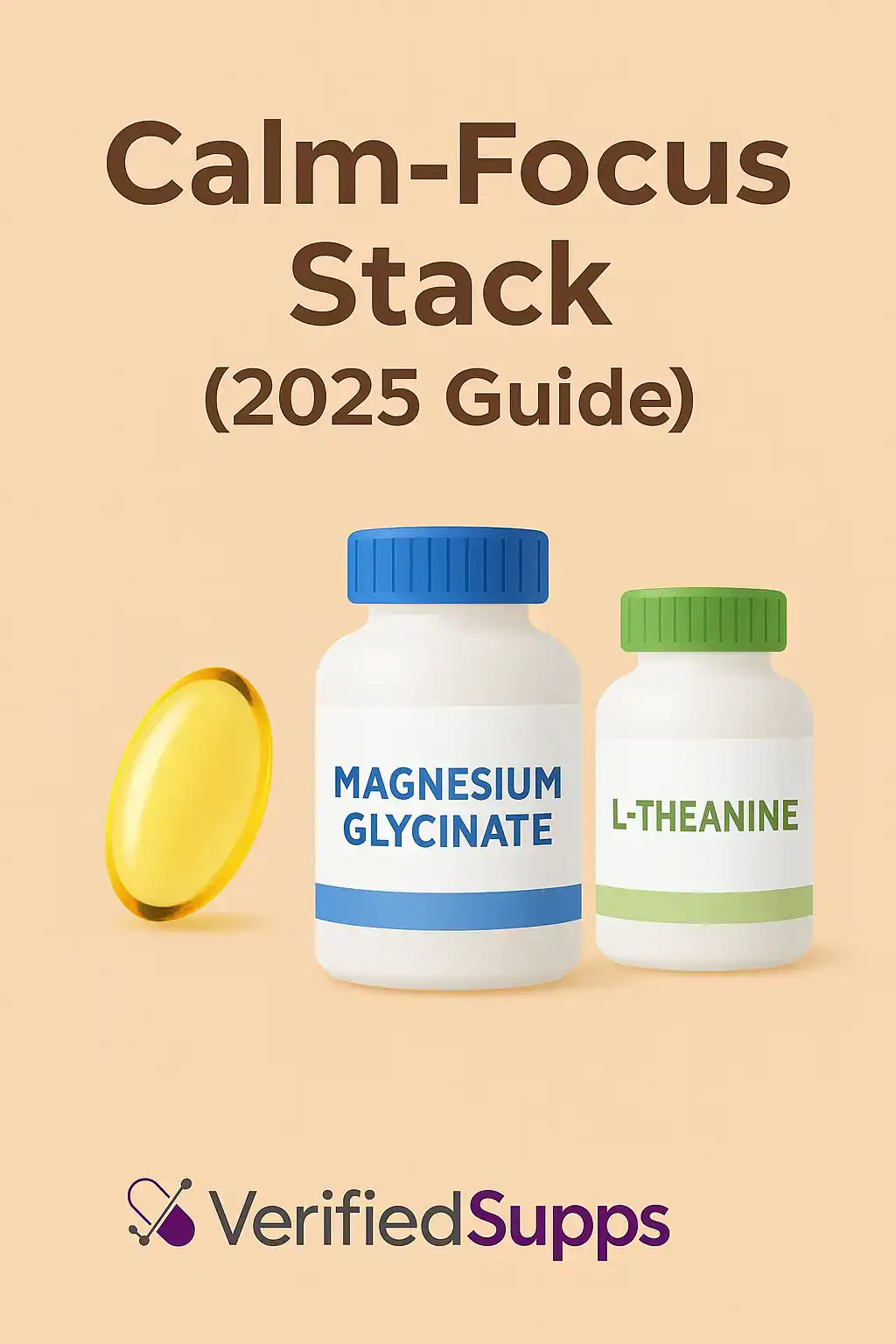
Calm Focus Stack: L-Theanine + Magnesium + Omega-3 (Focus Without Jitters)

8016e2e5 abe2 4e60 8557 f795b664f2e4
Calm focus · Mental clarity · Smooth caffeine · Nervous system
Stack guide

Calm Focus Stack: Clear Thinking Without Jitters

The simplest calm focus stack is: L-theanine + magnesium glycinate + omega-3. It’s built for people who want clear thinking without stimulant edge, and steadier mood without feeling sedated. If your brain flips between tension and fog, this is a clean, low-drama place to start.

Scope note: This page is the “minimal stack.” If you need condition-specific protocols or medication guidance, treat this as educational—not medical care.

Key terms: L-theanine · magnesium glycinate · EPA · DHA · caffeine jitters · calm focus · elemental magnesium
If this is you…
  • Caffeine helps… until it turns into jitters, tight chest, or “too wired.”
  • You can focus, but it costs stress (and your evenings feel restless).
  • You want clarity that feels clean—not forced.
Quick Take
  • Fast lever: L-theanine (often noticeable same day).
  • Downshift lever: magnesium glycinate (evening routine).
  • Resilience lever: omega-3 (EPA+DHA daily, weeks-long compounding).
  • Most common mistake: trying to “out-supplement” too much caffeine and too little sleep.
TL;DR decision: If you want focus without edge, start with L-theanine (workdays), add omega-3 (daily with food), then add magnesium glycinate (evenings) to protect your downshift and sleep.
🧭
Parent Hub: The Complete Calm Focus Stack
Want the full system (templates, variants, timing, what to avoid, and troubleshooting)? Start here.
Open hub

Calm focus stack: what to take based on how it feels

If you feel…Start with…Typical doseBest next step (today)
Wired / overthinking / “mental static”L-theanine100–200 mgTake with your usual caffeine (don’t increase caffeine)
Tense body + restless eveningsMagnesium glycinate200–400 mg elementalTake with dinner for 10–14 nights
Mood brittle under stressOmega-3 (EPA+DHA)1,000–2,000 mg/dayStart daily with meals (judge in weeks)
Caffeine helps but you get jittersTheanine + caffeine100–200 mg theanineKeep caffeine stable; smooth the edge first
Best next step (today): If you’re jittery or overthinking, add L-theanine to your current caffeine before changing anything else.

What is a calm focus stack?

A calm focus stack is a small, repeatable supplement routine that supports attention and mental clarity without the stimulant edge. The target outcome is steadiness: less mental noise, better stress tolerance, and cleaner work output.

Mechanism (in 3 bullets)
  • Quiet the noise: L-theanine supports calm attention (especially with caffeine).
  • Protect the downshift: magnesium glycinate supports evening relaxation and sleep quality.
  • Build resilience: omega-3 (EPA+DHA) supports long-horizon brain and mood signaling.
Cannibalization guardrail: This page is the “minimal” stack. If you want advanced variants (ADHD-like patterns, shift work, heavy anxiety), use the Parent Hub.

What is the best calm focus stack for focus without jitters?

For most people, the best calm focus stack is L-theanine + magnesium glycinate + omega-3 because it covers the three most common bottlenecks: mental noise, nervous-system tension, and low resilience under stress.

L-theanine
Most noticeable lever for “edge” and overthinking.
Magnesium glycinate
Best when calm focus fails because sleep/downshift is weak.
Omega-3 (EPA+DHA)
Slow compounding support for mood stability and resilience.
Dose-clarity rule: Magnesium = elemental mg. Omega-3 = EPA + DHA mg. Theanine = mg per capsule.

How much L-theanine should you take for focus?

Most people start at 100–200 mg. If you’re using it with caffeine, that same range is usually enough to smooth jitters without dulling you.

Calm focus (no caffeine)
100–200 mg once or twice daily.
Smooth caffeine
100–200 mg alongside your normal caffeine dose.
Common mistake: increasing caffeine when the real problem is overstimulation.

Does magnesium glycinate help anxiety and focus?

It can—when “focus problems” are really downshift problems. If you’re tense, restless in the evening, or you wake up unrefreshed, magnesium glycinate often helps the foundation that makes calm focus possible.

Label-reading micro-rule
Dose by elemental magnesium (Supplement Facts). Ignore big “compound mg” numbers on the front label.
Typical routine
200–400 mg elemental magnesium in the evening (many prefer dinner timing). Start lower if you’re sensitive.

How much omega-3 should you take for mood and focus?

A common daily range is 1,000–2,000 mg combined EPA + DHA with meals. Omega-3 works best as a steady input—its benefits are usually easier to notice over weeks than over days.

Dose-clarity rule
Ignore “fish oil 1,000 mg” claims. Find the line that lists EPA (mg) and DHA (mg). Add them.

How to take a calm focus stack: dose, timing, and caffeine

Timing is about consistency and sleep protection. Use theanine where you work, omega-3 with meals daily, and magnesium glycinate in the evening to protect downshift.

Morning / work block
Caffeine (optional) + L-theanine 100–200 mg.
Meals
Omega-3 (EPA+DHA) with food daily.
Evening
Magnesium glycinate with dinner (or early evening).
Timeline: Theanine can feel fast. Magnesium is often noticeable as better evenings/sleep over 7–14 nights. Omega-3 is a weeks-long baseline shift.
Pattern interrupt:
If your calm focus stack “fails,” it’s usually because caffeine and sleep are still driving the bus.

Why the calm focus stack isn’t working

Most “no results” outcomes are dose clarity problems, inconsistent use, or bigger bottlenecks (sleep debt, too much caffeine, unstable meals) overpowering the effect.

Most common fixes
  • Smooth before you boost: add theanine before raising caffeine.
  • Fix label math: omega-3 = EPA+DHA; magnesium = elemental.
  • Protect sleep: magnesium timing + caffeine cutoff.
  • Stop stacking variables: change one input at a time for 7–14 days.
Red flags / seek care
  • New severe anxiety/panic symptoms or chest pain
  • Severe insomnia that is escalating
  • Medication interactions or complex medical history
  • Any urgent symptoms—don’t “supplement-debug” emergencies
Selected Professional References

Go Deeper (VerifiedSupps Guides)

VerifiedSupps Medical Disclaimer
This content is for informational and educational purposes only and is not medical advice. Supplements can affect individuals differently and may interact with medications and medical conditions. Consult a qualified healthcare professional before starting, stopping, or changing supplementation—especially if you take prescription medications (including mood medications or stimulants), have significant medical conditions, or are pregnant or breastfeeding. Seek medical attention for severe, rapidly worsening, or concerning symptoms.

Related Articles

Health

Ribupatide for Weight Loss: Oral and Injectable GLP-1/GIP Results

Investigational Weight-Loss Drugs Ribupatide for Weight Loss: Oral and Injectable GLP-1/GIP Results Ribupatide is an investigational dual GLP-1/GIP receptor agonist being developed in both once-weekly injectable and once-daily oral forms for obesity and overweight. The injectable version is further along in global Phase 3 development, while oral ribupatide has early Phase 2 data from China.

Read More »
Health

Is Retatrutide Approved Yet? FDA Status, Availability, and Timeline

FDA Status & Drug Availability Is Retatrutide Approved Yet? FDA Status, Availability, and Timeline No. As of May 19, 2026, retatrutide is not FDA-approved for weight loss, type 2 diabetes, or any other condition. It remains an investigational once-weekly triple hormone receptor agonist being studied by Eli Lilly in Phase 3 clinical trials. Retatrutide has

Read More »
Health

CT-388 for Weight Loss: Results, Side Effects, and Current Status

Investigational Weight-Loss Drugs CT-388 for Weight Loss: Results, Side Effects, and Current Status CT-388, also called enicepatide, is an investigational once-weekly injectable GLP-1/GIP receptor agonist being developed by Roche and Genentech for obesity, type 2 diabetes, and related metabolic conditions. Early clinical results are promising, but CT-388 is not approved and should not be used

Read More »