By VerifiedSupps Editorial Team
Taurine Dosage Guide: How Much to Take and Best Time to Take It
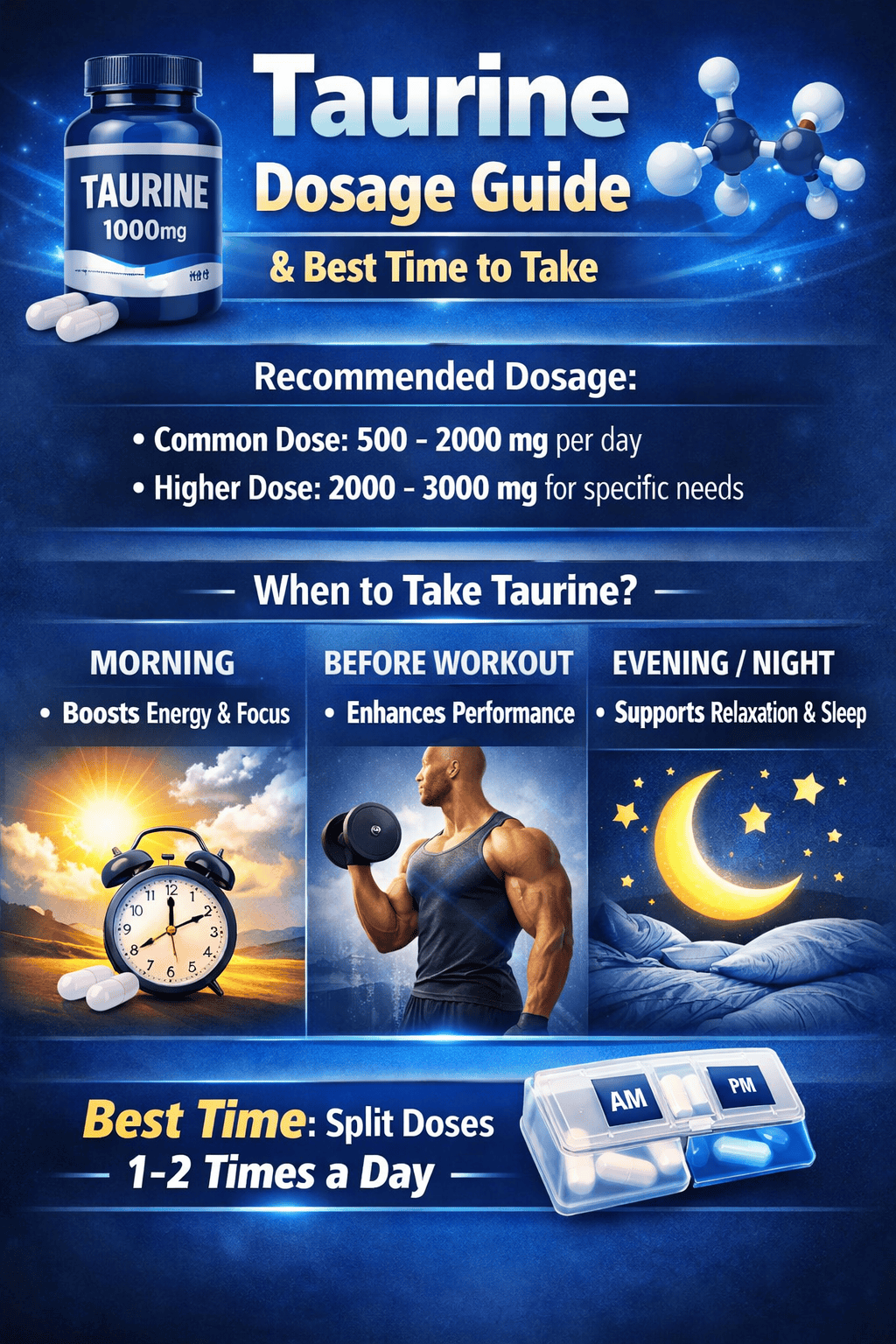
For most adults using taurine as a supplement, the practical range is 1–3 g/day. If your goal is performance, the evidence usually clusters around 1–3 g taken before training. If your goal is broader cardiometabolic support, the more useful range looks like 1.5–3 g/day taken consistently over weeks, not just once in a while.
The “best time” is not one universal clock time. It depends on the job. For workouts, pre-exercise timing makes sense. For daily support, consistency matters more than morning versus night. For sleep or calm, bedtime taurine is a reasonable experiment, but the human evidence there is still weaker than the internet makes it sound.
This page owns the taurine dosage and timing question. The broader “what taurine actually helps with” discussion belongs in the main taurine benefits guide, while sleep, stress, and workout stack decisions each have their own deeper pages.
Key terms: taurine dosage, taurine timing, best time to take taurine, taurine before workout, taurine morning or night, taurine before bed, taurine safety
Quick Take
If you want the shortest useful answer: start around 1 g/day if you are just testing tolerance, use 1–3 g/day as the main practical taurine range, take it about 60–90 minutes before training if performance is the goal, and do not assume morning or night matters much unless your goal is very specific.
TL;DR decision
Use taurine timing to match the job. Pre-workout for performance. Any consistent daily slot for ongoing cardiometabolic support. Bedtime only as a cautious personal experiment, not because bedtime taurine is already a proven sleep protocol. For long-term everyday use, 1–3 g/day is the range most people should think in.
Evidence standard: human trials, dose ranges, guideline-level sources when available
Who this is for: adults who want a practical taurine dose and timing strategy for exercise, daily support, or a simple self-test
Who this is not for: anyone treating taurine like a replacement for blood-pressure or glucose treatment, or using energy drinks as their main “taurine trial”
Reviewed by: VerifiedSupps Editorial Team
Last reviewed: March 30, 2026
Parent Hub
Taurine Benefits: The Complete Science-Backed Guide
Start with the main taurine hub if you want the bigger picture first: what taurine may help with, where the evidence is strongest, and where the hype gets ahead of the data.
Taurine dose and timing decoder
Use this first. It turns the whole taurine timing question into something you can actually test.
| If you want… | Practical dose | Best timing | How long to judge it |
|---|---|---|---|
| A cautious everyday starting point | ~1 g/day | Any consistent time you will actually keep | 1–2 weeks for tolerance and fit |
| Exercise performance or recovery support | 1–3 g | About 60–90 minutes pre-workout | Several training sessions, not one |
| Cardiometabolic support | 1.5–3 g/day | Any consistent daily slot | Usually 8+ weeks |
| An evening calm or sleep experiment | Start low | Evening if you are specifically testing it for that purpose | A short trial, with modest expectations |
Best next step (today): Decide what job taurine is supposed to do before you decide when to take it. Dose and timing only make sense once the goal is clear.
How much taurine should you take per day?
For most adults, 1–3 g/day is the practical taurine range. If you are new to taurine, 1 g/day is a clean starting point. If you are using it for exercise support, 1–3 g is the range most often used. If your goal is blood pressure, vascular, or broader metabolic support, the best human evidence currently points toward 1.5–3 g/day, especially when used consistently over time.
Mechanism
- Taurine is absorbed orally and, in healthy volunteers given a 4 g dose, plasma levels peaked at about 1.5 ± 0.6 hours, which helps explain why pre-exercise timing is usually measured in hours, not minutes.
- For acute performance, more is not automatically better. A 2025 meta-analysis did not find a clear dose-response pattern within the commonly used 1–6 g range.
- For cardiometabolic outcomes, newer dose-response analysis suggests 1.5–3 g/day may be the sweet spot, particularly when supplementation lasts long enough to affect blood pressure, glucose, or lipid markers.
That is why a calm progression works so well. Start lower. Match the dose to the job. Only go higher when there is a specific reason. If you are already thinking about 4–6 g/day, you should know why you are doing it, because the best-supported long-term safety benchmark still sits at 3 g/day in healthy adults.
What would change my recommendation
- Low blood pressure or blood-pressure medication: taurine’s “good” effect may be too much for some people.
- Glucose-lowering medication: taurine’s metabolic effects deserve more caution, not less.
- High-caffeine energy drink use: you are not really testing taurine alone.
- No clear goal: if the target is vague, your dose decision will be vague too.
When is the best time to take taurine?
The best time to take taurine depends on the goal. There is no strong human evidence that “morning is best” or “night is best” for everyone. The literature is much more goal-driven than clock-driven.
If performance is the point, take taurine before training. If daily cardiometabolic support is the point, take it whenever you can stay consistent. If sleep or evening calm is the point, an evening trial is reasonable, but that should be treated as a personal experiment rather than a settled evidence-based rule.
Useful rule: once the goal is obvious, the timing usually becomes obvious too.
Should you take taurine before a workout?
Yes—if your reason for using taurine is exercise performance, recovery, or a smoother pre-workout support role. A practical evidence-based window is about 60–90 minutes before training, because human pharmacokinetic work suggests taurine peaks around that range and sports reviews commonly describe effective acute dosing 1–3 hours before activity.
For most people, 1–3 g is enough to test this well. Some studies use 6 g, but the more recent one-shot meta-analysis did not find a clear dose-response advantage within the commonly used range. That means doubling or tripling the dose is not automatically a smarter move.
Practical takeaway: if taurine is in your pre-workout plan, think “moderate dose, taken early enough to matter,” not “as much as possible right before I lift.”
Should you take taurine in the morning or at night?
For general daily use, either can work. There is no clear human evidence that taurine is universally better in the morning or universally better at night. Morning or daytime use often makes the most sense when taurine is part of a performance or cardiometabolic-support routine, simply because those goals are usually daytime goals.
Night use only makes more sense when you are specifically testing taurine for evening calm or sleep. Even then, the evidence is still limited enough that you should not interpret “night taurine” as a proven sleep formula. It is better framed as a reasonable trial for some people than a guaranteed right answer.
If you feel no difference either way, that is normal. In that case, keep the time that is easiest to remember.
Can you take taurine before bed?
Yes, generally you can. The more important question is whether you should take taurine before bed for your goal. Current human evidence does not support treating taurine as a strong, proven sleep supplement, so bedtime taurine should be framed as a cautious test rather than a settled protocol.
If you want to test bedtime taurine, keep it modest and simple. Start lower than your maximum daily range, keep the rest of the evening routine stable, and judge it on actual sleep outcomes rather than “did I feel sedated?” Taurine does not work like melatonin, and it is not supposed to feel like a sleeping pill.
The smartest bedtime test is not “take a lot and hope.” It is “take a modest amount, keep the routine clean, and decide whether this is actually a sleep supplement for me.”
Is taurine safe every day and what is the upper range?
For healthy adults, taurine appears generally well tolerated. The strongest conservative long-term safety benchmark is an observed safe level of up to 3 g/day. Higher doses have been studied without obvious harm in some shorter-term settings, but the long-term evidence above that level is not strong enough to be equally confident.
That is why 1–3 g/day is such a useful zone. It covers most sensible taurine use while staying inside the best-supported long-term safety range. If you are pushing toward 4–6 g/day, that should usually be because the use-case is specific and deliberate, not because more always sounds better.
People who should be more cautious include those with low blood pressure, those taking blood-pressure or glucose-lowering medication, and anyone using taurine through heavy energy-drink habits rather than a clean taurine-only supplement.
Why isn’t taurine working for me?
Usually because the goal was not specific enough, the timing did not match the goal, or the expectations were too dramatic. Taurine tends to work better as a subtle support tool than as a “you should feel this instantly” supplement.
Common mistakes
- Using taurine for a vague goal like “more energy” instead of a specific goal like endurance, recovery, or BP support
- Taking it at random times and then blaming taurine when the trial itself was messy
- Using an energy drink and assuming you learned something about taurine
- Judging taurine after one use when the goal really needed repeated sessions or several weeks
Clean test protocol
| Inputs | Use taurine alone. Pick one goal. Start around 1 g/day for a general trial, or 1–2 g before training if performance is the reason you care. |
|---|---|
| Duration | Give timing and tolerance 1–2 weeks. Give performance several workouts. Give cardiometabolic support 6–8+ weeks before drawing big conclusions. |
| 3 metrics | Track one primary outcome, one side-effect/tolerance outcome, and one practical adherence outcome. For example: training performance, dizziness/GI comfort, and whether you actually kept the timing consistent. |
| Stop conditions | Stop if you develop persistent GI symptoms, unusual dizziness, low-BP or low-glucose symptoms, or if the supplement no longer matches the actual problem you are trying to solve. |
How to tell it’s working
The signal is usually quieter than people expect. For workouts, it might look like slightly better repeated efforts, endurance feel, or recovery. For daily support, it might look like a more favorable trend over time rather than a dramatic sensation. If your metric is “Did I feel a buzz?” taurine will probably look like it failed.
Red flags / seek care
Get clinician input if you take blood-pressure or glucose-lowering medication and start feeling unusually lightheaded, weak, or “off.” Seek urgent care for chest pain, severe dizziness, significant allergic symptoms, or anything that clearly does not fit a routine supplement issue.
Selected Professional References
These are the main sources behind the dose ranges, timing logic, and safety boundaries used in this guide.
Pharmacokinetics of Oral Taurine in Healthy Volunteers
Key source for the practical timing logic, including the roughly 1.5-hour plasma peak after a 4 g oral dose.
Used for: timing logic, absorption window, pre-workout timing rationale
Taurine in Sports and Exercise
Useful review for the common exercise dose range, pre-activity timing window, and the “promising but not magic” performance framing.
Used for: 1–3 g pre-workout logic, timing windows, mixed-but-promising exercise evidence
Does One Shot Work? The Acute Impact of a Single Taurine Dose on Exercise Performance
Important for the “how much” question because it found no clear linear dose-response across the commonly used 1–6 g range.
Used for: why more is not automatically better, acute timing logic, single-dose performance context
Effects of Oral Taurine Supplementation on Cardiometabolic Risk Factors
Best current source for dose-response clues in cardiometabolic use and why 1.5–3 g/day stands out in that lane.
Used for: 1.5–3 g/day range, 8+ week context, BP/glucose/lipid support framing
Taurine Supplementation Lowers Blood Pressure and Improves Vascular Function in Prehypertension
Useful real-world trial showing that daily taurine can shift BP and vascular outcomes, which is why dose decisions deserve more caution in medicated people.
Used for: 1.6 g/day example, BP effects, medication-caution logic
Risk Assessment for the Amino Acids Taurine, L-Glutamine and L-Arginine
Still the key reference behind taurine’s conservative long-term observed safe level in healthy adults.
Used for: daily safety range, upper-range caution, long-term use framing
Go Deeper (VerifiedSupps Guides)
Once the dose and timing are clear, these are the next pages that make taurine easier to place in the bigger picture.
Best Pre-Workout Ingredients Explained
Best next read if your taurine question is really a pre-workout question.
The Best Pump Stack
Open this if you want to see where taurine fits inside a simple pump and training stack.
The Complete Sleep Stack
Go here if bedtime taurine is really part of a broader sleep-support question.
How to Choose Supplements Without Guesswork
Use this when the real question is whether taurine deserves a place in your plan at all.
Final Takeaway
Taurine is easier to use once you stop asking for one perfect clock time. Use 1–3 g/day as the practical range, time it before training if performance is the job, use any consistent daily slot if the goal is broader ongoing support, and treat bedtime taurine as a modest personal experiment—not a proven universal sleep fix.
FAQ
What is a good taurine starting dose?
A practical starting dose is about 1 gram per day if you mainly want to test tolerance and overall fit.
How much taurine should I take per day?
For most adults, 1 to 3 grams per day is the practical range. Cardiometabolic studies often point toward 1.5 to 3 grams per day.
When is the best time to take taurine?
The best time depends on the job. Pre-workout timing fits performance goals, while any consistent daily slot works for general ongoing support.
Should I take taurine before a workout?
Yes, if exercise performance or recovery is the goal. A practical window is about 60 to 90 minutes before training.
Should I take taurine in the morning or at night?
Either can work. There is no strong human evidence that morning or night is universally better for everyone.
Can I take taurine before bed?
Usually yes, but bedtime taurine is better treated as a cautious personal trial than a proven sleep formula.
Is 3 grams of taurine too much?
For healthy adults, 3 grams per day sits within the strongest conservative long-term safety range.
Do I need to cycle taurine?
There is no strong evidence that taurine needs cycling for ordinary use. Matching dose and timing to the goal matters more.
Can I take taurine with caffeine?
Yes, but that changes the experience and makes it harder to tell what taurine alone is doing.
Who should be more cautious with taurine?
People with low blood pressure, people taking blood-pressure or glucose-lowering medication, and people relying on energy drinks should be more cautious.
VerifiedSupps Medical Disclaimer
This content is for educational purposes only and is not medical advice. Taurine is not a substitute for treatment of high blood pressure, glucose disorders, cardiovascular disease, or any diagnosed condition. Use extra caution if you have low blood pressure, take blood-pressure or glucose-lowering medication, or tend to test taurine through mixed products like high-caffeine energy drinks. Always consult a qualified healthcare professional before starting taurine if you have a medical condition, take prescription medication, or plan to use higher doses for a therapeutic-style goal.