By VerifiedSupps Editorial Team
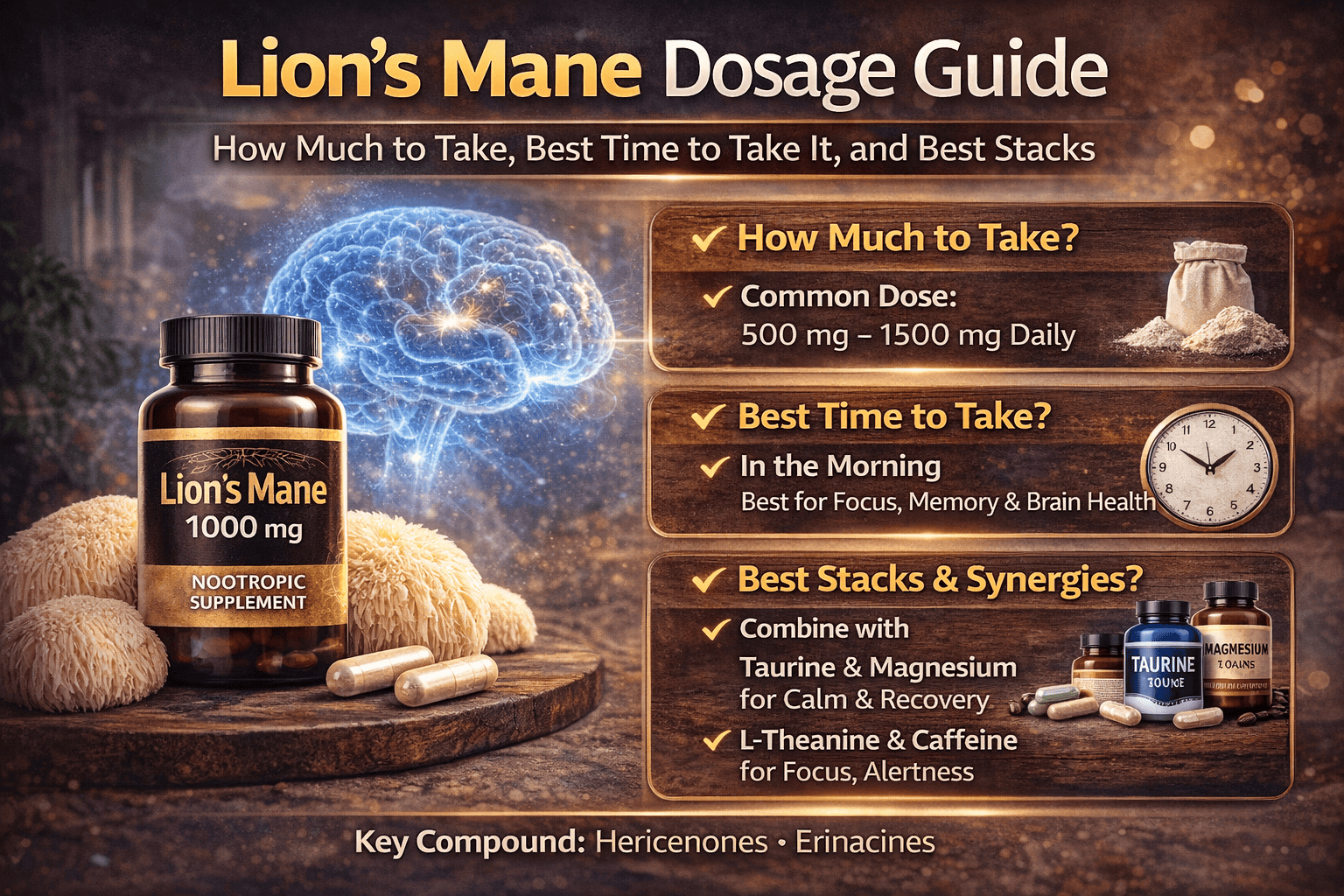
Lion’s Mane Dosage Guide: How Much to Take, Best Time to Take It, and Best Stacks
There is no single perfect Lion’s Mane dose because the human studies used very different products: fruiting body powder, mixed fruiting body and mycelium preparations, enriched mycelial extracts, and high-ratio extracts. That is why online dosage advice gets messy fast. In practical terms, many cognition-oriented trials cluster around roughly 1.8–3.2 g/day, but that does not mean every extract or every label is equivalent gram for gram.
The “best time” is also less magical than people make it sound. For memory and cognition support, morning or early day is the cleanest place to start. For stacks, the useful comparison is not “What combines best on paper?” It is “What stack best matches my goal?” For example, Lion’s Mane + L-theanine + caffeine makes more sense for productivity, while Lion’s Mane + creatine makes more sense for longer-game mental performance support.
This page owns the Lion’s Mane dosage and stack question. The broader “what Lion’s Mane actually helps with” page lives in the benefits guide, and the sharper focus comparison lives in the Lion’s Mane vs L-theanine & caffeine page.
Key terms: Lion’s Mane dosage, Hericium erinaceus dosage, best time to take Lion’s Mane, Lion’s Mane stacks, Lion’s Mane extract vs powder, Lion’s Mane with caffeine, Lion’s Mane with L-theanine, Lion’s Mane with creatine
Quick Take
If you want the shortest useful answer: start with one product, use it consistently, and do not assume extract ratios equal the gram doses in older fruiting-body trials. Morning is the simplest first timing choice. The best stacks are usually Lion’s Mane + L-theanine for calmer cognitive support, Lion’s Mane + caffeine + L-theanine for productivity, and Lion’s Mane + creatine for a steadier, non-stimulant mental-performance angle. Those stack ideas are evidence-guided, not large direct combo-trial conclusions.
TL;DR decision
For a clean self-test, use one Lion’s Mane product for 4–8 weeks, take it in the morning, and judge memory or mental-clarity trends instead of waiting for a stimulant-like feeling. For stacks, match the partner to the job: theanine for smoother cognition, caffeine + theanine for acute productivity, creatine for longer-game mental performance support.
Evidence standard: human trials, dose ranges, guideline-level sources when available
Who this is for: adults who want a practical Lion’s Mane dose, timing, and stack strategy for memory, focus, or longer-game cognitive support
Who this is not for: anyone trying to self-treat dementia, major anxiety, severe depression, neurologic symptoms, or meaningful memory decline with supplements alone
Reviewed by: VerifiedSupps Editorial Team
Last reviewed: April 7, 2026
Parent Hub
Lion’s Mane Benefits: The Complete Science-Backed Guide
Use the main Lion’s Mane guide if you want the bigger-picture evidence first: memory, mood, safety, side effects, and what the current human literature actually supports.
Lion’s Mane dose and stack decoder
This is the fastest way to match Lion’s Mane dose and stack choice to the actual job you want it to do.
| If your main goal is… | Practical Lion’s Mane range | Best time | Best stack | What to expect |
|---|---|---|---|---|
| A clean memory-support trial | Common trial territory: around 3 g/day of fruiting-body-style material | Morning or early day | Lion’s Mane solo first | Slow, subtle, trend-based readout |
| Calmer focus without heavy stimulation | Product-specific daily dose kept steady | Morning | Lion’s Mane + L-theanine | Smoother cognition, not dramatic stimulation |
| Productivity and immediate focus | Lion’s Mane stays steady; caffeine/theanine drive the acute feel | Morning or pre-work block | Lion’s Mane + caffeine + L-theanine | Immediate focus from caffeine/theanine, slower background support from Lion’s Mane |
| Longer-game mental performance support | Lion’s Mane steady daily dose | Morning | Lion’s Mane + creatine | More of a resilience stack than a “feel it now” stack |
Best next step (today): Pick one goal before you pick a dose. Lion’s Mane only becomes easy to dose once the job is clear.
How much Lion’s Mane should you take per day?
The most honest answer is that there is no universal Lion’s Mane dose that fits every product. The human cognition literature used different formulations, and that makes the numbers look more standardized than they really are. Still, the clearest cognition-oriented studies often land somewhere around 1.8–3.2 g/day, depending on whether the product was a powder, a capsule blend, or a concentrated extract.
Mechanism
- The compounds people care about most are often discussed as hericenones and erinacines, but the actual active-equivalent content varies a lot by product.
- That means 3 g of fruiting body powder is not automatically comparable to 3 g of a 10:1 extract.
- So the most important dosing rule is not “copy the biggest number you see online.” It is “match the product form to the study pattern that best resembles it.”
What would change my recommendation
If the product is a concentrated extract, I would lean lower and more cautious at first. If it is a simple fruiting-body powder, I would be more comfortable comparing it to the older gram-based cognition trials. If the label is vague about mushroom part or extract standardization, I would trust the product less before I trust the dose.
What is the best Lion’s Mane dosage for memory and cognition?
If memory support is the reason you are using Lion’s Mane, the most relevant human literature still points back to the older cognition studies rather than the acute healthy-young-adult data. In practical terms, around 3 g/day of fruiting-body-style material is the most recognizable “memory-support study territory.”
That does not mean everyone should jump straight to 3 grams of any product. It means that when people say “Lion’s Mane helped memory in studies,” that is usually the neighborhood they are thinking of. The 2009 mild cognitive impairment study used 250 mg tablets, four tablets, three times daily, which works out to about 3 g/day. The 2019 older-adult study also used a fruiting-body powder intervention for 12 weeks and reported MMSE improvement. The 2020 early-Alzheimer’s pilot used a more specialized erinacine A-enriched mycelia formula rather than a generic powder, which is why it should not be converted too casually into a powder dose.
Practical memory rule: if memory is the main goal, use a product that looks reasonably close to the better cognition literature, keep the dose steady, and give it enough time. This is not an ingredient that usually rewards impulsive “more is better” dosing.
What is the best time to take Lion’s Mane?
There is no settled universal “best time” for Lion’s Mane. The literature is not strong enough to prove that morning beats evening across all goals. But for real-world use, morning or early day is the simplest and most logical starting point—especially if the goal is focus, task performance, or memory support.
That logic comes from the fact that the healthier-younger-adult acute studies measured outcomes around 60–90 minutes after dosing. Even though the 2025 study found no overall cognitive or mood benefit, that timing window still tells you how the acute human trial model is being tested. For longer-game use, consistency matters more than timing perfection.
Practical rule: start with breakfast or your first real meal. If the product bothers your stomach, keep it with food. If you are using Lion’s Mane mainly as a longer-term brain-support supplement, the best time is usually just the one you can actually repeat daily.
What are the best Lion’s Mane stacks for focus?
For focus, the best Lion’s Mane stacks are the ones that admit what Lion’s Mane is not. It is not the most reliable acute focus ingredient. That role still belongs to caffeine, and the smoother version of that role belongs to caffeine + L-theanine. Lion’s Mane works better here as the background layer, not the acute driver.
Best stack for productivity: Lion’s Mane + caffeine + L-theanine. The logic is straightforward: caffeine drives alertness, L-theanine smooths it, and Lion’s Mane becomes the slower, less dramatic cognition-support layer. The strongest human evidence in this stack actually belongs to the caffeine + L-theanine pair, not to a direct three-ingredient trial. That matters, because it keeps your expectations honest.
Best stack for calmer focus: Lion’s Mane + L-theanine. This is the better option if you do not want a heavy stimulant feel. The tradeoff is obvious: calmer, but also less dramatic. If you already know you are sensitive to caffeine, this is the cleaner first stack to test.
Practical dose logic: keep Lion’s Mane at its normal daily dose, then layer 100–200 mg L-theanine and only as much caffeine as your sleep and stress tolerance allow. For many people, the mistake is not “too little Lion’s Mane.” It is “too much caffeine for the day they are trying to have.”
What are the best Lion’s Mane stacks for memory and brain health?
If your goal is more memory support or longer-game cognitive resilience than immediate focus, the best stacks change. The stack I find easiest to justify from the current human evidence is Lion’s Mane + creatine. That is not because the combo has robust direct human trials. It is because Lion’s Mane and creatine each have a slower, brain-support angle that makes more sense together than Lion’s Mane and a purely stimulant-style ingredient.
The 2024 systematic review on creatine and cognition concluded that creatine monohydrate may confer beneficial effects on cognitive function in adults. It is not a miracle compound either, but it is one of the cleaner evidence-based ways to make a non-stimulant “mental performance over time” stack more serious.
A second, more minimalist option is simply Lion’s Mane alone before you stack anything. That sounds less exciting, but it is often the smarter first move. If you do not know what Lion’s Mane does for you by itself, every extra ingredient makes interpretation worse.
Practical rule: if your goal is brain-health support or memory, stack slower with slower. If your goal is acute performance, stack Lion’s Mane under faster ingredients instead of pretending it is one.
Is Lion’s Mane extract, powder, or mycelium better for dosing and stacks?
There is no single winner, but there is a cleaner way to think about it. If you want a dose that resembles the classic cognition studies, fruiting-body-style powder or capsules are easier to line up with the older human trials. If you want a concentrated product for convenience, extracts may make sense—but you should not assume their gram weight behaves like a powder gram weight.
Mycelial or erinacine-focused products are the most scientifically interesting for people who care about the neurotrophic story, but they are also the easiest category to misread because the labels can feel more “advanced” than the clinical evidence really is. The 2020 early-Alzheimer’s pilot using erinacine A-enriched mycelia is one reason people get excited, but that does not mean every mycelium product automatically outranks a good fruiting-body product.
Practical rule: choose the form that is easiest to compare with the evidence you actually care about. Powder-like fruiting body for classic cognition-trial alignment, concentrated extract for convenience, and mycelium-focused products only if you understand why you are choosing them.
Why isn’t Lion’s Mane working for me?
Usually because the goal was vague, the product type did not match the dose advice you copied, or the expectation was too immediate. Lion’s Mane is one of the easiest supplements to judge badly because the product labels look standardized while the human literature is not standardized at all.
Common mistakes
- Using a 10:1 extract like it is directly equivalent to a fruiting-body powder dose from an older study
- Testing Lion’s Mane for acute focus when caffeine or caffeine + L-theanine would have been the more logical first tool
- Changing products too often to learn what any single product actually does
- Expecting a stimulant-like sensation instead of a slow trend in memory or mental steadiness
Clean test protocol
| Inputs | Use one Lion’s Mane product only. Pick one goal only. Keep caffeine and sleep habits stable while testing. |
|---|---|
| Duration | Give it at least 4–8 weeks unless side effects stop the trial earlier. Memory-support questions usually need more patience than focus questions. |
| 3 metrics | Track one memory or cognition target, one daily-life target, and one tolerance target. Example: memory slips, task follow-through, and GI or allergy symptoms. |
| Stop conditions | Stop if you develop breathing symptoms, rash, obvious allergic-type symptoms, persistent GI issues, or if the product is clearly the wrong tool for the job. |
How to tell it’s working
The signs are usually quieter than people expect: fewer minor memory slips, steadier follow-through, less mental drag, or slightly cleaner recall over time. If you are waiting for a caffeine-like “switch-on” feeling, Lion’s Mane will usually feel like a miss even when that was never its real job.
Red flags / seek care
Seek medical care for breathing difficulty, facial swelling, chest symptoms, or a significant rash. Seek clinician input if you are trying to self-manage meaningful memory decline, worsening mood, panic, neurologic symptoms, or major functional impairment with supplements alone.
Selected Professional References
These are the main sources behind the dosage logic, timing advice, stack choices, and safety guardrails used in this guide.
Benefits, Side Effects, and Uses of Hericium erinaceus as a Supplement
Best single overview of the current clinical picture, including cognition, side effects, heterogeneity, and why dose interpretation is so messy.
Used for: overall caution level, side effects, dose-interpretation guardrails
Improving Effects of the Mushroom Yamabushitake on Mild Cognitive Impairment
Still the cornerstone paper for gram-based Lion’s Mane cognition dosing in mild cognitive impairment.
Used for: classic ~3 g/day reference point, memory-support positioning
Improvement of Cognitive Functions by Oral Intake of Hericium erinaceus
Useful because it supports the fruiting-body cognition story while also reminding you that not every cognitive test moved equally.
Used for: older-adult memory support, fruiting-body trial alignment
Prevention of Early Alzheimer’s Disease by Erinacine A-Enriched Hericium erinaceus Mycelia
Important because it keeps the mycelium/erinacine conversation real—but also shows why not all Lion’s Mane products belong on the same dose scale.
Used for: mycelium-dose caution, why specialized extracts complicate simple dosing advice
The Acute and Chronic Effects of Lion’s Mane Mushroom Supplementation on Cognitive Function, Stress and Mood in Young Adults
Useful because it gives one of the clearest healthy-young-adult Lion’s Mane dose patterns and reminds you the benefits are narrower than the hype.
Used for: 1.8 g/day example, young-adult trial context
Acute Effects of a Standardised Extract of Hericium erinaceus on Cognition and Mood in Healthy Younger Adults
A good reality-check paper showing that even a concentrated acute Lion’s Mane dose does not automatically improve overall cognition or mood in healthy younger adults.
Used for: why morning timing is logical but not magical, why acute expectations should stay modest
Promising, but Not Completely Conclusive—The Effect of L-Theanine on Cognitive Function
Best source for calmer-focus stack logic and why theanine deserves a place in Lion’s Mane focus stacks even without direct combo trials.
Used for: theanine stack logic, 200–400 mg/day pattern
The Combined Effects of L-Theanine and Caffeine on Cognitive Performance and Mood
Strong support for the acute productivity stack logic: caffeine + theanine helps attention more clearly than Lion’s Mane does acutely.
Used for: best acute Lion’s Mane stack rationale
The Effects of Creatine Supplementation on Cognitive Function in Adults
Useful because it gives a more evidence-based foundation for a non-stimulant Lion’s Mane + creatine stack than most “brain stack” marketing does.
Used for: longer-game mental-performance stack logic
Spilling the Beans: How Much Caffeine Is Too Much?
Useful official anchor for the practical caffeine side of Lion’s Mane stacks and why “more caffeine” is rarely the smartest fix.
Used for: caffeine guardrails and stack sanity
Go Deeper (VerifiedSupps Guides)
If this dosage and stack guide helped narrow the field, these are the best next reads to place Lion’s Mane correctly in your routine.
Lion’s Mane vs L-Theanine & Caffeine
Go here if you want the direct ingredient comparison before building a stack.
Focus & Productivity Stack
Best next read if your Lion’s Mane stack is really a productivity stack with caffeine and L-theanine doing the acute work.
Creatine Benefits for Mental Focus
Open this if the non-stimulant Lion’s Mane + creatine stack looks more interesting than a caffeine-driven one.
How to Choose Supplements Without Guesswork
Use this if the real question is which product type or stack deserves your money first.
Final Takeaway
Lion’s Mane dosing only looks confusing until you stop pretending every product is the same. Use a product that resembles the evidence you care about, keep the dose steady, and match the stack to the real job: theanine for calmer support, caffeine + theanine for acute productivity, and creatine for longer-game non-stimulant mental support. Lion’s Mane is not the loudest ingredient in those stacks. It is the quieter one that may make more sense over time.
FAQ
How much Lion’s Mane should I take per day?
There is no single universal dose because studies used different products, but many cognition-oriented trials cluster around roughly 1.8 to 3.2 grams per day depending on the form.
What is the best Lion’s Mane dosage for memory?
If memory support is the main goal, the classic cognition literature most closely matches around 3 grams per day of fruiting-body-style material, though extract products are not directly equivalent gram for gram.
What is the best time to take Lion’s Mane?
Morning or early day is the simplest first choice, especially if the goal is cognition or focus. For long-term support, consistency matters more than the exact clock time.
Should I take Lion’s Mane in the morning or at night?
Morning is usually the cleaner first option. There is no strong human evidence that night is universally better.
What are the best Lion’s Mane stacks for focus?
For focus, the most practical stacks are Lion’s Mane with L-theanine for calmer cognition, or Lion’s Mane with caffeine plus L-theanine for productivity. The acute effect mainly comes from caffeine and theanine, not Lion’s Mane.
What is the best Lion’s Mane stack for memory and brain health?
A practical non-stimulant option is Lion’s Mane plus creatine, because both make more sense as slower, longer-game brain-support ingredients than as immediate stimulants.
Is Lion’s Mane extract better than powder?
Not automatically. Powder-like fruiting body products are easier to compare with older cognition studies, while extracts are more concentrated but harder to compare directly to gram-based powder trials.
Can I stack Lion’s Mane with caffeine?
Yes, but Lion’s Mane works best as the background layer while caffeine drives the acute effect. If caffeine makes you edgy, pairing it with L-theanine often makes more sense.
Can I stack Lion’s Mane with L-theanine?
Yes. That is one of the cleaner low-stimulant stacks if you want calmer cognitive support rather than a sharp stimulant effect.
Why isn’t Lion’s Mane working for me?
Common reasons include using the wrong product type for the dose advice you copied, expecting an acute stimulant effect, switching products too often, or testing it for the wrong goal.
VerifiedSupps Medical Disclaimer
This content is for educational purposes only and is not medical advice. Lion’s Mane is not a substitute for evaluation or treatment of memory loss, dementia, depression, anxiety disorders, ADHD, insomnia, neurologic symptoms, or any other diagnosed condition. Use extra caution with caffeine if you are stimulant-sensitive or have sleep disruption. Seek medical care for breathing difficulty, facial swelling, chest symptoms, or any severe allergic-type reaction after Lion’s Mane use.