By VerifiedSupps Editorial Team
Best Adaptogens for Stress and Anxiety: Which One Fits Your Pattern?
The best adaptogen depends on the kind of stress you are actually dealing with. Ashwagandha usually makes the most sense for chronic background stress. Rhodiola fits better when stress feels like fatigue and drag. L-theanine is not really an adaptogen, but it earns a place here because it is one of the cleaner “fast calm focus” tools when stress looks like mental overstimulation.
The cleanest approach is not to stack everything. It is to match one herb to one stress pattern, keep the dose realistic, and give it enough time to work without changing five other variables at once.
This page covers adaptogenic herbs for stress patterns plus one useful non-adaptogen companion, L-theanine. It does not re-cover magnesium, omega-3, or the broader “best supplements for stress relief” category page.
Key terms: adaptogen, ashwagandha, rhodiola rosea, L-theanine, stress-fatigue, chronic stress load, mind-racing
Quick Take
Best starter strategy: choose one adaptogen first. Use ashwagandha if your stress is chronic and always on. Use rhodiola if your stress feels like fatigue and mental drag. Use L-theanine as the faster companion tool when the real problem is overthinking or overstimulation.
TL;DR decision
If you mainly feel tired but stressed, start with rhodiola. If you feel chronically overloaded and always “on”, start with ashwagandha. If you feel mentally noisy, caffeinated, or overstimulated, use L-theanine first. Run one change at a time for a clean 2–8 week trial depending on the ingredient.
Evidence standard: human trials, dose ranges, guideline-level sources when available
Who this is for: people with stress-fatigue, chronic stress load, or mind-racing who want a calmer, cleaner routine without guessing.
Who this is not for: anyone expecting adaptogens to replace sleep, therapy, burnout recovery, or medical care for significant anxiety or mood symptoms.
Reviewed by: VerifiedSupps Editorial Team
Last reviewed: March 9, 2026
Parent Hub
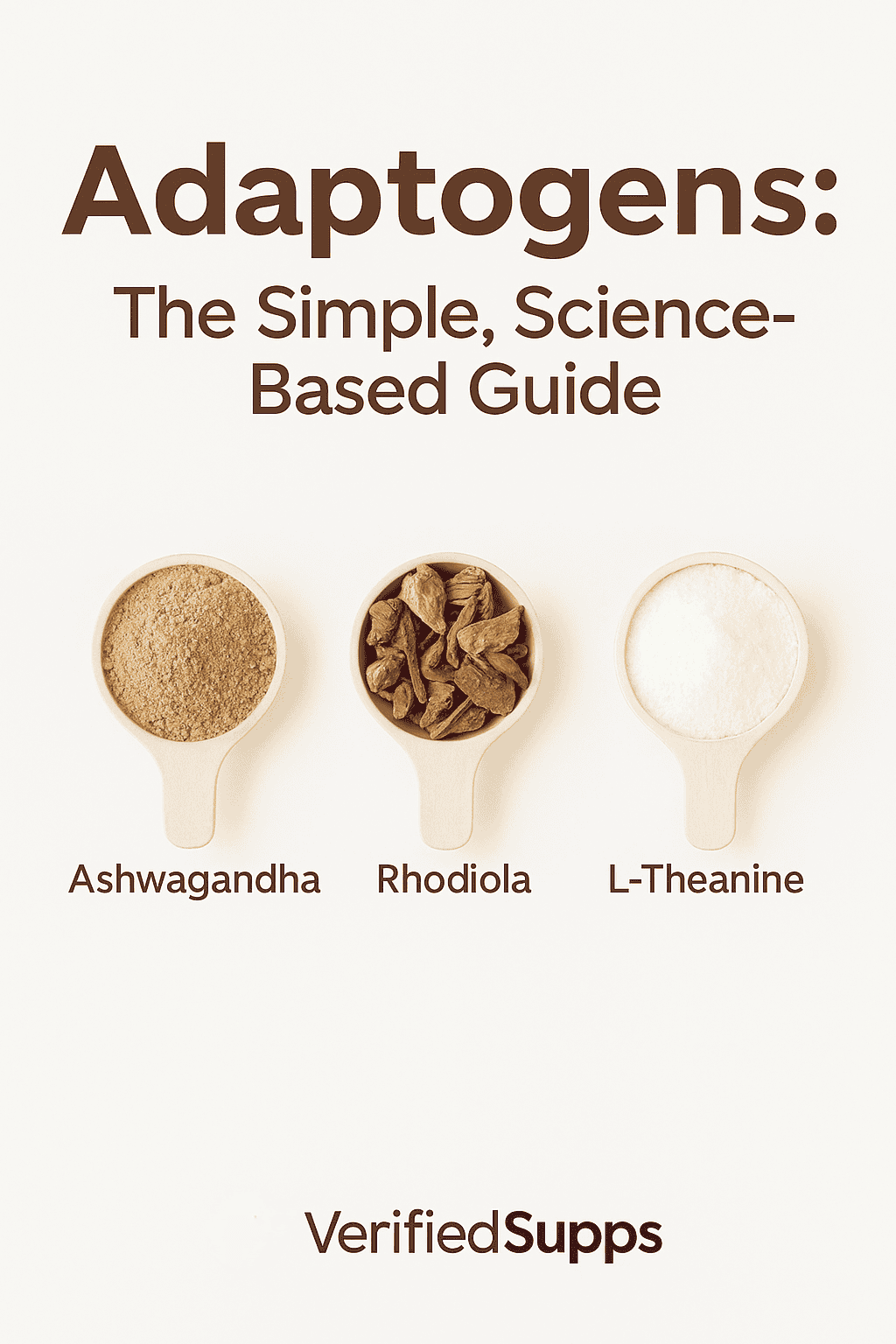
Adaptogens: A Simple Science-Based Guide
Use the broader adaptogen guide when you want the bigger landscape. This page stays tightly focused on the highest-ROI stress patterns and how to choose between the main options.
Adaptogen decoder: match the herb to the stress pattern
Most “adaptogens didn’t work for me” stories are really just pattern mismatches.
| If you feel… | Try first | What it usually feels like | Common mistake |
|---|---|---|---|
| Tired but tense, chronically overloaded, always “on” | Ashwagandha | A steadier stress baseline over weeks | Taking too much too fast and expecting same-day calm |
| Mentally drained, stress-fatigued, dragging through the day | Rhodiola | Calm energy and less stress drag | Judging it like a stimulant or taking it too late |
| Overthinking, mental noise, caffeine edge | L-theanine | Quieter mind and smoother focus | Trying to out-supplement too much caffeine |
| Burnout season with both overload and brain noise | One adaptogen + optional theanine | Cleaner output without stack chaos | Starting rhodiola, ashwagandha, and multiple extras on the same day |
What should you do first if your stress feels like fatigue, not panic? Start with rhodiola, earlier in the day, and do not expect it to feel like caffeine.
Best adaptogens for stress and anxiety
For most people, the best practical choices are ashwagandha for chronic stress load and rhodiola for stress-fatigue. L-theanine belongs here as a useful companion, but it is better thought of as a fast stress-support amino acid than as a classic adaptogen.
Mechanism
- Ashwagandha: makes the most sense when the stress signal is constant and you want a steadier baseline over weeks.
- Rhodiola: makes the most sense when stress looks like fatigue, lower resilience, and “drag,” not just anxiety.
- L-theanine: makes the most sense when the main problem is mental volume, overstimulation, or a jittery edge.
What are adaptogens and do they actually work?
Adaptogens are usually described as herbs or compounds that help the body resist or adapt to stress. That description is useful, but it is not as clean as many supplement labels make it sound. Human research exists, but the studies are heterogeneous enough that “adaptogens” is still a looser clinical category than people assume.
- What the category gets right: these herbs are often used to improve resilience under mental, physical, or chronic stress load.
- What the category gets wrong: it makes very different herbs sound interchangeable when they are not.
- Best practical takeaway: use “adaptogen” as a starting framework, then choose by the actual pattern and ingredient evidence.
Ashwagandha vs rhodiola: which adaptogen should I start with?
Start with ashwagandha if you feel chronically burdened, tense, and always “on.” Start with rhodiola if you feel depleted, mentally tired, and less resilient under workload. That one decision probably solves more confusion than anything else in this category.
What would change my recommendation?
- If you have thyroid disease or thyroid medication in the picture, ashwagandha becomes much less casual.
- If you are already prone to feeling overstimulated, rhodiola deserves more caution and earlier timing.
- If your real bottleneck is racing thoughts rather than fatigue or chronic load, L-theanine may be a cleaner first move.
- If your sleep is already fragile, do not place rhodiola late in the day and then blame the herb for the timing mistake.
- If pregnancy, breastfeeding, autoimmune disease, or a complex medication list is involved, this stops being a casual supplement choice.
How much ashwagandha, rhodiola, and l-theanine should I take?
The cleanest dosing strategy is conservative and boring. Start low enough to tolerate, stay stable long enough to judge, and do not confuse bigger doses with better trials.
- Ashwagandha: the best-supported extract range is usually about 300–600 mg/day, and official summaries note that benefits may look stronger around 500–600 mg/day than lower doses in some stress studies.
- Rhodiola: many human stress/fatigue trials use roughly 200–400 mg/day of a standardized extract, often earlier in the day.
- L-theanine: 200 mg/day has direct stress-related RCT support, and some reviews discuss a broader 200–400 mg/day range depending on the context.
When should I take adaptogens for stress?
Timing matters most when it prevents obvious mistakes. The general rule is simple: stimulating-feeling tools earlier, baseline-settling tools consistently, and situational calm tools when the stress spike actually happens.
- Rhodiola: earlier in the day is usually the safest default.
- Ashwagandha: consistency matters more than “perfect” timing; many people use it once daily and judge it over weeks.
- L-theanine: use it when the mind-noise problem is actually present—workday overstimulation, caffeine edge, or bedtime overthinking.
Are adaptogens safe to take every day?
For many healthy adults, careful daily use can be reasonable. But “adaptogen” is not a free safety pass. The caution zones are real, especially around ashwagandha, pregnancy, thyroid context, liver context, and medication overlap.
- Ashwagandha: more caution here than most people realize because official guidance flags pregnancy, breastfeeding, thyroid function, autoimmune context, medication interactions, and liver concerns.
- Rhodiola: generally encouraging, but still a herb you should treat with respect if you are very stimulation-sensitive or medically complex.
- L-theanine: usually low drama in healthy adults, but it still belongs inside a medication-aware conversation if sedatives or psychiatric medications are already in the picture.
Why adaptogens aren’t working for your stress
Most failed adaptogen trials are messy trials. The herb may be fine. The setup may be terrible.
Common mistakes
- Using rhodiola when the real problem is mind-racing or bedtime stress
- Using ashwagandha like a same-day rescue tool
- Taking rhodiola too late and then blaming the herb for sleep disruption
- Stacking multiple herbs at once and learning nothing
- Ignoring sleep debt, caffeine timing, and overload while expecting herbs to do all the work
Clean test protocol
| Inputs | One stress pattern, one herb, one stable dose, no major caffeine or sleep changes |
|---|---|
| Duration | At least 2 weeks for rhodiola or theanine pattern-testing, and more like 4–8 weeks for a true ashwagandha trial |
| 3 metrics | Stress reactivity, sleep quality, and whether daily energy feels steadier or worse |
| Stop conditions | Meaningful worsening, repeatable sleep disruption, GI issues, or any concerning interaction-type symptoms |
How to tell it’s working
Working usually looks like fewer spikes, calmer output, less burnout drag, or easier mental downshift. It rarely feels dramatic. That is why clean pattern matching matters more than hype.
Red flags / seek care
If symptoms are severe, worsening, medication-related, or closer to significant anxiety or mood disorder than normal life stress, step out of supplement-troubleshooting mode and get clinical help.
Selected Professional References
External links only. These are rendered as premium clickable tabs so you can audit the claims quickly.
Critical Review of Adaptogen Outcome Domains in Humans
Best source for keeping the “adaptogen” category honest, because it shows how broad and heterogeneous the human evidence still is.
Used for: adaptogen-definition realism and evidence caution
Rhodiola rosea in Life Stress, Fatigue, and Burnout
Most useful rhodiola reference here because it focuses directly on life-stress symptoms, fatigue, and the “encouraging but not perfect” clinical picture.
Used for: rhodiola pattern fit and dose logic
Ashwagandha — Health Professional Fact Sheet
Best official source for short-term stress and anxiety evidence, studied dose ranges, and the real thyroid, liver, and medication cautions.
Used for: ashwagandha efficacy and caution zones
L-Theanine for Perceived Stress in Healthy Adults
Best l-theanine source here because it directly studied perceived stress, sleep, and cognition over 28 days in a moderately stressed population.
Used for: L-theanine fit and trial expectations
Go Deeper (VerifiedSupps Guides)
Four next reads that make the rest of the stress-support stack easier once the pattern match is clear.
Rhodiola Rosea Benefits
Best next read if your stress looks more like fatigue and depleted resilience.
Ashwagandha KSM-66
Best next read if your stress feels chronic, tense, and always on.
L-Theanine for Anxiety
Best next read if the main issue is mind-racing, overstimulation, or a caffeine edge.
Best Supplements for Stress Relief
Best next read if you want the broader stress-support map beyond adaptogens and L-theanine.
Final Takeaway
Adaptogens work best when you stop treating them like a bucket category. Ashwagandha is the slower chronic-stress herb. Rhodiola is the better stress-fatigue herb. L-theanine is the faster calm-focus companion. Pick the pattern first, then keep the trial simple enough that you can still tell what is happening.
FAQ
What are the best adaptogens for stress?
For most people, ashwagandha is the better fit for chronic stress load, while rhodiola is the better fit for stress-fatigue. L-theanine is a useful companion when the issue is mental overstimulation.
Do adaptogens actually work?
They can help in some stress-related patterns, but the human evidence is heterogeneous and they are not interchangeable or universally effective.
Is rhodiola or ashwagandha better for stress?
Rhodiola is usually a better fit for stressed-and-tired patterns, while ashwagandha is usually a better fit for chronic overload and background stress.
How much ashwagandha should I take for stress?
A common extract range is about 300–600 mg per day, with some evidence suggesting stronger stress benefits around the 500–600 mg range.
How much rhodiola should I take for stress and fatigue?
A common clinical range is roughly 200–400 mg per day of a standardized extract, usually taken earlier in the day.
How much L-theanine should I take for stress?
About 200 mg per day has direct randomized-trial support for perceived stress reduction, and some reviews discuss a broader 200–400 mg range depending on context.
When should I take adaptogens for stress?
Rhodiola usually fits better earlier in the day, ashwagandha is more about consistent daily use, and L-theanine is best used when the stress spike actually happens.
Can you combine rhodiola and ashwagandha?
Often yes, but it is cleaner to add one at a time so you can tell what is helping and whether timing is affecting sleep.
Who should avoid adaptogens?
Pregnant or breastfeeding people, people with thyroid or autoimmune issues, people with significant medical conditions, and people on prescription medications should use clinician guidance before trying adaptogens.
VerifiedSupps Medical Disclaimer
This content is for informational and educational purposes only and is not medical advice. Supplements can affect individuals differently and may interact with medications and medical conditions. Consult a qualified healthcare professional before starting, stopping, or changing supplementation, especially if you are pregnant or breastfeeding, have thyroid disease, autoimmune conditions, liver disease, significant medical conditions, or take prescription medications including antidepressants, stimulants, thyroid medication, sedatives, or blood-pressure medication. Seek medical attention for severe, rapidly worsening, or concerning symptoms.